
Updated: 13 September 2026 15:12:02
Battles of Political Narratives Amidst the Sudan War
Al-Asma’i Bashari
When War Becomes a Personal Saga
In a scene that encapsulates the paradoxes of war and politics in Sudan, Lieutenant General Abdel Fattah al-Burhan addressed a gathering of pro-military media figures—who had traveled from their countries of exile—at the Sudanese Armed Forces General Command headquarters. On the surface, the address was less a political speech answering questions about the war and its trajectory, and more a recounting of the general’s personal journey through the conflict. It was a tale of his heroism as he sees it: from the days when the General Command was under siege, through the perilous breakout to Wadi Seidna, to his current position at the heart of both power and the war itself.
Al-Burhan chose to transport his listeners back to the wars early days, when the General Command was besieged and any attempt to leave seemed a venture fraught with mortal danger. In his account, those moments were framed as acts of personal heroism he sought to cement in the public consciousness: the besieged general, the commander who held his ground before navigating the war-torn landscape to reach Wadi Seidna. Beyond its military dimension, this narrative clearly aimed to craft the image of a leader who refused to abandon his post during the crisiss darkest hour, placing his personal experience at the very center of the wars story.
Yet, al-Burhan’s address did not stop at the battlefield. He also reached back to the period prior to April 15, 2023, revisiting the politics that forged the alliances of yesterday and the enmities of today. He revisited the era of the Forces of Freedom and Change alliance and the coalitions formed following the fall of Omar al-Bashir’s regime—leading up to the "Taqaddum" alliance—recalling events and stances that allegedly unfolded behind closed doors. He accused political leaders who were once his allies of attempting to monopolize power or carve it up among themselves, excluding others.
In discussing these leaders, the General went beyond merely pointing to political disagreements; he employed harsh language, holding them responsible for the countrys current plight. He described them as scrambling for the spoils of power and recounted—according to his version of events—various scenarios proposed to share power exclusively with him. Here, the discourse shifted from a military account to a belated political indictment of former allies, an attempt to reframe the events preceding the war and place them within a narrative that serves the camp currently aligned with the ruling authority and the war effort.
However, the General’s account did not go unchallenged. Leaders from the Forces of Freedom and Change stepped forward to refute his claims and reject his version of events, accusing him of presenting a distorted or inaccurate picture of the political landscape prior to the war. Thus, political memory has once again become a battlefield where conflicting narratives clash—each side armed with its own witnesses, documents, and recollections—while independent inquiry remains largely absent. Such an inquiry is needed to present the facts to the Sudanese people as they actually occurred, rather than how the warring parties wish for them to be remembered.
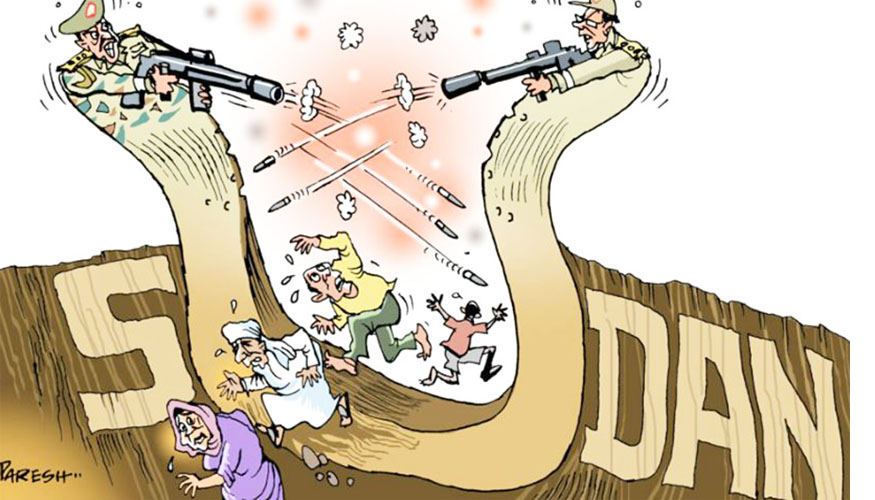
The irony is that this debate is taking place nearly four years into the war—years during which the conflict has evolved beyond a mere confrontation between two military forces. It has become an open wound in the body of Sudanese society, leaving behind millions of displaced persons and refugees, destroying cities and villages, tearing families apart, weakening state institutions, and condemning entire generations to a life of fear, poverty, and a lost future.
At this precise moment, the questions Sudanese people expect their leaders to answer differ vastly from the themes of personal heroism often invoked in speeches. A citizen who fled their home does not merely want to know how a general escaped the military headquarters; they want to know when they can return to their home. A mother who has lost her children seeks justice far more than she seeks details of a military campaign. A displaced person living in a shelter or a borrowed home wants to know when the war will end and who will restore the life that vanished overnight.
Meanwhile, those who remained inside Sudan face another war—no less brutal—characterized by soaring prices, currency collapse, a dwindling ability to afford food and medicine, the breakdown of services, and a scarcity of jobs. Abroad, millions of Sudanese live in a state of exile and displacement, anxious about their loved ones, while the prospect of return has become a deferred dream with no clear date of realization.
Thus, reverting to old political battles at this juncture seems more like an attempt to recreate the past than an effort to address the questions of the present. Former allies turned adversaries may trade accusations endlessly, yet this will not rebuild a ruined city, reopen a shuttered school, return a displaced person to their home, or halt the economic collapse.
Furthermore, recounting tales of personal heroism cannot substitute for public accountability regarding the war itself: How did it begin? Why did it persist? Who bears responsibility for the crimes and violations? Why did political and military forces fail to reach a settlement before the conflict spiraled into a national catastrophe? And what must be done to ensure the war’s end does not merely mark the beginning of another conflict—under new names and with new alliances?
The war in Sudan has spawned a new generation of conflicting narratives. Each side seeks to claim the right to write history, monopolize the role of victim or hero, and shift the blame for the catastrophe onto the other. Yet, history written amidst the smoke of battle does not necessarily reflect the full truth. After so much bloodshed, Sudan may need something far greater than rhetoric of victory and defeat: a shared national memory capable of acknowledging errors, calling things by their true names, and holding perpetrators accountable—without allowing justice to devolve into political retribution.
Ultimately, Sudan’s tragedy lies neither in a general recounting his heroism nor in his adversaries disputing that account. The deeper tragedy is that the country remains trapped in a cycle where politicians and military figures step up to the podium, while the ordinary citizen is relegated to the back of the line. Leaders speak of themselves, their adversaries, and their place in history, while the people search for a safe place to sleep, a meal not consumed by soaring prices, a school for their children to return to, and a hospital they can reach before illness becomes a death sentence.
After nearly four years of war, Sudan can no longer afford for politics to be merely a clash of conflicting narratives, nor for the war to serve as an occasion to manufacture the image of the lone hero. The country needs a different narrative—one that places the Sudanese people at its center; that treats the war as a national catastrophe rather than a feat of personal heroism; that views power as a responsibility rather than spoils of war; and that regards peace as a right belonging to the people, not a concession granted by the warring parties.
Unless this happens, the guesthouses will continue to host speeches and podiums will keep trading accusations, while the Sudanese people remain outside the halls—bearing the burdens of war alone and awaiting an end that never comes. In the gap between the general’s rhetoric and the citizen’s suffering, the distance between politics and the cessation of war continues to widen.
