
Updated: 12 September 2026 16:02:46
Education, Healthcare and Bread: War Strikes at Sudan’s Human Security Triad
Ameer Babiker Abdalla
“The transformation of wars from conflicts between states into civil and ethnic conflicts within individual states has led to a redefinition of sovereignty as a responsibility toward citizens, rather than a privilege or a shield for rulers to commit abuses. It has also fundamentally shifted the focus of United Nations charters and mechanisms in the post-Cold War era from state sovereignty and its protection against external aggression toward human security and the protection of individuals from internal violations.”
Perhaps the above captures the essence of the United Nations Development Programme’s 1994 Human Development Report, which helped consolidate this shift when it introduced the concept of “human security” as protection from fear and want, linking security to people’s lives, dignity and their ability to live in a safe and stable environment.
This certainly does not mean eliminating the importance of state security. Rather, it means redefining its relationship within a broader framework linked to the security of society. A strong state is one that has the capacity to protect its citizens, provide justice and essential services, uphold the rule of law, and maintain military capabilities capable of protecting its sovereignty.
Sudan’s war, in its daily evolution over more than three years, has moved beyond the conventional military confrontation between two warring forces. From its very beginning, and increasingly as it has continued, it has become an existential crisis affecting the lives of millions of Sudanese.
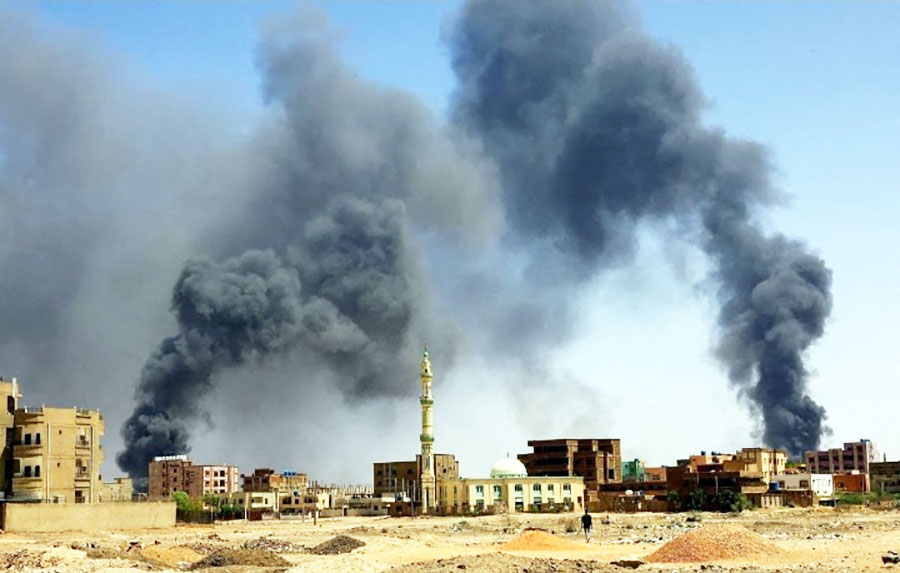
Because this is not a conventional war, but one resembling the conflicts witnessed in civil wars since independence, civilian infrastructure and civilian spaces have been repeatedly targeted or repurposed for military use. Schools, hospitals, markets and people’s homes have become military positions in which combatants take shelter.
As a result, people are not falling victim only to bullets and bombardment. They are also increasingly dying from disease, hunger and the collapse of education — what can be described as the “human security triad” — whose consequences may already be surpassing, and could eventually far exceed, the direct impact of military destruction.
Not by Bread Alone
Human life ultimately depends on food, and bread represents food in its broader sense.
The sight of people displaced from areas affected by the war — including those forced by circumstances to remain under a barrage of bullets and bombardment — receiving food assistance through the emergency response rooms established by Sudanese communities at the height of the crisis may seem like a temporary response to an immediate emergency. Yet it pales in comparison with the consequences that will emerge once the immediate military danger recedes.
Sudanese people are now facing, and may continue to face for years, the economic crisis generated by the war, compounded by long-standing structural weaknesses in the country’s economy.
Every morning, many Sudanese wake up with their eyes fixed on the exchange rate of the US dollar against the Sudanese pound, following it with the same anxiety with which they check the weather forecast.
The figures reveal the frightening reality of how difficult it has become for families to secure basic necessities. On the eve of the outbreak of war, the US dollar was trading at no more than about 560 Sudanese pounds on the parallel market, while the official banking rate stood at around 590 pounds. Now, after nearly four years of war, the exchange rate is approaching 7,000 Sudanese pounds to the dollar.
The issue, therefore, is not simply the scarcity of food, but people’s ability to access it. Goods may be available in the market, but a family that has lost its job or source of income may no longer be able to afford them.
This is one of the war’s most complex consequences: food is transformed from a basic human right into a commodity whose accessibility depends on geographical location, income, the movement of markets and the continuity of humanitarian assistance.
This reality, compounded by the complete inability of the authorities in power to address it, affects not only access to food. Its consequences extend to virtually every necessity required for a life of dignity — and consequently to all the other foundations of human security.
Healthcare: Another Face of the War
According to the World Health Organization (WHO, as of the third quarter of this year, 37% of health facilities across Sudan’s 18 states had become completely non-functional, with the proportion rising to 80% in areas directly affected by the conflict.
In addition to the use of health facilities as military positions, the organization has documented 217 devastating attacks targeting healthcare facilities and medical personnel. Sudan’s Ministry of Health has estimated the resulting losses at approximately US11 billion.
The remarks made by the WHO representative in Sudan, Dr. Abdel Nasser Abu Bakr, before the UN Human Rights Council on Monday offer a stark illustration of the scale of the crisis.
Following his visit to Khartoum Teaching Hospital, the largest government hospital in the capital, he described the situation: “The operating rooms have been destroyed, imaging equipment has been lost, several wards have collapsed, and entire buildings and departments are out of service. The buildings require urgent structural rehabilitation before they can safely receive patients.”
This is the reality of the military fighting. But there is another reality. If bullets kill directly, the collapse of the healthcare system allows the war to kill more slowly and on a much wider scale.
The situation is made even worse by people’s inability to obtain medicines and appropriate treatment — not necessarily because medicines are unavailable, but because people can no longer afford them. Prices continue to rise as the local currency loses value on a daily basis, while household savings are steadily being eroded.
What the WHO representative did not mention is that many healthcare workers in Sudan have left the country, and the exodus is continuing amid economic conditions that no longer provide a reasonably viable environment in which to remain and work.
The health crisis therefore exposes the fragility of the state and its inability to provide basic healthcare to its citizens. Its consequences go beyond the shortage of services to a decline in public trust in state institutions — striking directly at health security.
“No Education in a Painful Reality”
This was one of the slogans raised by education stakeholders in their protests against the authorities before the outbreak of the war, as they sought to confront the country’s deepening education crisis — from the absence of a clear education strategy to inadequate educational resources and low salaries for teachers across different levels of education.
Today, the education sector is facing additional layers of crisis. Schools in many areas have been turned into shelters for displaced people, while other educational institutions have been looted or destroyed, or have ceased operating because of insecurity and the displacement of teachers and families.
The problem is not limited to the learning environment or the erosion of teachers’ salaries. Teachers have been demanding salary increases, yet even the highest salaries are worth no more than around US50 at today’s exchange rate.
The deeper concern is the real threat facing Sudan’s future.
At a time when the country needs to invest in education as a tool for rebuilding the state and society, the war is becoming a force that pushes thousands of children and young people away from schools and universities and into an environment where the presence of weapons is expanding while the authority of knowledge is receding.
This means that an entire generation is being cut off from the education process, potentially drawing it into a wider cycle of poverty, displacement, child labour and armed polarization. In turn, this constitutes another dimension of the assault on **educational security**.
Reports by international organizations, particularly UNICEF, indicate that the war has kept around 8 million children out of school, while between 30% and 50% of educational institutions and school buildings are effectively no longer functioning as part of the education system.
Added to this is another weapon of war that will have a direct impact on education: the collapse of the Sudanese pound against the US dollar.
The currency crisis has made it increasingly difficult for millions of families to meet the basic costs of educating their children. These costs begin with providing at least one nutritious meal a day and daily transportation expenses, in addition to emergency healthcare costs.
The three elements are therefore interconnected.
A hungry child struggles to learn. A family exhausted by illness loses its ability to work and produce. Poverty pushes children out of school, while interrupted education reduces their chances of finding employment in the future.
This is how the erosion of one pillar of human security feeds directly into the collapse of the others.
Ending the war remains the first and indispensable step, but it is not the end of the story.
The real challenge begins after the guns fall silent: rebuilding a country with a school system capable of building the future, hospitals capable of protecting life, and an economy capable of providing bread and dignity.
If the state fails to provide it, it will continue to face a genuine security crisis, regardless of how many weapons it possesses.
