
Updated: 9 September 2026 15:57:03
Sudan War Doubles Cost of Living; Wages Fail to Keep Pace with Prices
Moatinoon
Millions of Sudanese living in areas controlled by the warring parties face dire humanitarian and living conditions amidst ongoing fighting and the widening scope of economic and humanitarian crises resulting from the war that began in April 2023. As battles continue on multiple fronts, citizens face a daily reality of soaring costs for food, medicine, and services, alongside a rapidly eroding purchasing power.
The ongoing war casts a heavy shadow over economic and social life, coinciding with a sharp depreciation of the local currency. According to a study by economic experts, the Sudanese pound has lost approximately 40% of its value in less than a month; this has directly impacted the prices of goods and services, driving the cost of living to levels beyond the endurance of most households.
The crisis extends beyond rising prices; markets are experiencing shortages of essential commodities due to disruptions in trade and transport, damaged supply chains, and difficulties in moving goods between states and regions. The war has also crippled vast productive sectors and undermined income sources, particularly for government employees and those in fixed-wage professions.
In areas controlled by the Sudan Liberation Movement and Army, humanitarian conditions are even more severe; local authorities have explicitly declared a state of famine, given the scarcity of humanitarian aid reaching the affected population. Ongoing fighting further hinders humanitarian and international organizations from reaching affected areas, leaving large numbers of civilians with limited options for securing food, medicine, and basic necessities.
Observers note that the protracted war has widened the gap between mounting humanitarian needs and the capacity to address them, exacerbated by restricted access to affected zones, insecurity, and a decline in economic activity. Sudanese families across the country face a daily struggle to secure even minimal food supplies, as commodity prices rise at a rate that outpaces income growth.
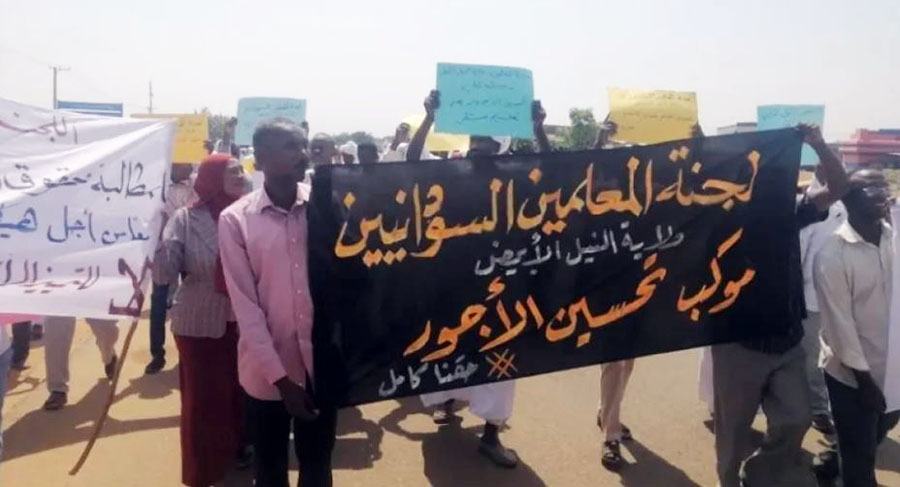
In a clear indication of the crisiss scale, a recent study by the Social Affairs Office of the Sudanese Teachers Committee revealed that the cost of living for a family of five in September 2026 stood at approximately 4,180,000 Sudanese pounds—equivalent to 643 based on the studys exchange rate. This figure covers only basic necessities, excluding any non-essential luxuries, highlighting the widening disparity between household income and the cost of daily living.
Data regarding wages—particularly for teachers—reveal an even starker gap. According to the study, the average teachers salary is currently around 128,125 Sudanese pounds (equivalent to 19.70), an amount that covers only a fraction of a familys basic needs. According to the Social Committee, the gap between a teachers salary and the average cost of living stands at approximately 4,051,875 pounds per month—meaning the salary covers only about 3% of essential needs. These figures place public sector workers in a dire economic predicament, as their monthly salaries are no longer sufficient to meet the bare minimum requirements for food, housing, education, healthcare, and transportation.
The impact of this deterioration extends beyond individual households to affect public institutions and services, particularly the education sector. Teachers unable to meet their families basic needs are increasingly driven to seek additional income sources, leave the profession, or emigrate. This trend threatens a continued decline in the quality of public services in a country already grappling with the consequences of war, displacement, and infrastructure destruction.
Furthermore, the collapse of salary purchasing power threatens to widen the scope of poverty, forcing families to cut back on spending for food, education, and healthcare, and to forgo many essential needs. As prices continue to rise, the increasing cost of goods places direct pressure on low-income groups—who lack the means to protect their savings or engage in economic activities capable of keeping pace with inflation.
The Social Committee believes that addressing the crisis requires urgent measures, foremost among them a revision of the wage structure to align with the sharp rise in the cost of living. The committee reiterated its demands for an immediate increase in the minimum wage to 370,500 pounds, alongside a 70% "nature-of-work" allowance, viewing this as a necessary step to help workers cope with the rapid erosion of their purchasing power.
According to observers, addressing the wage crisis—given the prevailing economic realities—cannot be separated from tackling the broader causes of the economic collapse. Issues such as currency stabilization, the restoration of production, the securing of trade routes, the provision of food and medicine, and the reactivation of vital sectors are all directly linked to ending the war and achieving political and security stability.
Amir Abdul Rahman, an academic and economics professor at Sudanese universities, tells *Mowatinoun* that the current humanitarian and economic crises in Sudan have become two sides of the same tragedy. The longer the war drags on, the wider poverty spreads, production capacity declines, and prices soar, while citizens incomes shrink. Meanwhile, access to aid becomes increasingly difficult in areas witnessing active combat.
Abdul Rahman notes that while Sudanese people await political and security solutions to end the war, the immediate priority remains protecting civilians, securing the delivery of humanitarian aid, and ensuring the availability of food and medicine, alongside taking urgent economic measures to protect those with limited incomes. He pointed out that the figures regarding the cost of living and salaries do not reflect merely a passing economic crisis; rather, they reveal a deep crisis of livelihood that now threatens the ability of millions of Sudanese to meet their most basic daily needs.
