
Updated: 25 August 2026 20:54:23
Sudan: Over 3 years into an emergency that has become everyday life
IFRC - 21/08/2026
After more than 1,200 days of conflict, the humanitarian story is no longer only about people fleeing violence. It is about those who chose to stay, those who couldn’t leave, and those finding the strength to start over after returning home.
Children born when conflict erupted in Sudan on 15 April 2023 are now toddlers.
Families who packed a small bag expecting to be away for a few weeks have spent years living far from home.
Some are only now returning to neighbourhoods where homes, schools, health facilities and businesses lie damaged.
Communities that first welcomed displaced families as an emergency measure continue sharing already scarce food, water and livelihoods with their neighbours.
After more than 1,200 days, what began as an emergency has become everyday life for millions of people across Sudan and the wider region. Yet behind every statistic is a person.
Those who chose to stay
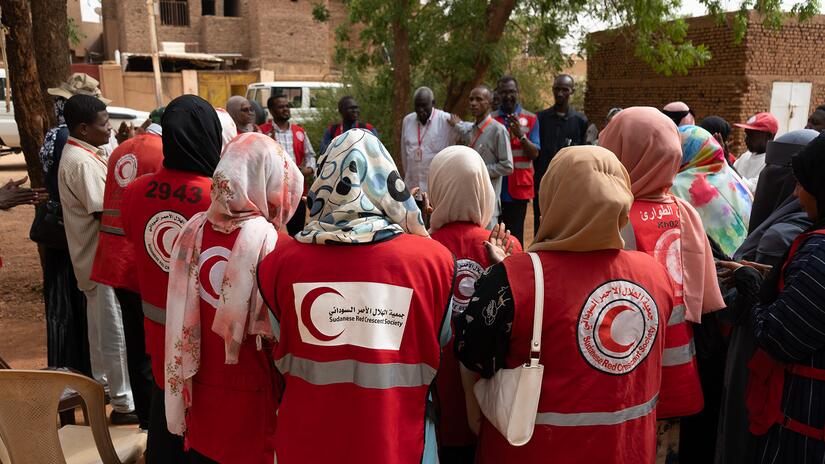
When conflict engulfed Khartoum, Omar, a Sudanese Red Crescent Society (SRCS) volunteer, faced an impossible choice - sending his wife and six children to safety while he chose to stay behind.
For more than three years, Omar has walked the streets of Khartoum carrying emergency medical supplies in a backpack, often covering long distances on foot after clinics and health centres were forced to close during the fighting.
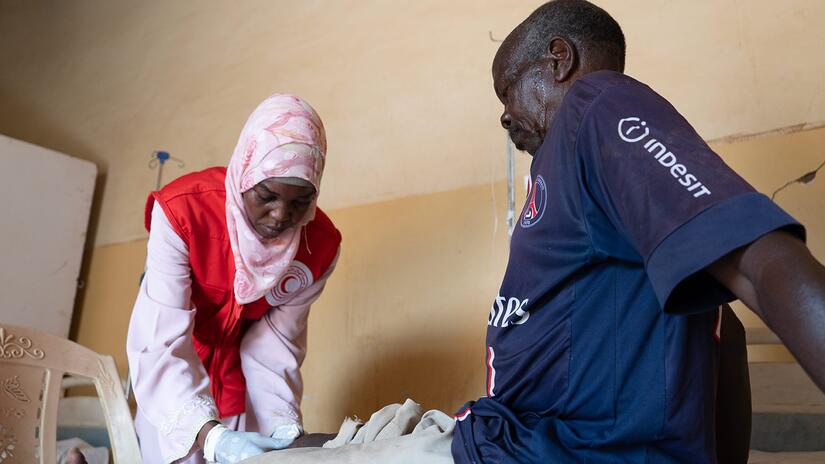
For many elderly people, people living with chronic illnesses and families unable to reach hospitals, Omar and other volunteers became the closest thing to a functioning health system.
"I could not leave the people here in Khartoum," he says. "They were totally relying on us for first aid and treatment."
Working in small teams, SRCS volunteers established clinics, treated wounded people, delivered medicines and provided first aid in communities cut off by the conflict.
However, the work came at an enormous personal cost.
Two of Omar’s fellow volunteers, Maha and Yasir, lost their lives while serving their communities. Both volunteered at the local health centre, where they provided first aid and supported patients throughout the conflict. They were among the volunteers who showed up day after day to care for others. As one colleague recalls, “They were very active in supporting their communities.”
Alongside Omar was Mariam, another Sudanese Red Crescent volunteer who continued working throughout the conflict at the SRCS-supported clinic and one of the few functioning hospitals in East Nile.
“We received patients with all kinds of injuries,” she recalls. “Some days we spent entirely in the hospital, and other days in the clinic.”
When people could not reach health facilities, Mariam and other volunteers walked long distances to bring medicines and provide care, often covering tens of kilometres on foot. They prioritised those who were most vulnerable, including elderly people and people with chronic illnesses.
Mariam was also living through her own loss. She lost her husband during the conflict. Yet she continued to serve the patients who depended on her.
Omar’s and Mariam’s stories are among thousands. Across Sudan, more than 122,000 Sudanese Red Crescent volunteers have remained at the heart of the humanitarian response, reaching communities in all 18 states despite insecurity, displacement and personal loss.
Those who could not leave
Not everyone had the opportunity to flee.
Amina remained in Khartoum because she simply had nowhere else to go. As the conflict continued, she lost two relatives and watched her familys livelihood disappear. When she became ill, there were no nearby health facilities where she could receive treatment.
"We suffered so much and lost everything during the conflict," she says.
Cash assistance provided by the Sudanese Red Crescent, with support from the IFRC, enabled her to receive medical care and cover her most urgent needs.
"The cash assistance helped me a lot. It allowed me to receive treatment when I needed it. I hope more families can receive this kind of support."
Those who returned home
For Samira, the conflict led her across the border into Egypt, and months later, she returned home to Khartoum. But returning home did not mean returning to normal: she found damaged neighbourhoods, limited services and the challenge of starting over.
Cash assistance helped her pay for treatment while beginning to rebuild her life. "The assistance helped me pay for my treatment and my needs. Without it, it would have been very difficult," Samira says.
Across Khartoum and Al Jazirah, thousands of internally displaced people and returnees are using cash assistance to meet their own priorities—buying food, paying for healthcare, purchasing medicines or repairing damaged homes.
For families who have lost so much, the ability to decide what they need most is itself a form of dignity.
When survival becomes recovery
The humanitarian response has changed over the past 3 years. In the early months, the priority was keeping people alive; today, while emergency needs remain immense, many families are also trying to rebuild their lives. Across neighbouring countries, that transition is becoming increasingly visible.
When Ibrahim crossed the border into Ethiopia, he left behind more than his home - he left behind the business he had spent years building, trading plastic products for coffee, sugar and Jelati containers.
"When I crossed the border, I had nothing," he says.
At the Metema border crossing, the Ethiopian Red Cross Society, supported by the IFRC, provided immediate humanitarian assistance before enrolling Ibrahim in Business Life Skills Training to strengthen his entrepreneurial skills, business planning and financial management. Later, he received a cash grant of ETB 50,000 (~USD 310), and instead of replacing what he had lost, he invested in something new: a poultry business. Today, business is growing steadily.
"Today, I wake up every morning knowing I can provide for my family again." Ibrahim Abdulkadir adds.
Hundreds of kilometers away in South Sudan, Jemila is rebuilding in a different way. When fighting reached Nyala in South Darfur, she fled more than 800 kilometres with her younger brother after becoming separated from the rest of her family, and reduced food rations left the siblings struggling to meet even their basic needs.
"Before receiving the cash assistance, I worried every day about how I would support my brother and myself," she says.
Cash assistance from the South Sudan Red Cross helped Jemila establish a small retail business that now provides a steady income, and through Restoring Family Links, she was also reunited with relatives she had lost contact with during displacement.
"The cash gave me the opportunity to start a business and earn an income. Now I can provide for our basic needs and plans for the future," Jemila adds.
Cash assistance is doing more than helping families survive: it is restoring dignity, rebuilding livelihoods, and giving people the opportunity to shape their own recovery.
One crisis. One region. One humanitarian response.
The conflict may have begun in Sudan, but its humanitarian consequences extend far beyond its borders.
In Chad, Kaltouma, a Sudanese refugee and mother of four, is among thousands of people using cash assistance to meet urgent needs and rebuild their lives in displacement. Living in Kouchaguine-Moura refugee camp after fleeing conflict in Sudan, she received support through a cash assistance programme led by the Chad Red Cross and IFRC.
"My children and I are very happy. This support will allow me to buy sorghum and clothes for my children," Kaltouma says. For families living with uncertainty, cash assistance offers not only practical support but also dignity, choice and hope for the future.
Across Chad, Egypt, Ethiopia, South Sudan and Uganda, Red Cross and Red Crescent volunteers continue welcoming families arriving with little more than hope.
Some provide first aid at border crossings; others reconnect with separated families.
Many volunteers distribute cash assistance, healthcare, psychosocial support and emergency relief to refugees and the communities hosting them.
For many people fleeing Sudan, their first act of safety begins with a Red Cross or Red Crescent volunteer. Their recovery often continues with one.
As humanitarian needs continue to outpace available resources, sustained international support remains essential—not only to save lives, but to help millions of people recover, rebuild and look towards the future with dignity.
Continued funding is critical to ensure local volunteers can remain alongside communities for as long as they are needed.
--
Names have been changed to protect the identities of individuals and their families.
