
Updated: 18 August 2026 16:33:43
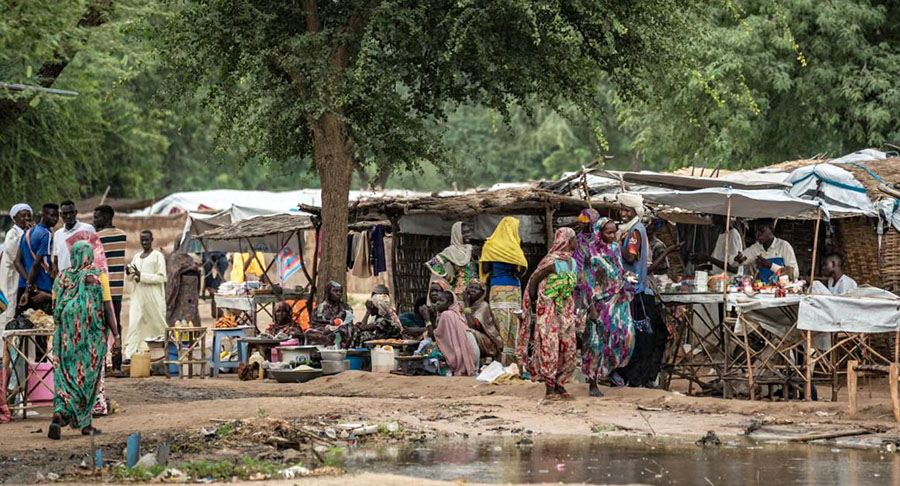
Samira’s story: the Sudanese refugee who has known no peace since she was 10
Source: The Guardian
Every morning, she spreads small piles of rice and spices on an aluminium tray in the market of Korsi refugee camp. Some of it comes from her monthly food ration, already meagre, distributed by the UN’s World Food Programme; some she buys when she can and resells for a small profit.
Samira crouches quietly behind her modest display, greeting customers as they pass. Her loose red toub cloth frames her thin face and falls across one side of it, hiding her injured right eye. Every so often she adjusts the long cloth to cover the empty sleeve where her right arm would have been. It is a habit the 33-year-old has developed since the war, but her injuries are only part of the terrible damage it has inflicted.
Samira has been displaced seven times since war first reached her village in 2003, when she was 10 years old. She has fled one conflict after another across Sudan and now beyond its borders. The journey eventually brought her, by minibus, motorbike, taxi and on foot, to Central African Republic, where she now lives among thousands of refugees who have escaped Sudan’s latest civil war, which erupted in 2023.
Around her, rows of small thatched shelters line a dusty path that cuts through the heart of Korsi camp. This is the market, where traders arrange handfuls of tomatoes, dried fish, onions, soap and secondhand clothes on wooden tables or plastic sheets spread on the ground.
Children weave through the crowd, between people carrying jerrycans and bags of charcoal, while women wrapped in colourful toubs bargain for handfuls of spices and vegetables.
This is a settlement built almost entirely from wood, straw and plastic. The refugees have fashioned their homes from branches and thatch, covering them with white tarpaulins distributed by the UN refugee agency, UNHCR. From a distance, the structures look fragile against the vast sky of north-east CAR.
Over the past week, dark clouds have begun gathering overhead as the rainy season approaches. Soon, heavy downpours will drum against the fragile shelters, built for survival rather than permanence.
Samira’s life once followed the rhythm of the seasons in a village on the outskirts of Tine, on the Sudanese side of the border with Chad. Her family farmed during the rainy months and moved with their livestock when drier conditions demanded it, combining agriculture and pastoralism in a way that had sustained generations.
There was a school – and she loved studying. Samira dreamed of one day travelling to Khartoum to study law at university and becoming a judge. “I wanted to help people find justice,” she says.
But in 2003, rebel groups drawn largely from communities in Darfur that complained of decades of political and economic marginalisation took up arms against the Sudanese government. Khartoum responded with a brutal counterinsurgency campaign, deploying its military and arming Arab militias that gained notoriety as the Janjaweed.
For villages such as Samira’s, the consequences were devastating. She remembers hearing warplanes overhead before attacks reached the ground. Villages were bombed, burned and looted. Families fled with whatever they could carry; some never returned, others disappeared altogether.
The violence uprooted her family and ended the life she had imagined for herself. After moving repeatedly across Darfur, she eventually married a man from her Zaghawa community and settled in El Geneina, capital of Sudan’s West Darfur state. Life felt stable for the first time in many years, she says.
Her husband traded goods between Sudan and Chad, where many Zaghawa families maintained close social and commercial ties across the border. Business was good. The family acquired vehicles, expanded their trade and raised five children.
For Samira, El Geneina became home. The memories of flight and loss never disappeared, but they no longer defined every day of her life.
Then, in April 2023, war returned to Sudan when two generals in the military government fell out once again – Mohamed Hamdan Dagalo, known as Hemedti, led his Rapid Support Forces paramilitaries against the Sudanese government army soldiers of Abdel Fattah al-Burhan. Other smaller militias have joined in the conflict.
West Darfur once again became a battleground. Ethnic tensions that had smouldered for years exploded into open violence.
By June, the city was descending into chaos. On the day that West Darfur’s governor, Khamis Abbakar, was abducted and killed, armed men arrived at Samira’s home. They came for her husband’s vehicles, money and property.
According to Samira, he refused to surrender what the couple had spent two decades building. “They killed him in front of me,” she says. “My husband spent all his life working for his family. They killed him and my two daughters on the same day.”
