
Updated: 20 July 2026 13:03:01
Book Review: Sudan... The Political Anthropology of Conflict, State-Building and Stability
By Mughira Harbiya
Published in New Horizon Magazine
Sudans borders were never merely lines drawn by colonial powers on a map. Rather, they marked the intersection of different systems of society, politics, economy, and culture. Far beyond their geographical and sovereign dimensions, these borders became part of a constantly evolving social chemistry that has yet to reach a stable equilibrium capable of explaining the complexities that continue to shape todays highly diverse Sudan. As the state failed to accommodate this diversity, borders transformed into open arenas of conflict, while the tribe evolved from a social institution into a political actor.
Against the backdrop of the current confusion and the increasingly blurred relationship between tribal boundaries and the definition of the Sudanese state, particularly after the April war, writer and researcher Ameer Babiker Abdalla presents his second contribution to this challenging field. His forthcoming book, Sudan: The Boundaries of Politics and Tribe (The Political Anthropology of Conflict, State-Building and Stability), examines the position of the tribe within Sudanese politics and demonstrates how it has often functioned as a political refuge and a closed support system rather than an open social institution fostering intermarriage, integration, and the enrichment of Sudans broad diversity.
The book argues that, in many instances, tribal structures have hindered political development and intensified conflict, thereby complicating efforts to build a state founded on a new social contract that recognizes diversity, establishes citizenship as the basis of political belonging, and makes justice and the rule of law the common denominator for all Sudanese. While discussing Sudans vast geographical borders, the book also explores the countrys relations with its neighbors and the ethnic and tribal interconnections that transcend state boundaries. It proposes a more realistic framework for regional relations based on partnership and development rather than security-centered approaches and investment in conflict.
The Tribe as a Historical and Social Reality
According to the author, the book neither advocates reviving the tribe nor abolishing it. Instead, it recognizes the tribe as a historical and social reality while calling for an end to the longstanding binary that has dominated Sudanese political thought, in which the tribe and the state are portrayed as opposing forces.
The volume consists of eight chapters, preceded by a preface and introduction and concluded with a closing chapter.
The first chapter traces the development of political anthropology and the concept of borders. It presents political anthropology as a relatively modern discipline that emerged during the first half of the twentieth century as anthropology expanded beyond the study of traditional societies toward understanding contemporary political life. Politics is approached not merely as a system of formal institutions but as a social practice deeply embedded in culture.
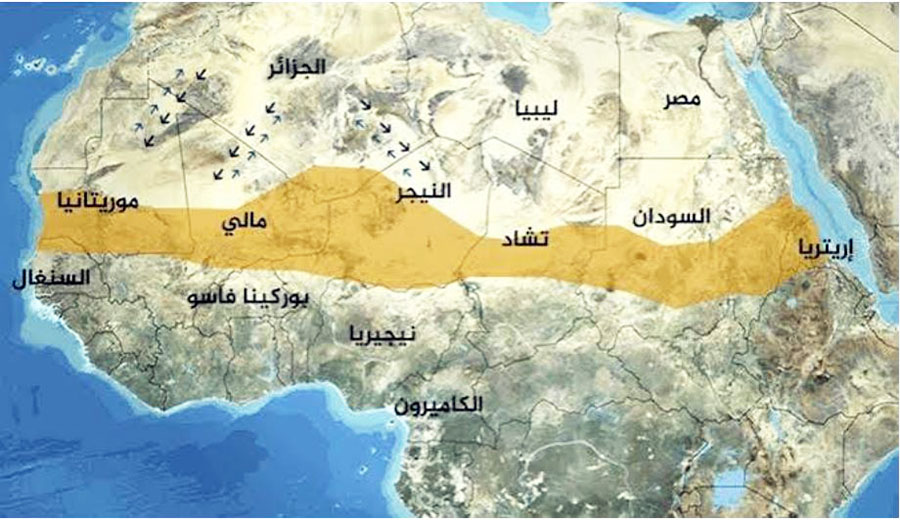
The second chapter examines the historical formation of the ancient Sudan Belt region, the nature of the conflicts that shaped it, and its influence on the political and sovereign landscape of Sudan and neighboring states in the post-colonial era. It emphasizes that most of Sudans neighbors once formed part of this broader historical zone characterized by interconnected political, economic, and social dynamics.
The third chapter reviews the period following the Christian kingdoms, examining the political systems of the old kingdoms and the flexible nature of their borders, which expanded or contracted as tribes, clans, and communities joined or withdrew. It also explores patterns of tribal movement, alliance-building, and the emergence of political structures capable of providing collective protection.
The fourth chapter investigates Sudan under both Ottoman-Egyptian and British colonial rule, highlighting how colonial administrations imposed political unity upon diverse populations within fixed territorial boundaries designed primarily to serve colonial security, political, and economic interests. In doing so, they largely ignored the ethnic and tribal realities that extended beyond these artificial borders, creating structural challenges inherited by the independent Sudanese state.
The fifth chapter discusses the emergence of national liberation movements in Sudan and neighboring countries, examining their relationship to territorial boundaries and their long-term influence on political systems. It raises a critical question: to what extent are todays parallel armies and armed movements a legacy of anti-colonial liberation struggles?
The sixth chapter focuses on borderland societies, the forms of authority governing them, and the influence of cross-border tribes on national security and stability. It also analyzes the role of these communities in border economies, legal and informal trade, smuggling, and the impact of the informal economy on state stability.
The seventh chapter addresses borders and armed conflict, examining the movement of armed groups across frontiers, the manipulation of border communities by neighboring governments in regional rivalries, the relationship between tribal and national identities, the emergence of hybrid identities in border regions, and the extent to which transnational communities identify with the modern nation-state and experience citizenship. It also evaluates the consequences of centralized state policies on these communities.
The eighth and final chapter presents a locally grounded understanding of security and stability by exploring the gap between state-centered and community-centered perceptions of security. It considers the role of customary traditions and social norms in building political systems that either contribute to security and stability or, conversely, become undermined by persistent policies of political marginalization from the center.
Tribal Consciousness Rather Than Citizenship
To explain Sudans fragile political reality, the book draws upon contemporary theories and analytical frameworks addressing the complex relationship between borders, political tribalism, and state-building. It offers a careful historical reading of Sudans demographic evolution, the formation of its ethnic and tribal landscape, and the emergence of early sultanates whose political and social legacies continue to influence Sudanese society.
Although colonialism introduced modern institutions and urban forms of governance, the author argues that the national state failed after independence to consolidate these developments through a new social contract based on citizenship, recognition of diversity, balanced development, democratic institutions, and dialogue rather than security-driven policies and the mobilization of one group against another.
The book further contends that post-independence governments misunderstood the nature of Sudans pre-colonial social systems, which encompassed a wide variety of political and social formations differing in complexity but sharing kinship, tribal, and religious ties as their principal organizing principles. Sudan, therefore, has historically been—and remains—a space where tribal societies, sultanates, and local agricultural and pastoral communities coexist.
The Foundations of Conflict
The book stops short of explicitly describing Sudans conflict as one between two competing states: an older, traditional political order that evolved through tribal alliances, and a modern state that attempted to interrupt indigenous political development. Nevertheless, it traces the historical evolution of local societies from relatively simple social organizations into increasingly sophisticated political and economic systems, exemplified by the Funj Sultanate, the Darfur Sultanate, the Kingdom of Taqali, and the earlier Nubian kingdoms.
These historical entities developed increasingly advanced methods of governance, warfare, and defense through networks of local leaders operating within flexible systems of authority. Although institutionally limited by modern standards, they maintained a degree of stability compatible with Sudans human geography, accepted fluid borders, and facilitated population mobility and social interaction—features that would later clash with the rigid territorial logic of the modern nation-state.
Following independence, Sudan inherited modern administrative institutions and colonial political boundaries but not a society fully integrated into a national framework. Tribal institutions, religious sects, and native administrations retained extensive social legitimacy that, in many regions, exceeded that of the state itself. Colonial rule contributed significantly to this outcome by strengthening native administration as an instrument of indirect governance, thereby preserving structures that outlived colonialism and limiting the capacity of national political forces to construct an independent post-colonial state.
Ameer Abdallas latest work ultimately offers a critical reassessment of the trajectory of the Sudanese state. It argues that Sudans central crisis lies in the fact that its diverse peoples were repeatedly forced, under successive phases of colonial rule, into a single political and administrative framework without their consent. Moreover, the experience of national governance since independence in 1956 has demonstrated that state-building cannot be achieved through political independence alone. It requires a broad social consensus on the nature of the state, the identity of society, and the equitable distribution of power and resources.
