
Updated: 30 June 2026 18:59:59
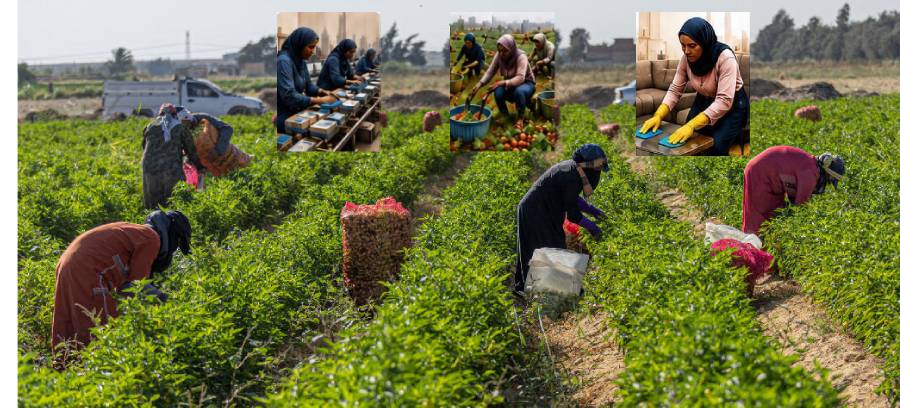
Between Vulnerability and Exploitation: Sudanese Refugee Women in Egypt and the Struggle for Survival (Part 2 of 2)

Cairo, June 28, 2026 — Since the outbreak of war in Sudan in April 2023, nearly 1.5 million Sudanese have fled to Egypt, according to data from the United Nations High Commissioner for Refugees (UNHCR). While women and children constitute the majority of those who arrived, thousands of refugee women have found themselves facing a harsh economic reality that has forced them to seek any available source of income after losing their jobs, savings, and livelihoods.
In factories, farms, and private homes, Sudanese refugee women work long hours for low wages, often without employment contracts or legal or social protection. Many previously held professional and administrative positions and possessed university degrees, but the war pushed them into physically demanding jobs far removed from their qualifications and experience.
Students Forced to Choose Between Survival and Education
The consequences of the war have not been limited to forcing women out of their professions. They have also affected university students and teenage girls who entered the labor market prematurely to help support their families or continue their education.
The testimonies of three Sudanese students reveal that working in factories and farms was not a temporary solution but has become part of their daily lives, as they struggle to balance long working hours with their right to education.
N., a university student in her twenties from South Darfur, says she began working after her family arrived in the city of 6th of October in 2024. As the eldest daughter, she felt responsible for helping support her family, particularly as both her parents suffer from health problems and her sisters have anemia.
Since then, she has worked in plastic, cardboard, iron, and potato-processing factories, as well as on berry farms.
She explains that a typical workday lasts up to 12 hours for approximately 300 Egyptian pounds per day. However, wages are often reduced unexpectedly or delayed for weeks. She says she left several factories after her pay was gradually cut and frequently had to request salary advances to cover her familys expenses while waiting for overdue wages.
Working conditions, she adds, were equally difficult. Breaks were short, restroom facilities were limited, and some tasks—such as cleaning raw iron materials—required handling sharp and hot tools and equipment. Despite this, she would return home in the evening to continue studying, determined to combine work with education.
R.N.S., who was studying dentistry before the war broke out, says displacement to Egypt forced her to exchange university lecture halls for strawberry, grape, and peach farms.
Her day begins before dawn so she can reach work by six in the morning, where she carries irrigation hoses or sorts thousands of strawberry seedlings under a productivity-based payment system.
She says the hardship extends beyond physical labor. As a Sudanese refugee, she has repeatedly faced discrimination and bullying.
"Some workers mocked me, deliberately harassed me, poured drinking water onto the ground, hid my food, and even bothered me when I went to the restroom," she says. These experiences forced her to leave more than one job.
She also suffered repeated injuries while using sharp pruning shears in grape farms but received neither first aid nor medical assistance. Nevertheless, she continued working to avoid losing her daily wage.
Part of her income supports her family, while the remainder goes toward paying university tuition fees for her remote studies.
"I work to survive, I work to continue my education, and I work to keep alive my dream of returning home one day," she says.
G.A. had not yet turned sixteen when she entered the labor market. After her family fled to Egypt, she found herself working on strawberry and grape farms in an industrial city instead of attending school.
She developed severe skin allergies from exposure to chemical fertilizers, yet farm management refused to cover her medical expenses and informed her that any worker who became ill would not be allowed to return to work.
She also endured verbal abuse from one supervisor and worked at a farm where men and women shared a single restroom.
According to her, younger female workers were expected to perform more physically demanding tasks because they were considered stronger, while wage increases tended to favor older workers. Much of her modest income went toward school fees so that she would not have to abandon her education entirely.
She sums up her experience in a single sentence: "Im still young, but I have no choice except to work."
Domestic Work: Vulnerability Behind Closed Doors
Away from factory production lines and agricultural fields, domestic work proved no safer for Sudanese refugee women. Instead, it revealed another form of vulnerability, where oversight is absent and workers are left alone to negotiate conditions imposed by employers or intermediaries, often without written contracts or legal guarantees.
The testimonies of women employed in domestic work reveal recurring patterns of abuse, including changes to agreed job duties after employment begins, delayed wage payments, unexplained deductions, restrictions on phone use and freedom of movement, and heavy dependence on brokers or personal connections for access to jobs.
After losing her pregnancy following an accident while traveling to a farm where she worked, A.A. found herself with no alternative but to accept domestic work arranged through an Egyptian broker who promised a monthly salary of 7,500 Egyptian pounds for six months.
According to her, the reality differed significantly from what had been agreed. In addition to cleaning duties, she was required to shop for the family, take out the trash, and perform numerous extra tasks not included in the original arrangement. She was also prohibited from using her mobile phone during working hours.
Her salary was delayed for more than a month, and money was deducted from her wages without explanation. As her pregnancy progressed and the physical burden increased, she eventually left the job to protect her health.
R.M.A., a medical laboratory graduate who was pregnant at the time, recounts a similar experience after failing to find employment in her field.
She worked for an Egyptian family for a monthly salary of 3,500 pounds, cleaning and caring for children from 7:00 a.m. until 4:00 p.m., four or five days a week.
The salary, she says, was insufficient to cover living and transportation costs. She received only one meal per day and was not allowed to use her phone or leave the house before completing all assigned tasks.
As her health deteriorated during pregnancy and she began suffering from low blood pressure, she was no longer able to continue working.
A.M.F., a mother of five, says domestic work did not provide the stability she had hoped for.
She moved between cleaning occupied and vacant apartments under subcontracting arrangements organized through intermediaries who took a share of her wages. Despite long working hours, her income remained irregular and insufficient to meet her familys needs.
As a result, she was forced to send one of her children to work in a factory to help support the household. Meanwhile, she could not afford school fees for her other children, some of whom had to rely on home-based study.
"I earn 150 pounds for cleaning work in Giza, but the work is unstable," she says. "My children had to rely on home study and sit for exams through educational centers. I was unable to pay the examination fees for one of them, even though he was supposed to take his exams."
She concludes that the work she accepted to secure her childrens education ultimately proved insufficient to keep them in school.
Understanding the Legal Framework: Refugees, Labor, and Gender
Legal expert Ashraf Milad explains that Egypts legal framework governing refugee affairs relies on a combination of the countrys new asylum law, its implementing regulations, and international conventions. He notes that the regulations are intended to organize implementation rather than create entirely new legal rules.
Among the positive developments, he highlights the extension of refugee card validity periods, the incorporation of the best interests of the child principle, and clearer procedures regarding appeals, voluntary return, and resettlement.
However, he points to challenges in implementing certain provisions, particularly those that may criminalize some forms of assistance or hosting arrangements, potentially undermining refugee protection in practice.
Refugees in the labor market, he notes, often work through intermediaries without contracts or effective legal protections, leaving them outside institutional safeguards.
According to Milad, the main gap lies not only in legal texts but also in enforcement mechanisms, oversight, and access to justice when disputes arise concerning employment or residency.
Egyptian Labor Law: A Gap Between Legislation and Reality
Egypts Labor Law No. 14 of 2025 regulates employer-employee relations, including fair wages, working hours, leave entitlements, and occupational safety standards.
In practice, however, the law contains no specific provisions addressing refugees as a distinct category. Instead, refugees are treated within the broader framework governing foreign labor, creating gaps in effective protection for refugee women.
Enforcement is also limited in informal sectors where daily labor arrangements, intermediaries, and labor brokers operate without written contracts or formal registration.
This creates a clear divide between legal protections on paper and the realities faced by workers in agricultural, industrial, and service sectors that depend heavily on vulnerable labor.
Multiple Layers of Vulnerability
Manal Abdel Halim, a specialist in gender issues, explains that refugee womens employment in factories, farms, and production lines often falls outside internationally recognized labor standards and takes place in an unregulated and precarious environment.
She argues that refugee womens employment is rarely a free choice. Rather, it is a direct consequence of the absence of alternatives, placing them in a state of "compound vulnerability" arising from their status as refugees, women, and family providers.
This combination significantly increases their exposure to exploitation.
She emphasizes that weak regulation and inadequate legal protection compel many women to accept harsh working conditions, including long hours, low wages, and the absence of contracts.
Lack of awareness is another critical factor. Many workers, including university graduates, have limited knowledge of labor laws or complaint mechanisms available to them.
Displacement and the Reshaping of Social Roles
Gender expert Al-Naqiya Al-Waseela argues that the experiences of Sudanese refugee women in Egypt represent a continuation of forced displacement trajectories, but in a far more challenging context because they involve relocation to an entirely new country.
Historically, women have borne a disproportionate share of the burdens of displacement inside Sudan. Refugee life abroad, however, introduces additional challenges related to language, employment, housing, and the loss of social support networks.
One of the most significant sources of vulnerability, she notes, is the transition from a familiar economy to an entirely informal one that depends on brokers and intermediaries rather than formal institutions.
She also points out that displacement has reshaped family roles, with many women becoming primary breadwinners, increasing the pressure of balancing paid work and caregiving responsibilities.
According to Al-Waseela, this is not merely a humanitarian refugee issue but a broader social transformation that exposes the fragility of economic and social structures affecting marginalized groups both before and after displacement.
Refugees and Egypts Labor Market: A UNHCR Perspective
Public data released by UNHCR indicate that refugees in Egypt, including Sudanese refugees, face significant barriers to economic integration due to limited access to formal employment opportunities.
UNHCR reports show that a large proportion of refugees rely on informal or temporary work to meet their basic needs, exposing them to exploitation because of the absence of contracts and social protection.
The agency also identifies women and children as the most vulnerable groups within refugee communities because of their greater dependence on informal employment and limited access to legal and social support services.
UNHCR stresses the importance of strengthening legal protections, expanding access to formal employment opportunities, and providing psychosocial support for the most vulnerable populations.
- The Sudan Media Forum and its member organizations are publishing this investigation in two parts to reveal how the war in Sudan has pushed dozens of refugee women—many of whom previously worked in professional and administrative careers and held university degrees—onto factory production lines, agricultural fields, and into domestic labor after seeking refuge in Egypt.
Their testimonies demonstrate that academic qualifications and professional experience have not translated into employment opportunities that match their expertise. Instead, the urgent need for income has exposed many of them to exploitation and abuse, highlighting the extreme vulnerability of refugee women living without adequate protection.
