
Updated: 21 June 2026 17:21:00
Networks of Deception: Humanitarian Aid Under Siege from Disinformation

Khartoum, June 21, 2026 — (Al-Alaq Press Services Center), by Rehab Fadl Al-Sayed
An investigation reveals how digital fraud networks exploit the desperate need of Sudanese refugees for humanitarian assistance through fake social media pages and fraudulent links impersonating international organizations, luring victims into elaborate scams that result in financial losses and identity theft.
A WhatsApp message plunged "Hadiya" into significant financial and psychological hardship. The sender claimed to be a Sudanese representative of an initiative providing assistance to Sudanese refugees in Egypt. To receive the aid, she was told she needed to transfer 350 Egyptian pounds in her name and another 350 pounds for her children, bringing the total to 700 Egyptian pounds. She complied.
Forty-seven-year-old Hadiya is a Sudanese refugee supporting six children after the disappearance of her husband. She arrived in Egypt in 2025 after spending more than two years inside Sudan in areas controlled by the Rapid Support Forces (RSF). Working as a domestic worker for a daily wage of no more than 200 Egyptian pounds, she relies on her son to help cover the familys monthly rent.
Her ordeal began when she received a WhatsApp message from an individual claiming to represent a charitable initiative, though he never identified the organization by name.
Hadiya explained that the scammers compassionate language and humanitarian tone earned her trust. She transferred the requested amount to a mobile wallet account after being promised clothing for herself and her six children. When she arrived at the designated location at the agreed time, she discovered that no aid initiative was operating there. Repeated attempts to contact the sender went unanswered. When she called from a different phone number, he informed her that the distribution location and time had changed and instructed her to coordinate with another employee.
The second individual then demanded an additional 2,000 Egyptian pounds to "expedite" her application in the alleged aid program.
Digital Verification
Scammers commonly use the names of well-known international organizations to create credibility, including the World Food Programme (WFP), the United Nations High Commissioner for Refugees (UNHCR), and UNICEF.
For this investigation, five fraudulent Facebook groups were analyzed. Poor-quality content, glaring spelling errors—even in the names of the groups themselves—and comments from followers questioning their legitimacy were among the clearest indicators that these pages were not authentic.
Together, these groups have accumulated more than 500,000 followers. According to Facebooks Page Transparency information, four of them were created after the outbreak of war in Sudan, during 2024 and 2025.
The groups actively disseminate misleading information while using official logos and branding from legitimate organizations to make their messages appear authentic. They employ pressure tactics designed to create urgency and push victims into making quick decisions. After establishing trust, they ultimately request money transfers.
During the most recent Ramadan season (February 2026), a series of images circulated showing Red Crescent workers unloading food aid boxes from a truck. Dozens of fake accounts and groups reposted these images alongside claims that Ramadan aid had arrived and invited people to register through private Messenger accounts.
A digital verification conducted using reverse image search through Google Images revealed that the images were misleading. The earliest publication date traced back to October 25, 2024, and the photographs actually documented humanitarian aid distribution on the Syrian-Lebanese border.
This technique is among the most common forms of online deception. Fraud networks routinely recycle old images and repurpose them in unrelated contexts to create a false sense of credibility and attract potential victims.
Examples of Fraudulent Facebook Groups
World Food Organization Supporting Families in Sudan
Created: May 2025
Followers: More than 69,000
Admin location: Sudan
UNHCR News Updates
Created: January 2025
Followers: More than 158,000
Admin location: Hidden
World Food Programme for Supporting Sudanese Families (WFP)
Created: December 2024
Followers: More than 76,000
Admin location: Sudan
Monitoring and Evaluation of World Food Programme Partners
Created: May 2022
Followers: More than 149,000
Admin location: Yemen
UNICEF Organization
Created: October 2024
Followers: More than 16,000
Admin location: Syria
Money Is Not the Only Objective
The individuals behind these aid-related disinformation campaigns appear to pursue goals beyond financial gain.
"Amani," a 36-year-old Sudanese refugee in Egypt, described her experience. She contacted a WhatsApp number listed in a Facebook post supposedly affiliated with the World Food Programme. Hoping to register for assistance, she was asked to provide personal information, including her name, address, family size, bank account number, and account holder details.
After submitting the information, she received a message stating:
"Praise be to God, your registration with the Qatari organization has been successfully completed."
She was then informed that finalizing the process required providing an IMO messaging application contact for a video call before receiving cash assistance.
Hadiya, Amani, and thousands of other refugees rely on such Facebook groups for information about refugee services, education, healthcare, and humanitarian assistance, making them particularly vulnerable to manipulation.
World Food Programme Issues Warnings
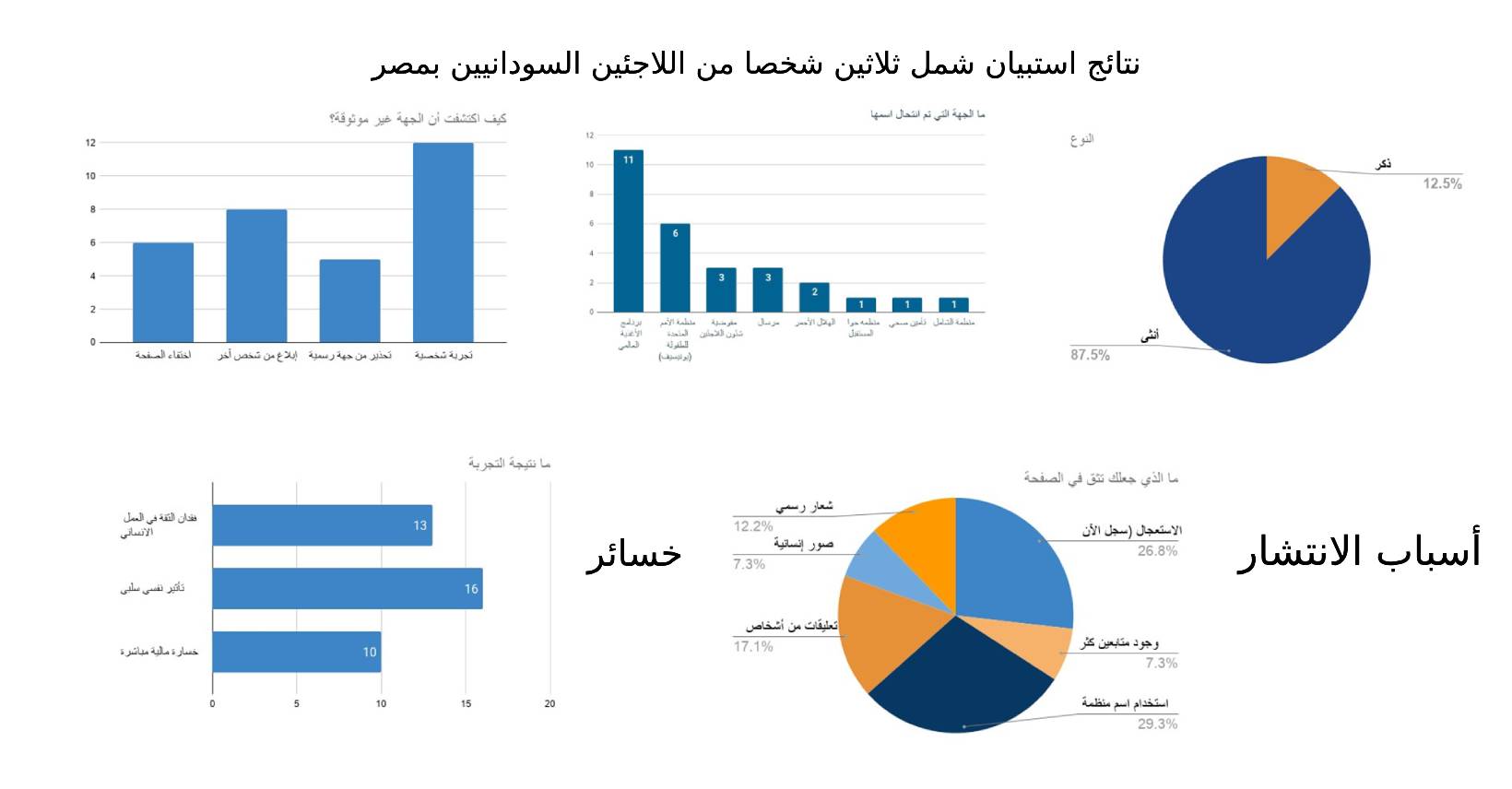
A survey conducted among 30 Sudanese refugees in Egypt—87 percent of whom were women—found that the World Food Programme was the organization whose name and logo were most frequently misused in online fraud schemes.
Eleven respondents reported being targeted by scams carried out in the WFPs name.
Based on these findings, the investigation team formally contacted the WFPs communications department by email, seeking clarification on whether the organization had documented cases of fraud, impersonation, or misuse of its identity; what legal and technical measures it employs against perpetrators; and how it combats misinformation. No response was received before publication.
However, open-source research uncovered repeated warnings published on the organizations official platforms alerting the public to fake Facebook and WhatsApp links falsely claiming affiliation with the WFP.
The organization emphasizes that all of its services are free and that it never charges fees for humanitarian assistance.
A warning issued by the WFP in Sudan noted a significant increase in fake Facebook accounts and groups impersonating the organization. The program warned that these fraudulent accounts undermine public trust and contribute to the spread of misinformation.
To address the problem, the WFP introduced a volunteer initiative recruiting Arabic-speaking online volunteers to help identify and report fraudulent accounts to Meta for removal.
The Threat of Algorithms
Dr. Adam Ahmed Adam, Dean of the Faculty of Arts at Omdurman Ahlia University and an expert in media literacy and countering disinformation, attributes the spread of humanitarian-aid rumors primarily to the scarcity of reliable information from official sources.
"The absence of official communication creates an information vacuum that rumors quickly fill," he explained.
He noted that humanitarian assistance has become one of the most sought-after topics among war-affected populations. Under such circumstances, people are more likely to believe aid-related information because it offers hope amid hardship.
The widespread use of social media has further complicated efforts to verify information.
Dr. Adam also argues that political and economic actors actively fuel these rumors through coordinated online campaigns, fully aware that repeated exposure to misinformation within vulnerable communities increases the likelihood that people will believe it.
According to him, the war itself has contributed to the rise of disinformation. Psychological distress among civilians, combined with the absence of official information due to communications outages across large parts of Sudan, has created ideal conditions for fraudsters.
These actors exploit the situation by creating pages bearing the names of prominent humanitarian organizations and directing users to links designed to harvest personal information or extort money.
He further warned about the role of social media algorithms.
"The real danger lies in algorithms designed to amplify content that generates high engagement regardless of its accuracy," he said.
According to Dr. Adam, algorithm-driven promotion significantly contributes to the spread of humanitarian-related misinformation through repeated sharing, commenting, and engagement.
Financial and Psychological Harm
Survey results revealed that 16 of the 30 respondents first encountered fraudulent aid schemes through Facebook and WhatsApp groups, while the remainder were approached through individual outreach efforts.
Regarding payment methods, more than 65 percent transferred money directly to personal bank accounts, 20 percent used bank transfers, and 13 percent paid through mobile wallets.
Twelve respondents discovered they had been scammed through personal experience. Eight learned they had been deceived after being informed by someone else, while four became aware only after warnings from official sources.
The consequences were severe:
10 respondents suffered direct financial losses.
16 reported psychological distress.
13 lost trust in humanitarian organizations.
Cybercrime Law
Sudans Cybercrime Act of 2018, as amended in 2020, criminalizes all forms of electronic fraud aimed at obtaining money or benefits through deception.
Article 12(1) stipulates that any person who intentionally uses information networks, communication systems, applications, or digital platforms to deceive another person in order to obtain money, documents, information, data, benefits, or induce them to sign documents or conduct electronic transactions may face imprisonment of up to seven years, a fine, or both.
Article 12(2) increases the penalty to up to nine years imprisonment, a fine, or both for repeat offenders convicted for a third time.
Refugee Lawyer: A Persistent Problem
Ashraf Milad, an Egypt-based lawyer specializing in refugee rights, migration, and human rights, revealed that he reported a fraud case to UNHCR Egypt two years ago involving a Sudanese refugee who purchased a SIM card and registered it on the Truecaller application so that calls would appear under the name of UNHCR.
The individual then contacted refugees and demanded money.
Regarding the scale of the phenomenon, Milad said he receives reports of online fraud approximately every three months.
Over the past decade, he has reported around 30 fraud cases to UNHCR.
--
- The Sudan Media Forum and its member organizations publish this data-driven investigation, prepared by Al-Alaq Press Services Center, to expose the growing wave of online fraud targeting Sudanese refugees through fake pages and groups impersonating well-known humanitarian organizations.
The investigation demonstrates how misleading information, recycled images, and fraudulent communication channels are being used to lure vulnerable refugees into transferring money or surrendering personal data, highlighting an urgent need for greater awareness, digital literacy, and stronger protections for displaced communities.
