
Updated: 9 June 2026 11:34:51
Anti-Aircraft Fire Shakes Omdurman as Drone Wreckage Found in Khartoum North
Moatinoon
The cities of Khartoum and Omdurman witnessed renewed military developments on Tuesday morning amid ongoing drone attacks that the Sudanese Armed Forces accuse the Rapid Support Forces (RSF) of carrying out against various targets in the Sudanese capital. The army continued efforts to counter the attacks using air defense systems deployed across several military and strategic locations.
Field sources and eyewitnesses reported that Sudanese army air defenses successfully intercepted and destroyed a number of drones that flew over the two cities during the early morning hours, prompting heightened military and security alertness amid the continuing conflict that has gripped the country since the outbreak of war between the Sudanese Armed Forces and the RSF.
In Omdurman, military sources said air defense units detected a drone operating within the city’s airspace and were able to engage and destroy it before it reached its intended target. The sources added that the drone was identified and neutralized within a short period of time, preventing potential casualties or damage in the targeted area.
The incident coincided with intense anti-aircraft fire heard across several neighborhoods in Omdurman, particularly in Karari locality. Residents reported hearing repeated bursts of gunfire from the early hours of the morning. One resident, who requested anonymity for security reasons, said the sounds appeared to originate from the Wadi Seidna military area north of Omdurman.
The resident said the anti-aircraft fire continued for some time, causing concern among local residents and prompting many to follow developments through social media platforms in an effort to understand the situation. He added that the area remained on high alert amid increased aerial activity and military movements.
In Khartoum, drone attacks reportedly continued at an intense pace, according to residents and local sources, as the armed forces sought to engage aerial targets detected in several locations. Sources indicated that ground-based air defense systems remained on maximum alert to counter any new attempts to strike military facilities or critical infrastructure.
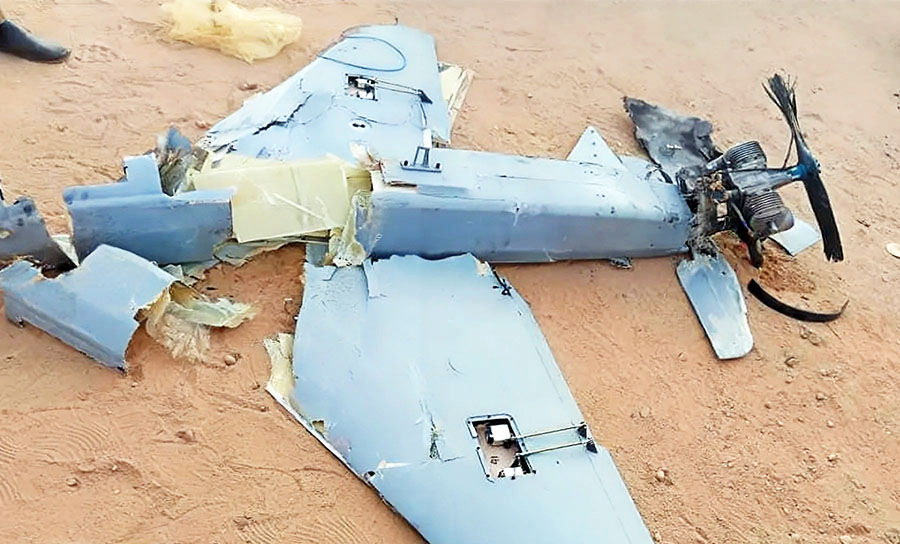
In a related development, eyewitnesses in the Al-Droshab area of Khartoum North (Bahri) reported discovering parts of what appeared to be a suicide drone that crashed near the road leading to Souq Al-Ahad (Sunday Market), one of the areas busiest commercial centers.
Several residents said they were surprised to find drone debris scattered along the roadside, noting that the wreckage appeared to belong to an attack drone that had been destroyed before reaching its target. Witnesses added that authorities quickly responded to the scene, secured the area, and prevented civilians from approaching the crash site.
The incident raised concerns among local residents, particularly because Sunday Market is usually crowded with traders and shoppers during the morning hours. Residents noted that the consequences could have been severe had the drone reached its destination or detonated within the densely populated area.
These developments come amid a growing reliance on drones in Sudan’s conflict, where unmanned aerial systems have become one of the most prominent tools of warfare in recent months. Drone attacks have increased significantly, targeting military positions, public facilities, and infrastructure across several Sudanese states, prompting the armed forces to strengthen air defense capabilities and intensify aerial surveillance and monitoring operations.
Observers believe the continued use of drones reflects a shift in the nature of battlefield confrontations, as warring parties increasingly rely on modern technologies that allow for long-range operations while reducing direct risks to attacking forces. They also note that the successful interception of several drones highlights the importance of surveillance and early warning systems in mitigating the impact of such attacks.
As military operations continue in several parts of the country, residents of the capital and its surrounding areas face increasingly difficult humanitarian and security conditions due to ongoing clashes and reciprocal attacks. Many hope that regional and international efforts will help push the conflicting parties toward a political settlement capable of ending the war and restoring stability to Sudan.
With intermittent drone activity continuing and military forces remaining on high alert, the situation in Khartoum and Omdurman remains closely tied to developments on the ground in the coming hours and days, amid fears that a new escalation could further affect security and humanitarian conditions in the Sudanese capital and its surroundings.
