
Updated: 5 June 2026 18:18:08
Sudan Faces One of the Worlds Worst Hunger Crises in 2026
Moatinoon
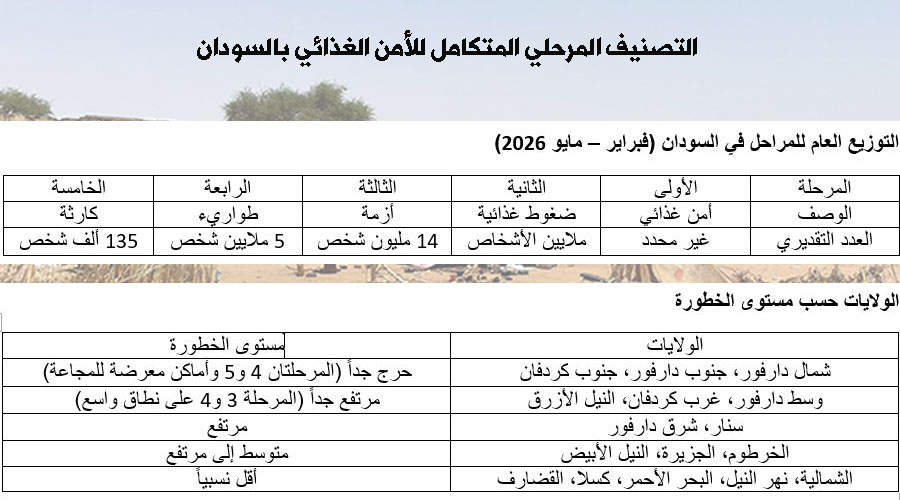
The latest analysis by the Integrated Food Security Phase Classification (IPC), published on June 3, 2026, has revealed that approximately 19.5 million people in Sudan—about 41 percent of the population—are experiencing acute food insecurity, making it one of the largest humanitarian crises in the world.
According to the report, millions of Sudanese are living under conditions classified as either “Crisis” or “Emergency,” while around 135,000 people are facing catastrophic levels of food insecurity under IPC Phase 5, the highest classification level, indicating extreme hunger, severe malnutrition, and the collapse of livelihoods.
The analysis found that the Darfur region, Kordofan, and Blue Nile states remain among the areas hardest hit by the crisis due to ongoing armed conflict, economic deterioration, disrupted agricultural activities, and limited humanitarian access to affected communities.
The report warned that 14 areas across Sudan remain at risk of famine in the coming months, particularly in parts of North Darfur, South Darfur, and South Kordofan, should fighting continue or humanitarian access become further restricted.
It also noted that the lean season, expected between June and September 2026, could lead to a further deterioration of humanitarian conditions as food prices rise, income opportunities decline, and displacement continues to increase.
On nutrition, the report projects that approximately 825,000 children under the age of five will suffer from severe acute malnutrition during 2026, raising serious concerns about increased mortality and illness among vulnerable children.
North Darfur, South Darfur, and South Kordofan were identified as the most severely affected areas, while Central Darfur, West Kordofan, and Blue Nile continue to experience high levels of acute food insecurity. The report also highlighted persistent humanitarian pressures in Khartoum, Al Jazirah, Sennar, and White Nile states due to large-scale displacement and the deterioration of basic services.
Food security experts cited the ongoing conflict as the primary driver of the crisis, compounded by economic collapse, damage to agricultural infrastructure, disrupted markets, and broken supply chains.
The report called for an urgent scale-up of humanitarian assistance and unhindered access to food and nutrition support in the most affected areas, warning that delays in intervention could lead to a further expansion of acute hunger and place more communities at risk of famine during the second half of the year.
The Integrated Food Security Phase Classification (IPC) is the internationally recognized framework for assessing food insecurity and malnutrition. It categorizes conditions into five phases, ranging from minimal food insecurity to catastrophe or famine.
