Updated: 5 June 2026 11:48:23

The Addis Ababa Statement: A Crisis of Vision in Civilian Political Discourse
By Al-Asmai Bashari
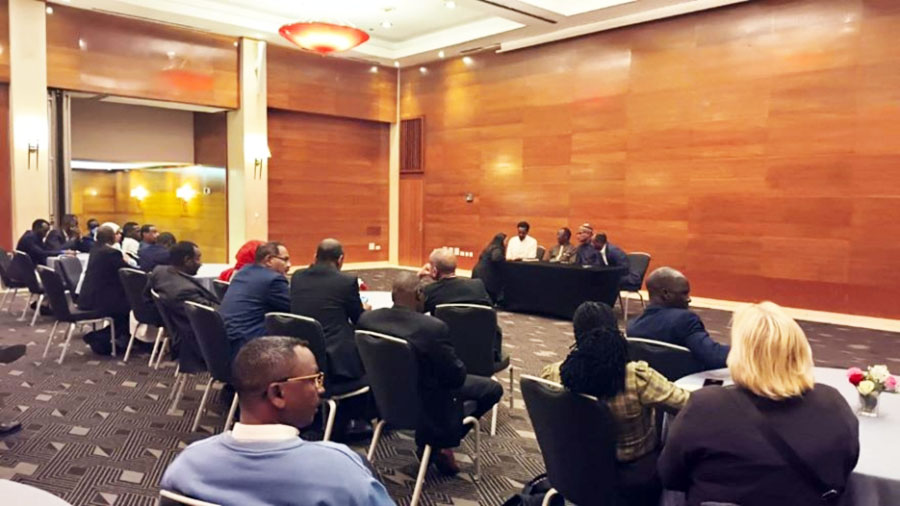
The statement issued by the Sudanese civilian forces meeting in Addis Ababa reveals one of the deepest crises facing Sudan’s political elite: an inability to produce a genuine political vision, replaced instead by an accumulation of slogans and moral rhetoric that may sound appealing but fails to offer practical solutions to the country’s national crisis.
The statement speaks of peace, justice, citizenship, development, reconciliation, and a new social contract—all noble concepts with which few would disagree. Yet the question confronting the reader from the first line to the last remains: What comes next? Where is the plan? Where is the project? And where are the answers to the questions imposed on Sudan by the war? What role is envisioned for the preparatory committee that the parties agreed to establish?
In contemporary Sudanese political discourse, it has become easy to speak of “ending the war” without explaining how, of a “political process” without identifying its participants, of “justice” without clarifying its mechanisms, and of a “new social contract” without presenting any vision of its content. This is precisely what the statement does. It offers a long list of broad aspirations without providing a coherent political vision or an actionable program.
Perhaps most striking is the way the statement discusses the war as though it were a natural phenomenon that descended upon Sudan from the sky, rather than a direct consequence of crises involving power, state institutions, and both political and military elites. There is no serious diagnosis of the roots of the conflict, nor any clear position on the issues that ignited the crisis in the first place: the relationship between the military and politics, the future of armed formations, security sector reform, the structure of the state, and the distribution of power and wealth. It is as if the intention is to leap directly into a post-war phase without confronting the difficult questions that produced the war itself.
The statement also reveals a growing tendency among some civilian forces to produce moral discourse rather than political discourse. The language is saturated with values and principles but lacks vision and strategy. Politics is not measured by the number of attractive words contained in a statement; it is measured by its ability to answer the fundamental question of power: Who governs? How do they govern? Through which institutions? And under what guarantees?
Ironically, the civilian forces calling for a “national renaissance project” provide no meaningful outline of such a project. There is no economic blueprint for reconstruction, no vision for addressing institutional collapse, no program for dealing with millions of displaced persons and refugees, and not even a timeline or practical roadmap for moving from war to peace. It is as though invoking grand concepts alone is sufficient to build the future.
What Sudan needs today is not more statements filled with general concepts, but political courage to confront reality. War will not end through slogans, justice will not be achieved through good intentions, and development will not emerge from rhetorical formulations. Unless civilian forces move beyond producing discourse and begin producing concrete projects, they will remain part of Sudan’s political crisis rather than part of its solution.
Over the past decades, Sudanese people have become accustomed to statements that speak of peace, democracy, justice, and development while avoiding the details that ultimately determine whether such ideals can be translated into reality. The Addis Ababa Statement, unfortunately, does not appear to be an exception. It reflects a broad linguistic consensus, but not a clear political vision. At a historic moment when Sudan faces the risk of fragmentation and collapse, the absence of a coherent vision is more than a political shortcoming—it is a crisis in itself.