
Updated: 3 June 2026 13:01:26
Women in Sudan Are “Carrying Their Country on Their Shoulders” Amid Continuing War
Moatinoon – Follow up
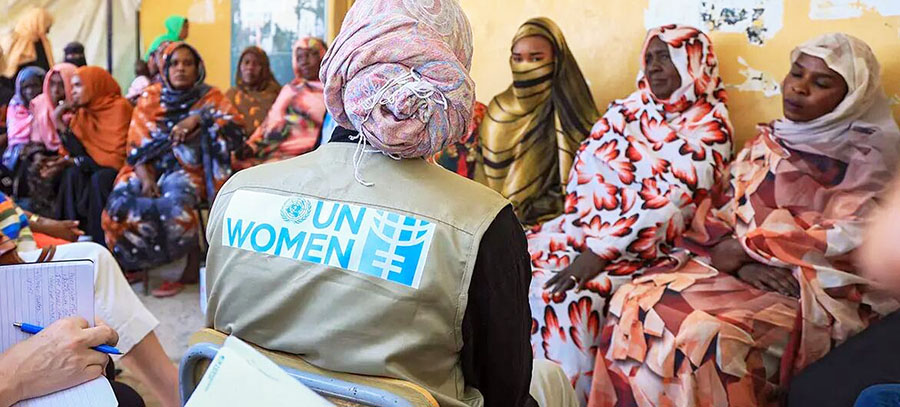
The United Nations Population Fund (UNFPA) has said that Sudanese women continue to be “carrying their country on their shoulders” as they strive to secure a dignified life for themselves and their children despite the ongoing war and widespread insecurity affecting the country.
Speaking to journalists in Geneva from Cairo, Egypt, Andrew Saberton, UNFPA Deputy Executive Director for Management, said that during his recent visit to Sudan he witnessed “a country trying to come back to life, even while the war continues.”
He described parts of the Sudanese capital, Khartoum, as a “ghost city” filled with burned-out buildings and darkness. “Yet people are returning,” he said, “because no one wants to remain indefinitely in displacement camps.”
Recovery Encourages Return
Saberton noted that camps in eastern Chad, which he also recently visited, provide temporary refuge for Sudanese people who fled the conflict. While the Chadian government and humanitarian organizations are doing their utmost to support refugees, he stressed the harsh realities of camp life.
“Make no mistake,” he said. “These are miserable places to live. In one camp, the maternity ward was handling around 30 deliveries a day under extremely poor conditions, often without anesthesia. About 10 percent of those births were by Caesarean section. No woman should be forced to give birth under such circumstances.”
While the conflict has placed enormous pressure on Sudan’s healthcare system, Saberton pointed to signs of recovery. He highlighted UNFPA’s support for the rehabilitation of the Dayat Hospital in Khartoum, including the provision of medical personnel and equipment.
The hospital, he said, is set to become “one of the largest maternity hospitals in Africa,” capable of handling more than 50 births per day. For the first time, its services will be offered free of charge thanks to government investment.
“These kinds of services make return possible,” he added. “When people are given a choice, they almost always prefer to return home.”
The Resilience of Women
Saberton said that women and girls he met in safe spaces in Port Sudan and Khartoum described insecurity not as isolated incidents but as a constant feature of daily life. Despite this, he said, their resilience was unmistakable.
“In many ways, I witnessed how Sudanese women are carrying their country on their shoulders,” he said. “They do not simply want food. They want access to basic healthcare, safety, opportunities to earn an income to support themselves and their children, and the ability to send their children to school.”
The UNFPA official emphasized that the starting point for recovery must be a sustainable ceasefire and lasting peace. Once peace is achieved, he said, rebuilding Sudan will require major investments in healthcare, protection services, and other essential public services.
Humanitarian Aid Remains a Lifeline
In the meantime, Saberton stressed that humanitarian assistance remains a lifeline for millions of Sudanese and that humanitarian appeals must be adequately funded.
He warned that without urgent financial support, UNFPA will be forced to further scale back its programs and services. Currently, protection services have received only 20 percent of the funding required, while health services have secured just 14 percent of their funding needs.
Saberton reiterated that sustained international support is essential to ensure that Sudanese women, children, and families can access the protection and services they urgently need while the country continues its path toward recovery.
