
Updated: 30 May 2026 12:15:41
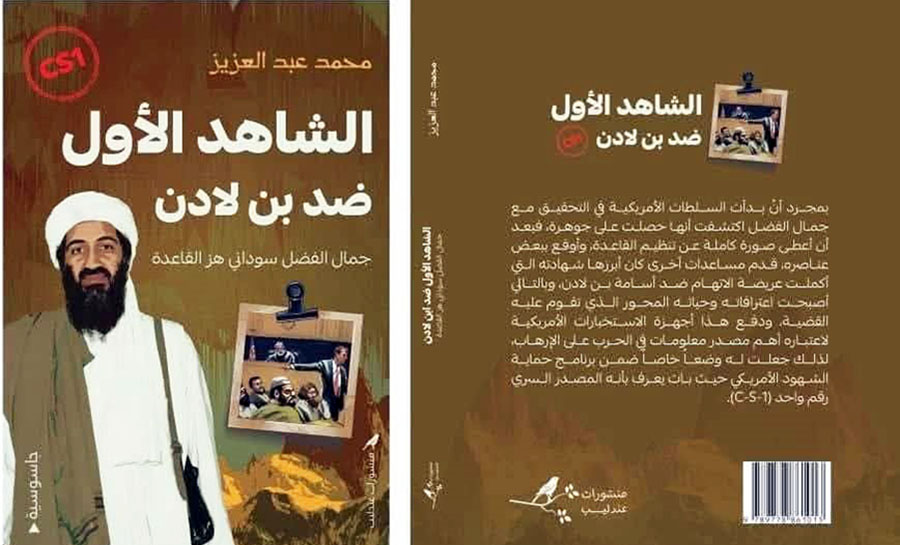
Jamal al-Fadl: The Sudanese Man Who Shook Al-Qaeda
A Reading of The First Witness Against bin Laden by Journalist and Novelist Mohamed Abdel Aziz
By Al-Asmaei Bashri
In a world where politics intertwines with intelligence operations and secret stories intersect with bloody realities, The First Witness Against bin Laden: Jamal al-Fadl, the Sudanese Man Who Shook Al-Qaeda by Sudanese writer and journalist Mohamed Abdel Aziz emerges as an exceptional work that transcends conventional documentation. It ventures into the realm of compelling narrative storytelling, capturing the reader’s attention from the first page to the final line.
Published by the Egyptian-Sudanese-Emirati Publishing House and distributed by Andaleeb Publications, the book spans approximately 250 medium-sized pages. It is divided into three chapters containing 28 subheadings. Yet the true value of the work lies not in its size or structure, but in the author’s ability to reconstruct one of the most mysterious and fascinating stories in the history of Al-Qaeda through the life of a man who seems to have stepped straight out of an international espionage novel: Jamal al-Fadl, the Sudanese insider who transformed from a member of the organization into a pivotal witness whose testimony exposed Al-Qaeda’s secrets to the world.
From the very title, Mohamed Abdel Aziz succeeds in creating a sense of anticipation. The phrase “the Sudanese man who shook Al-Qaeda” is not merely a journalistic description; it serves as a dramatic gateway into a story filled with betrayal, shifting loyalties, and intelligence intrigues. To the author’s credit, he does not portray Jamal al-Fadl simply as an “informant” or “witness,” but as a complex human character shaped by contradictions and operating within a deeply turbulent political and security environment.
While the book may appear at first glance to belong to the spy-thriller genre, it ultimately transcends such a narrow classification. Investigative journalism blends seamlessly with novelistic storytelling, and documentary evidence sits alongside vividly narrated scenes, creating a hybrid structure that gives the work its unique identity. This artistic fusion is one of the book’s greatest strengths, allowing readers to experience the events not as static archival material but as a tense political drama unfolding before them.
The author employs a fluid narrative style characterized by conciseness, suspense, and skillful transitions between events, without falling into the trap of excessive detail or informational overload. Mohamed Abdel Aziz, known for his elegant journalistic prose and strong narrative sensibility, carefully balances information and entertainment. As a result, the pages maintain a brisk pace that keeps readers engaged, even in sections that are primarily documentary in nature.
One of the book’s most significant achievements is its examination of Al-Qaeda through a distinctly Sudanese lens—a perspective rarely explored with such depth. The author goes beyond recounting Jamal al-Fadl’s personal story to reconstruct the political and social climate surrounding Osama bin Laden and his organization during their years in Sudan in the 1990s, a period that continues to provoke questions and controversy. Through this exploration, the book opens a window onto a highly sensitive chapter of Sudanese and Arab history, when regional and international security interests intersected in complex ways.
The book also offers a different perspective on the relationship between individuals and closed ideological organizations. Jamal al-Fadl is portrayed as someone who entered Al-Qaeda for multiple reasons, only to later rebel against it and expose its secrets. This psychological and intellectual journey forms the backbone of the narrative, prompting readers to reflect on the fragility of loyalty within secretive organizations and how a trusted insider can become their most dangerous witness.
The author’s clear sympathy for the human dimension of the story is equally evident. He portrays his protagonist as a product of complex circumstances rather than reducing him to the simplistic labels of traitor or hero. This approach adds depth to the text by moving beyond ready-made judgments and encouraging a more nuanced understanding of both the character and the events.
From a literary standpoint, Mohamed Abdel Aziz’s novelist’s instincts are unmistakable. Certain passages are written with vivid, highly visual language that allows readers to see the settings, imagine the characters, and follow their internal dialogues. The author also demonstrates a strong ability to construct dramatic scenes, knowing when to slow the narrative and when to accelerate it—a skill not commonly found among journalists venturing into long-form writing.
Despite its suspenseful tone, the book avoids sensationalism and maintains a clear documentary foundation. Readers can sense the considerable effort invested in gathering information, tracing events, and connecting scattered threads. This lends the work substantial credibility, particularly given the complexity and controversy surrounding its subject matter.
Another notable strength is the author’s ability to simplify complicated events without compromising their seriousness. Non-specialist readers can easily follow the story and understand its political and organizational dimensions, while those with an interest in security affairs will find a wealth of details and insights.
In part, the book is also a meditation on the very concept of testimony. What does it mean for someone from within one of the world’s most secretive organizations to become a witness against it? What price must be paid for such a transformation? How is such a figure perceived by different parties? These questions resonate throughout the text, giving the work a philosophical dimension that extends far beyond a simple security narrative.
It is impossible to discuss the book without highlighting Mohamed Abdel Aziz’s writing style, which once again confirms him as one of the Sudanese voices capable of blending journalistic precision with literary imagination. He writes not only with the mind of a journalist but also with the eye of a novelist. Consequently, his scenes feel alive, and his characters resemble real people moving before the reader’s eyes.
Ultimately, The First Witness Against bin Laden: Jamal al-Fadl, the Sudanese Man Who Shook Al-Qaeda is far more than a book about Al-Qaeda or a controversial individual. It is an attempt to reinterpret an entire era of Arab political and security history through the story of one man who found himself at the center of a storm. Combining knowledge with narrative pleasure, it offers readers a rare opportunity to approach a world long shrouded in mystery and myth.
Mohamed Abdel Aziz has successfully transformed highly sensitive material into a compelling and coherent text, demonstrating that when journalism masters the tools of storytelling, it can rise to the level of fine literature—and that true stories are sometimes more astonishing than fiction itself.
