
Updated: 26 May 2026 10:34:53
Moatinoon Center Calls for War-Affected Communities to Lead Sudan’s Political Process
Moatinoon
Moatinoon Center for Peace Culture Journalism said Sudan’s crisis has gone beyond being a mere power struggle between armed actors and has become a crisis concerning the nature of politics itself and who has the right to represent society and shape the country’s future, calling for rebuilding the political process on the basis of broad popular participation and empowering war-affected communities.
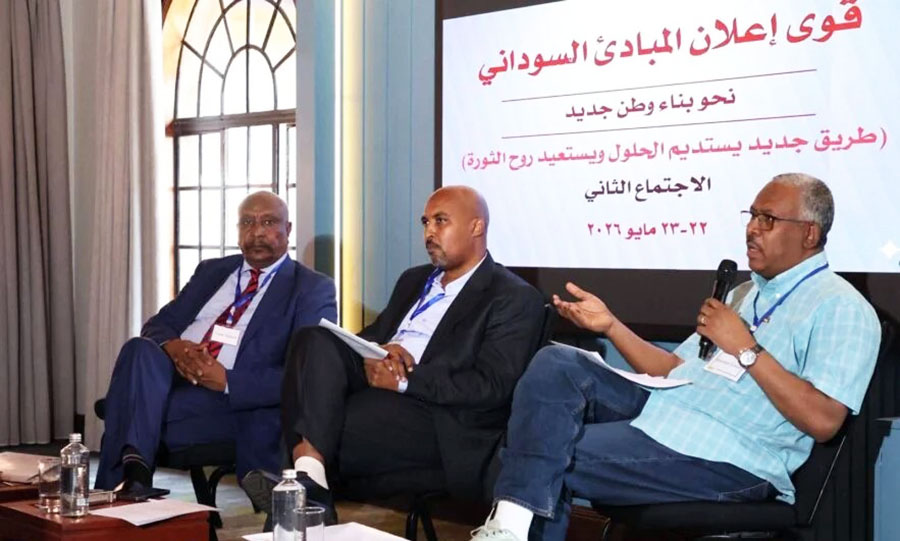
In an analytical paper titled “Toward Civic Action that Imposes Peace and Reclaims the Public Sphere,” the center stated that the final communiqué of the “Sudanese Declaration of Principles Forces – Toward Building a New Homeland” represented a relative development in the discourse of Sudanese civilian forces by holding the warring parties responsible for the humanitarian catastrophe, warning against fragmentation and hate speech, and emphasizing Sudan’s unity and the need for a political process with “Sudanese ownership.”
However, the paper argued that civilian political discourse still operates within the limits of a traditional elite-centered approach, as it speaks about displaced persons, refugees, emergency response rooms, and grassroots initiatives as victims or moral support bases without granting them a genuine role in political decision-making.
Toward Civic Action that Imposes Peace and Reclaims the Public Sphere
A Critical Reading of the Statement of the “Sudanese Declaration of Principles Forces” and a Proposal for Building Popular Ownership of the Political Process
Muawia Mohamedin
Introduction
Sudanese civilian forces are experiencing one of their most complex moments since the outbreak of war in April 2023, amid the collapse of state institutions, the escalation of the humanitarian catastrophe, and the widening gap of trust between society and traditional political forces. In this context, the final statement of the second meeting of the “Sudanese Declaration of Principles Forces – Toward Building a New Homeland” emerged as an attempt to reformulate a civilian discourse seeking to transcend the sharp polarization between the parties to the war and to present a political vision based on ending the war and restoring the path of democratic civilian transition.
The statement indeed reflected a relative development in political language, whether in the clarity of its characterization of the war, its warning against the dangers of fragmentation and hate speech, or its emphasis on Sudan’s unity and the necessity of building a political process with “Sudanese ownership.” However, the significance of any political discourse is measured not only by what it says, but also by what it omits, and by its ability to provide practical answers to the questions imposed by the war and its profound transformations within Sudanese society.
This paper is based on the central premise that the Sudanese crisis is no longer merely a power struggle between competing actors; rather, it has become a crisis concerning the very nature of politics itself, and who possesses the right to represent society and shape the future. Therefore, any civilian project genuinely seeking to end the war and build sustainable peace cannot succeed if it remains trapped within traditional elite-centered approaches, or if it merely speaks on behalf of war-affected communities without involving them as principal partners in shaping political decisions.
In its first section, the paper examines the statement of the “Sudanese Declaration of Principles Forces” as a relatively advanced attempt within the discourse of civilian forces, while also addressing the limits of this progress and its core shortcomings. The second section presents an alternative vision based on the necessity of rebuilding politics from below, by transforming war-affected communities — including displaced persons, refugees, emergency response rooms, grassroots initiatives, and local organizations — from passive victims into the center of political action and the civilian force capable of imposing peace and reclaiming Sudan’s public sphere.
First: Does the Statement of the “Sudanese Declaration of Principles Forces” Represent a New Shift in Civilian Political Discourse?
The final statement of the second meeting of the “Sudanese Declaration of Principles Forces – Toward Building a New Homeland” constituted a clear attempt to reformulate the discourse of Sudanese civilian forces in light of the profound transformations imposed by the ongoing war since April 2023. Compared to many previous civilian political statements, it appeared more explicit in characterizing the nature of the Sudanese crisis and in holding both the National Congress regime and the Islamic Movement responsible for igniting the war, while also holding the two warring parties accountable for its continuation and the expansion of its catastrophic consequences for society and the state.
The statement was also distinguished by a political and humanitarian language more closely aligned with the scale of the Sudanese tragedy, through its focus on displacement, famine, the collapse of services, and the rise of hate speech and racism, alongside its affirmation of Sudan’s unity and rejection of projects of division and fragmentation. It further offered a more structured vision of possible solutions by linking the humanitarian process, ceasefire efforts, and the political process within an integrated roadmap aimed at building “a Sudan of freedom, peace, and justice.”
Among the statement’s notable aspects was its emphasis on the necessity of “Sudanese ownership of the solution,” and its call for a political process driven by national will, coupled with the rejection of impunity and insistence on dismantling military and militia structures in favor of a unified national army. The call to build a “third bloc” or a “broad civilian front” also represented an attempt to move beyond the sharp polarization between the warring parties and their respective allies.
Yet the fundamental question remains: does this statement truly represent a qualitative transformation in the discourse and practice of civilian forces, or does it still operate within the limits of the same traditional approach, albeit in more advanced language?
Despite the noticeable development in the statement’s political language, its deeper structure remained closer to the discourse of traditional civilian elite alliances than to a project seeking to redefine politics on the basis of the immense social transformations created by the war. The statement spoke extensively about displaced persons, refugees, victims, emergency response rooms, and community initiatives, and praised their resilience, yet it failed to take the most important step: recognizing these forces as authentic partners in political decision-making itself.
Here, a fundamental gap emerges between discourse and practice. The statement kept war-affected communities in the position of “inspirational victims” or an “ethical support base,” without proposing clear mechanisms for their representation within the leadership and political structure of the civilian bloc it advocates. It did not explain how displaced persons, refugees, resistance committees, emergency response rooms, and grassroots organizations would participate in shaping the political vision or influencing the negotiation process. In doing so, it reproduced the traditional pattern in which elites speak in the name of the masses without building politics together with them and through them.
The statement also failed to provide a practical answer to the question of power: how can a political process be imposed upon armed actors? From where would civilian forces derive effective leverage? In reality, civilian forces possess neither military superiority nor state institutions. Therefore, their true source of strength cannot lie in rhetoric alone or in reliance on international mediation, but rather in their ability to organize and represent the social force generated by the war itself.
The war has produced a new reality embodied in millions of displaced persons and refugees, networks of grassroots relief efforts, emergency response rooms, women’s and youth initiatives, and local communities that have managed daily life in the absence of the state. These forces are no longer merely victims; they have become, in practice, the most dynamic and organized social structures in Sudan today. Yet the statement failed to move these forces from the position of moral symbols to that of leading political partners.
On the other hand, the call for the “unification of negotiation platforms” appeared closer to reproducing a demand repeatedly raised over the past years, without being accompanied by a practical step reflecting a genuine transition toward “Sudanese ownership of the solution.” Instead of merely calling for unified platforms, it would have been possible to propose a practical initiative toward a Sudanese–Sudanese negotiation forum capable of testing the civilian forces’ ability to produce an independent national political center and of relocating the political process back into Sudan’s public sphere rather than leaving it hostage to foreign capitals and external mediators.
National ownership of the solution cannot be achieved merely by using it as a slogan. It requires practical answers to questions concerning who designs the political process, who participates in it, how it is managed, and who exercises real influence over its outcomes.
Therefore, it can be said that the statement represents an important relative development in the discourse of Sudanese civilian forces, but it has not yet achieved a complete break with the traditional elite-centered approach. It succeeded in diagnosing the crisis, criticizing the war, and warning against fragmentation, but it did not go far enough toward rebuilding politics from below, starting from the war-affected communities themselves as the genuine actors capable of creating a civilian balance of power against the logic of war and weapons.
Second: Toward a Politics Built with the People, Not in Their Name
The current Sudanese crisis is no longer merely a struggle for power between armed actors; it has become a historical moment that has reshaped society itself and exposed the limitations of traditional politics that has governed the public sphere for decades. Therefore, any civilian project genuinely seeking to end the war and build a new Sudan cannot succeed if it remains trapped within old elite-centered approaches, even when using advanced revolutionary language.
From this perspective, the essence of any genuine transformation in civilian action must begin with redefining the central question: who has the real stake in ending the war? And who possesses the social power capable of imposing peace?
Millions of displaced persons and refugees, emergency response rooms, grassroots relief networks, resistance committees, women’s and youth initiatives, and local communities that sustained people’s lives amid state collapse are not merely victims of war or subjects of moral solidarity. Today, they are the most present, legitimate, and influential social forces within Sudan. These forces must not remain at the margins of the political process or confined to the position of “listeners” and “supporters”; rather, they should become principal partners in shaping political vision and leading the struggle for peace and civilian transformation.
The true strength of civilian forces will not come from statements or proximity to international mediators, but from their ability to transform popular suffering into organized political power. Armed actors, regardless of their military capabilities, still depend on social legitimacy, popular support, and human and economic resources. Once a broad and organized social bloc emerges from those directly affected by the war, it becomes possible to impose a political and moral cost on the continuation of fighting, isolate the discourse of war, and transform the demand for peace into a popular force that cannot easily be ignored.
For this reason, building the “third bloc” should not merely mean forming another alliance among traditional political and civilian forces, but rather creating a project aimed at redistributing the center of political action toward the war-affected communities themselves. This requires practical and clear mechanisms, including:
Building broad popular consultation platforms,
Forming grassroots councils for displaced persons and refugees,
Involving emergency response rooms and local organizations in decision-making,
Developing tools for accountability and direct representation,
And creating genuine political spaces for the communities that have borne the greatest burden of the war.
In the same context, the notion of “Sudanese ownership of the solution” must not remain a general slogan. National ownership is not achieved through rhetoric alone, but through building a political process that emerges from within Sudan itself, is managed by Sudanese will, and is shaped by the influence of Sudanese society rather than solely by the agendas of foreign capitals.
Accordingly, what is required is not merely a call to “unify negotiation platforms,” but a practical initiative toward establishing a Sudanese–Sudanese negotiation forum that opens the way for a broad national dialogue led by civilian forces and war-affected communities, and that restores politics to Sudan’s public sphere. Even if such a step faces difficulties due to the complexities of war and regional and international interventions, the mere effort to build it would represent a genuine test of civilian forces’ ability to produce an independent political center, and would give the slogan of “Sudanese ownership of the solution” substantive rather than symbolic meaning.
A democratic civilian Sudan will not be built solely through top-down settlements, nor through recycling old political elites, but through refounding politics itself on the basis of broad popular participation, justice, and genuine representation of the communities that have paid the price of war. The devastated society is no longer merely the object of politics; it has become the only actor capable of producing a civilian balance of power that confronts the logic of weapons and opens the path toward sustainable peace and a just democratic state.
The paper stressed that millions of displaced persons and refugees, alongside grassroots relief networks, resistance committees, and women’s and youth initiatives, have become the most organized and influential social forces in Sudan today, emphasizing the need to transform these groups into key partners in leading the political process and imposing peace.
It further called for the establishment of a “Sudanese-Sudanese negotiation platform” that would relocate the political process back inside Sudan and give war-affected communities a direct role in shaping the country’s future, instead of leaving the process dependent on foreign capitals and international mediation.
The paper added that building a “third bloc” should not be limited to alliances among traditional political forces, but should instead become a project aimed at redistributing the center of political action toward war-affected communities through popular consultation platforms, grassroots councils for displaced persons and refugees, and the inclusion of local organizations in decision-making.
