
Updated: 25 May 2026 17:35:48
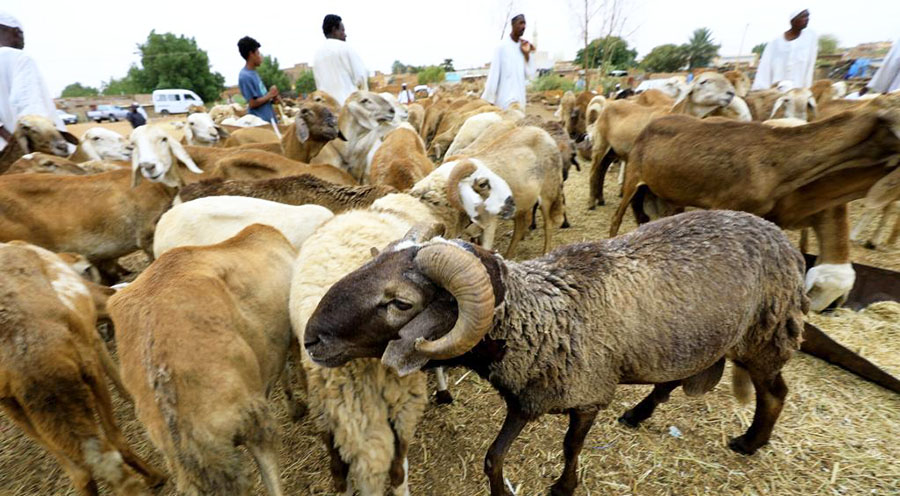
Eid al-Adha in Khartoum: The Hell of the Market Robs Citizens of Their Joy
Moatinoon
Two days before the blessed Eid al-Adha, and after three years of displacement and fear, Nadia Abubakar returned to her home in northern Bahri. She held her house key in one hand and a small bag of flour in the other. She expected to find the neighborhood exhausted by the war, but what she did not expect was for the markets to be harsher than the sounds of the bullets she had once fled.
Nadia stood in front of a small shop near her house, asking about the price of eggs. The merchant replied indifferently, "A tray of eggs is thirty thousand pounds." For a moment, she thought she had misheard. She repeated the question, only to receive the same answer. She lowered her head, silently calculating the remaining money her husband had brought back from a long journey of displacement to another state, and then left without buying anything.
Nadia, a mother of three children in different school stages, says that returning to Khartoum after the war was not the end of suffering as she had imagined, but rather the beginning of a new battle with skyrocketing prices and a lack of income sources. She adds in a faint voice:
"We thought returning home would bring life back to normal, but we returned to find prices on fire, people without work, and empty pockets."
In the early morning, the residents of Al-Darushab, Al-Halfaya, and Al-Kadroo neighborhoods—which are beginning to regain some signs of life—wake up to the sounds of street vendors offering bread, vegetables, and fruit. Residents content themselves with asking about the prices and then closing their doors in silence. The market is no longer a place for purchasing; it has become a daily arena for testing helplessness.
Shrinking Quantities and Defeated Pockets
Inside a popular market in Omdurman, Omar Al-Madina, a retail merchant, stands behind bags of sugar and flour that have shrunk in size compared to before the war. Pointing his hand toward semi-empty shelves, he notes that the prices of food staples have jumped by about 30% in recent weeks alone. Wholesalers justify the increases by pointing to rising transport costs and the deterioration of the exchange rate. However, the ordinary citizen cares little about all that; they are consumed by a single question: How do I feed my family?
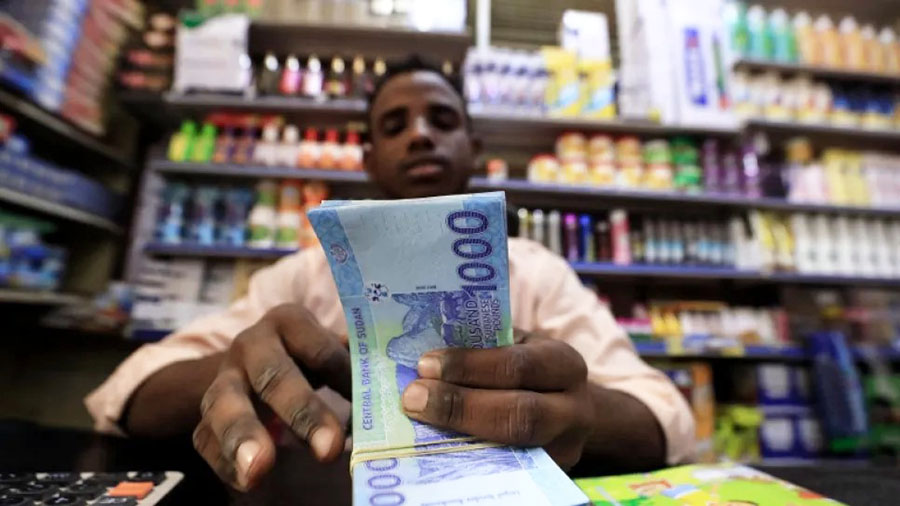
"People have started buying by the ounce and half-ounce," Omar says. "The customer who used to take an entire five-kilogram bag of sugar now buys in much smaller quantities. There are those who enter the market and leave without buying anything at all."
In a neighborhood in Karari, Um Mohamed sat in front of her mud house, trying to divide two small pieces of bread among her four children. Bread is no longer what it used to be—its size has shrunk while its price has simultaneously soared. She recounts with heartbreak that before the war, she used to buy the house’s basic needs once a week. Now, she buys day by day, and sometimes, she buys nothing.
"Salaries stopped at the beginning of the war, and my husband used to work as a rickshaw driver, but he lost it," she says. "We have come to rely on assistance from our relatives, but everyone’s circumstances are difficult."
Price Overview: The Cost of Survival
The inflation hitting Khartoum’s markets has spared no basic commodity. 1 Liter of Cooking Oil 10,000 SDG, 1 Kg of Mutton (Lamb) 50,000 SDG, 1 Kg of Sugar 5,000 SDG, 1 Ratl (approx. 450g) of Tea 14,000 SDG.
These numbers are no longer just economic data; they have transformed into a daily heartache that shapes life inside homes. Many families have completely removed meat from their tables, others settle for a single meal a day, while some households have resorted to cutting down on purchases altogether due to their inability to pay.
Dreams Lost to the Rubble
At a small bakery in Bahri, dozens of citizens stood in a long queue to get bread. Among them was Abdul Rahman, a government employee who lost his source of income after his institution ceased operations when the war broke out. He says the hardest thing he faces is not hunger itself, but his feeling of helplessness before his family.
"My children started asking me: Why dont we bring meat like we used to? and I have no answer. The war stole our jobs, our safety, and even our purchasing power."
He adds that returning to Khartoum was a dream for all displaced persons, but many returned to find destroyed homes and merciless markets. Some families have sold what remained of the womens gold to cover the cost of living, while others have been forced to borrow from neighbors or shopkeepers.
In the markets, foot traffic appears lighter than usual despite the return of thousands of citizens to the capital. Shop owners also complain of stagnation and weak purchasing power. One merchant says that people no longer ask about quality or brand, but only for the cheapest option, even if the quantity is very small.
The war did not destroy buildings alone; it tore apart the entire economic cycle. Thousands of workers lost their jobs, small business owners lost their tools of trade, and many companies and institutions closed their doors. With the absence of stability and the decline of services, securing a stable income has become a distant dream.
Solidarity as a Last Lifeline
Despite the harshness of the conditions, residents are trying to innovate ways to survive. Some women have started preparing and selling food within neighborhoods, while others have turned to baking home-made bread or selling tea on the streets. Young people who used to work in various professions now spend long hours searching for any job opportunity, even for a pittance.
In the evening, Nadia Ahmed sits in front of her cracked house, watching her children review their lessons under a dim light. She says what hurts her most is her fear of the future, but she clings to hope despite everything.
"The war taught us to be patient. It is true that life is very difficult, but people are trying to live. Sometimes we divide a single meal among everyone, and sometimes the neighbors help us. If it werent for solidarity, the situation would be worse."
That community solidarity has become the last lifeline for many families. In some neighborhoods, neighbors share food and water, and cooperate to provide for the needs of the poorest families. However, everyone realizes that these temporary solutions are not enough in the face of the escalating wave of high prices.
With each new morning, the Sudanese citizen goes out to the market carrying a long list of needs, but usually returns only with what they can afford, not what they want. Between store shelves and bread lines, small stories unfold daily of mothers hiding their anxiety, fathers chasing a job opportunity, and children learning early the meaning of war—even after the roar of rifles has stopped.
Khartoum, which is trying to rise from beneath the rubble of war, faces today another, more silent battle, but one that is no less cruel: the battle for survival in the face of inflation, poverty, and the loss of livelihoods.
