
Updated: 23 May 2026 09:54:43
Between Oxford and the British Ballot Boxes: The Face of Sudan Eclipsed by the Flames of War
By: Al-Asmai Bashri
While images of war and destruction coming out of Sudan dominated international news broadcasts, two highly significant Sudanese events passed in the United Kingdom this May without receiving the Sudanese media attention they justly deserved. At a time when the world remained fixated on the rising plumes of smoke in Sudans skies, the countrys name was being elevated in the halls of thought and literature, as well as in the arenas of civil and political engagement, through two events carrying deep significance about the ability of the Sudanese people to forge hope amidst the darkness.
The First Event: Re-reading Tayeb Salih at Oxford
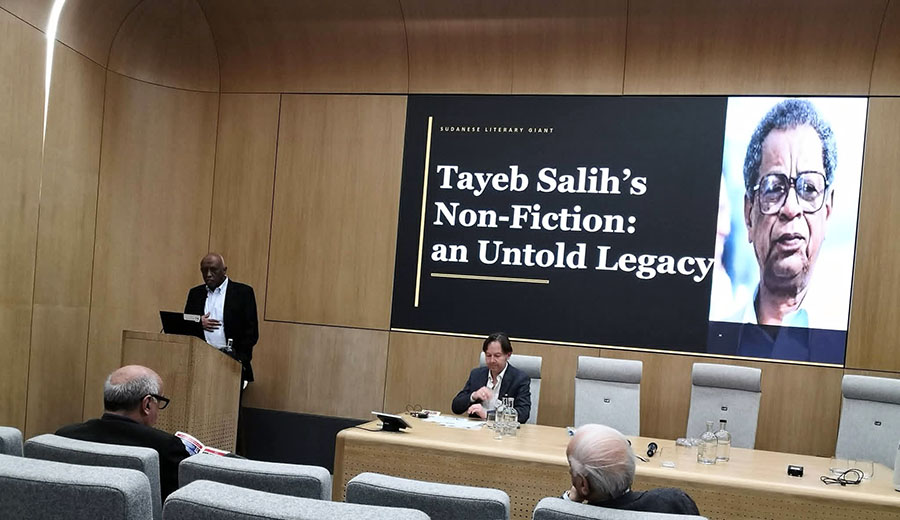
The first event came from the prestigious University of Oxford, where the Middle East Centre and the Faculty of Asian and Middle Eastern Studies organized an academic conference titled "Reading Tayeb Salih in the Twenty-First Century." The conference saw the participation of an elite group of Sudanese and European academics, critics, and writers. Far from being just a fleeting literary function, it felt like an attempt to reintroduce Sudan to the world through one of its most luminous faces: literature and culture.
In the university halls that have embraced great thinkers and philosophers for centuries, the name of the international Sudanese novelist Tayeb Salih returned to assert its presence anew—not merely as a fiction writer, but as a human and cultural phenomenon that still provokes major questions regarding identity, migration, colonialism, and the complex relationship between East and West.
Participants approached Salih’s works from various critical angles, invoking the worlds of Season of Migration to the North, Mansi, The Wedding of Zein, and other works that transformed a small Sudanese village into a vast human space transcending borders and geography. Speakers also discussed how Salih’s writings (including his non-fiction) retain their ability to speak to the contemporary reader despite the passage of decades, at a time when the world is witnessing profound shifts in the concepts of identity, belonging, and migration.

Key Contributions to the Conference:
Mohamed Khalaf presented a keynote paper titled: "Mustafa Saeed and Mansi: How the British Fragmented English Language Learning to Consolidate Colonial Hegemony in Anglo-Egyptian Sudan (1899–1955)."
Lamia Shamat presented a paper titled: "Reclaiming Hosna’s Lineage: Local Oral Memories and the Eclipsed Legacy."
Adel Babikir contributed a paper titled: "Tayeb Salih: The Untold Non-Fictional Legacy."
Dr. Abdel Majid Abdel Rahman Al-Habboub (joining from Saudi Arabia via Zoom) presented: "Defamiliarizing the Familiar: Representations of the Urban Landscape in Tayeb Salih’s Non-Fiction—An Eco-Critical Reading."
Amal Osman contributed a paper on: "Factors of Time, Place, and Belonging in Tayeb Salihs Works."
Non-Sudanese contributions included Timour Muhidine from Paris with a paper titled: "Season of Migration to the North and East: Tasting the Arabic Novel in French and Turkish," and Upala Das from Bilkent University in Ankara, Turkey, with a paper titled: "Sufism and the Manifestations of Post-Modern Secularism in Tayeb Salih’s Works."
The novelist Mohamed Suleiman Al-Shadhly, who arrived from Doha, shared a personal testimony about his experience with Tayeb Salih.
Every paper presented received dedicated commentary from discussants. It is also essential to note the vital contribution of Ahmed Al-Shahi and Laurent Mignon in organizing and moderating the conference, as well as supervising the forthcoming publication of these papers in a dedicated book.
Perhaps the painful irony lies in the fact that this major Sudanese cultural event took place at a time when libraries, cultural centers, and universities inside Sudan are suffering catastrophic conditions due to the war. This lent the conference an additional symbolic dimension; it appeared as a defense of Sudans cultural memory against total destruction.
The Second Event: Sudanese Women in British Politics
The second event emerged from the heart of the British democratic experience, where two Sudanese women achieved a remarkable milestone by winning seats in the British local council elections: Nadia Al-Rashid Nayel and Walaa Bahaa El-Din. This victory marked a momentous occasion for the Sudanese diaspora in Britain and sent a clear message about the capacity of Sudanese men and women to integrate positively and participate actively in their host societies.
The victory of these two women was not merely a limited electoral success; it carried deep social and political implications, particularly in light of the stereotypes that often reduce immigrant communities to groups solely preoccupied with issues of asylum and alienation. Their achievements proved that Sudanese individuals are capable of moving from the margins of social presence into the spheres of influence and local decision-making.
Furthermore, this win reflects the growing presence of Sudanese women in public and political spheres, following long years of social and rights activism both inside and outside Sudan. Since the outbreak of the December Revolution, Sudanese women have played prominent roles in civil and political movements, and today they continue to write new chapters of presence and influence—this time within British local government institutions.
A Shared Thread of Hope
Despite the differing nature of the two events, a profound common thread unites them. Both reflect another face of Sudan, far removed from images of war and collapse. At Oxford, Sudan was present through literature, thought, and cultural memory; in the British local elections, it was present through civic participation, political success, and positive integration.
Yet, it is striking that these two events did not receive the coverage they deserved in Sudanese and Arab media outlets, which seemed entirely consumed by tracking battles, destruction, and displacement. While it is true that the war imposes its heavy shadow on the landscape, restricting the narrative strictly to destruction does an injustice to a people who remain capable of producing knowledge, beauty, and success even under the darkest circumstances.
Sudan is not merely a battlefield, nor is it just breaking news about bombardment, famine, and political divisions. It is also a country possessing an immense cultural and human ledger, with diaspora communities that have achieved significant success across the globe.
Perhaps the importance of these two events lies in the fact that they offer a different blueprint of the Sudanese diaspora: a portrait of individuals who carry their homeland wherever they go—writing about it in universities, debating its issues at conferences, and helping build new societies through politics and public service.
In an era where images of death and ruin proliferate, such news is vital to restoring psychological and morale balance, and to reminding us that Sudan, despite everything it is enduring, is still capable of generating life, meaning, and hope.
Finally, it is worth noting that the Tayeb Salih conference—celebrated here for the second time (the first being on his 70th birthday at Oxford, and now repeated on the approach of his centenary)—should confront those involved in Sudanese literature and culture with a crucial question: how do we celebrate and re-read our cultural icons, with Tayeb Salih at the forefront? This is a realization already grasped by several Sudanese intellectuals who—as we have learned—are currently preparing to celebrate our great writer in various regions. Even the Moroccan city of "Asilah" is not far from mind, no matter how long the war drags on.
