
Updated: 18 May 2026 15:25:19
Thirst Spreads Across Khartoum State
Moatinoon
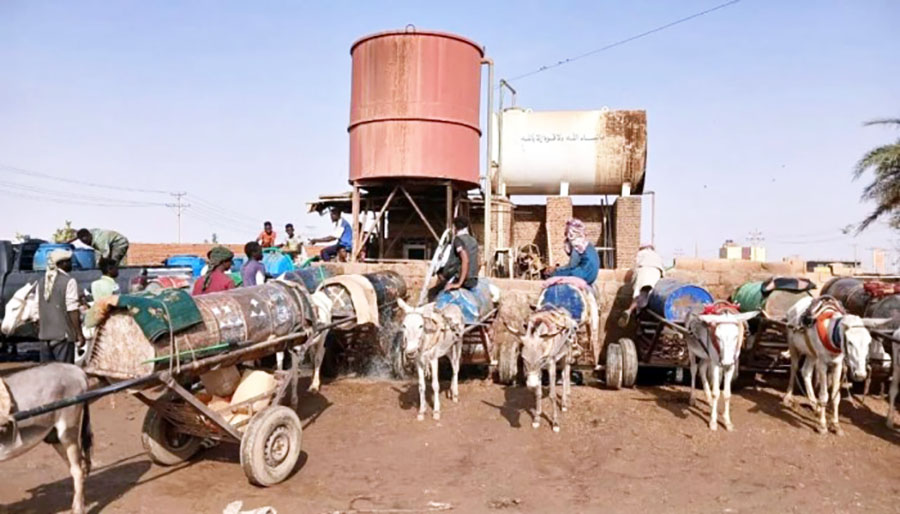
In the fourth year of war, the priorities of fear have changed for residents of Khartoum State. It is no longer the sound of artillery that wakes them in panic every morning, but the absence of the most basic necessity of life: water. From Umbadda Dar Al Salam in the west, and the western neighborhoods of Omdurman, to Jebel Aulia in the south, the daily search for a barrel of water has become a draining battle that exhausts bodies and empties pockets — a bitter irony for a city embraced by both the White and Blue Nile, yet whose waters never reach people’s homes.
“We are dying of thirst” has become a recurring cry among residents of Umbadda Dar Al Salam and surrounding areas, where neighborhoods have endured an almost complete disruption of water supplies for weeks. There is no water for drinking, washing, or any of life’s daily necessities.
Imad Al-Haj, a resident of Umbadda, says families who returned to their homes after a relative lull in fighting found themselves facing a new battle, harsher than the sounds of clashes. “People came back hoping to start over and shake off the dust of suffering, but how can they stay and live without a single drop of water?” he asks.
Al-Haj adds that the parallel market has filled the vacuum left by the state, driving the price of a water barrel up to 12,000 Sudanese pounds — far beyond the reach of most families amid collapsing purchasing power and soaring prices of essential goods. For comparison, a single pound of sugar has reached 5,000 pounds, illustrating the scale of the economic crisis squeezing citizens from every direction and turning access to water into a luxury only a few can afford.
The situation is little different in Jebel Aulia, south of Khartoum, where the city is experiencing a severe water crisis due to supply cuts affecting several neighborhoods. The price of a barrel of water there has risen to 10,000 Sudanese pounds on the parallel market, while families struggle to secure basic necessities.
Residents say the crisis has forced them to buy water at crushing prices that deepen their economic hardship under current conditions. When citizens contacted local authorities, one resident reported that the director of water services in Jebel Aulia locality stated the station was operating normally and suffering no technical faults. He attributed the interruptions to weak and unstable electricity feeding the station, noting that it operates with four pumps and requires a stable power supply to maintain water flow.
He added that a backup generator has already arrived, but still requires maintenance and a direct allocation of diesel fuel before it can be put into operation immediately.
But ordinary citizens do not have the luxury of waiting. Every day of delay means greater thirst, heightened risks of disease, and unbearable costs, while solutions remain trapped in promises and fuel shortages.
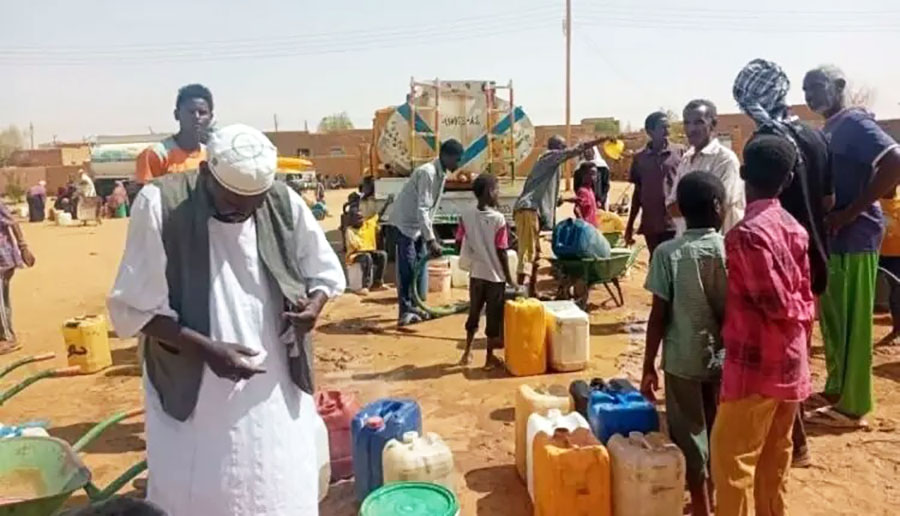
What is happening in Khartoum is not merely a temporary technical malfunction that can be fixed at the push of a button. It is the direct result of a cascading collapse in infrastructure. Continuous power outages have paralyzed pumping stations, fuel shortages have disabled backup generators, and the absence of maintenance has caused already fragile networks to crumble under pressure.
As a result, access to water has shifted from being a public service to a daily struggle for survival. Women and children stand for hours at the few available distribution points, others resort to untreated groundwater wells, while many cannot afford to buy water at all and are forced to ration drinking and washing to dangerous levels.
The crisis reached a peak in Omdurman on Monday, when students were sent home from schools due to water shortages. Educational institutions closing their doors because the most basic condition for human survival is unavailable sends a devastating message to the next generation: that the state is absent, and that education itself can be halted by the lack of a barrel of water.
Public anger is increasingly directed at the absence of urgent intervention. Residents are not demanding miracles; they are demanding basic necessities that cannot be delayed. Responsibility, they say, is not about sitting in air-conditioned offices, but about ensuring water reaches homes, medical treatment is available, and electricity lights people’s houses.
Residents of Umbadda remind officials that the city is not far away, and that people’s need for water cannot wait for committees to be formed or meetings to be held.
Although returning to Khartoum was a courageous decision for many after months of displacement, it is now turning into a new ordeal unless the water crisis is addressed immediately. The contradiction cuts deep and exposes the scale of the tragedy: how can a city located at the confluence of the two Niles suffer from thirst?
The answer lies not in the absence of water sources — the river flows before everyone’s eyes — but in the absence of management, operation, and maintenance. The war destroyed what remained of an already deteriorating infrastructure, while power outages severed the lifeline of pumping stations, turning the Nile into a beautiful view that quenches no one’s thirst.
Without functioning stations, the river is worthless. Without fuel, generators cannot run. And without urgent decisions, citizens will continue paying the price of institutional failure with their health and their money. This thirst crisis is not natural; it is manufactured through neglect and the collapse of operations.
Hassan Ali, a resident of Block 72 in Omdurman, believes the solutions require neither invention nor lengthy conferences. According to him, the first and most urgent step is to provide the fuel needed to operate backup generators at water stations and to maintain them immediately to ensure stable pumping.
The second step, he says, is securing stable electricity supplies for vital facilities, even if this requires assigning emergency power lines exempt from general outages. The third step is urgent humanitarian intervention to distribute water by tankers in the most affected neighborhoods at symbolic prices or free of charge, in order to break the monopoly of the parallel market exploiting people’s desperation.
Without these measures, the thirst crisis could escalate from a daily hardship into a full-scale health and humanitarian disaster, especially with the approach of summer and rising temperatures, when the loss of water increasingly means the loss of life.
