Updated: 16 May 2026 20:25:41

United Nations Welcomes Additional 1.8 Billion in U.S. Funding for Humanitarian Operations
moatinoon
The United Nations has welcomed the United States’ announcement of an additional 1.8 billion in funding for humanitarian operations worldwide, describing the move as a major step toward delivering life-saving assistance to millions affected by worsening humanitarian crises, according to a UN statement issued last Thursday.
UN Secretary-General António Guterres said the new U.S. commitment would enable humanitarian workers to reach millions of people in need amid some of the world’s most urgent crises.
For his part, UN Under-Secretary-General for Humanitarian Affairs and Emergency Relief Coordinator Tom Fletcher also welcomed the U.S. announcement, noting that the 2 billion funding package announced by Washington last December came at a critical moment when many humanitarian operations were at risk of shutting down.
With the new contribution, total U.S. support for reform initiatives, coordinated humanitarian efforts, and life-saving assistance implemented by the UN Office for the Coordination of Humanitarian Affairs (OCHA) has now reached 3.8 billion across 21 key countries, including Bangladesh, Myanmar, the Central African Republic, Chad, Colombia, the Democratic Republic of the Congo, El Salvador, Ethiopia, Guatemala, Haiti, Honduras, Kenya, Lebanon, Mozambique, Nigeria, South Sudan, Sudan, Syria, Uganda, Ukraine, and Venezuela, in addition to the UN Central Emergency Response Fund, according to a statement issued by the U.S. State Department.
The State Department said the funding builds “on the tremendous success of the landmark framework agreement reached by the Trump Administration in December 2025 on ‘resetting the humanitarian system’ between the United States and the United Nations Office for the Coordination of Humanitarian Affairs.”
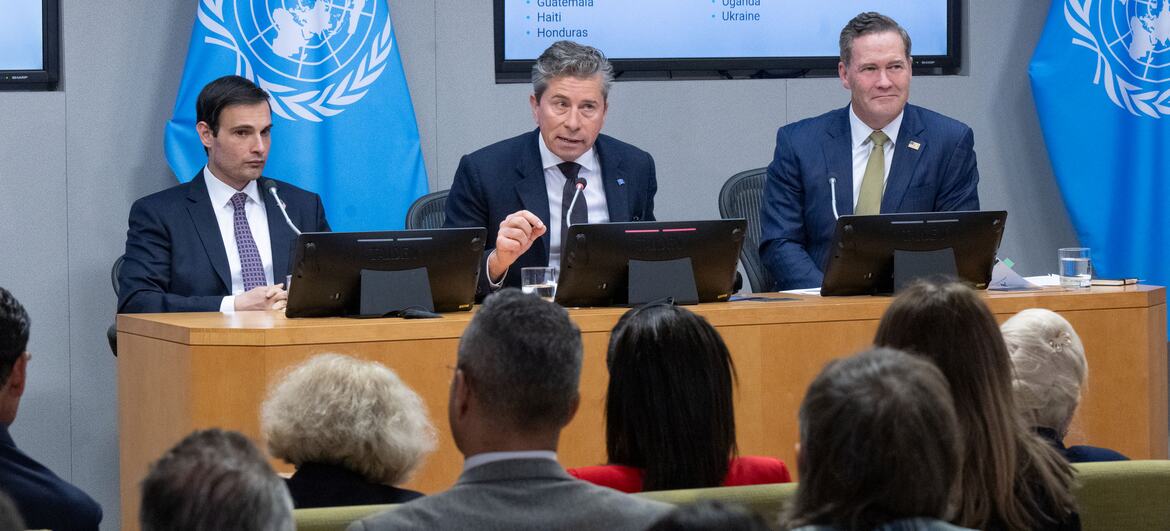
Speaking at a joint press conference at UN headquarters, Fletcher explained that the United Nations had moved quickly to allocate 1.68 billion to support humanitarian operations guided by the principles of neutrality and needs-based assistance across 18 different crises, with the goal of reaching more than 22 million people with life-saving aid.
He added that more than 90 percent of the funding is directed toward people living under the harshest humanitarian conditions, in line with the UN plan aimed at assisting 87 million people this year.
Fletcher stressed that humanitarian workers are facing mounting pressure due to funding shortages and increasing attacks, but emphasized that humanitarian organizations continue to deliver tangible results despite extremely difficult circumstances. He said the new funding would help accelerate and expand humanitarian responses and save millions of lives.
During the same press conference, U.S. Ambassador to the United Nations Mike Waltz said the new funding would not only help save lives but would also contribute to advancing reforms within the UN system to ensure greater efficiency, accountability, and sustainable impact.
Waltz noted that the United States remains the world’s largest humanitarian donor, both through government funding and private-sector contributions, adding that Washington is seeking to address what he described as “bureaucratic inflation” that often undermines the effectiveness of the United Nations’ mission.
He also rejected claims that the United States had abandoned its humanitarian responsibilities, stressing the importance of ensuring that a larger share of every dollar reaches people in need directly.
Meanwhile, Jeremy Lewin, Acting U.S. Assistant Secretary of State for Foreign Assistance, Humanitarian Affairs, and Religious Freedom, said Washington had carefully selected the countries and regions receiving the funding to ensure alignment with U.S. interests.
He added that every dollar of American taxpayer money should be spent in a way that serves the national interests of the United States, noting that some regions where U.S. interests overlap with humanitarian priorities would receive funding, while other areas could rely on support from other international donors.