
Updated: 17 December 2025 09:50:55
Achievements Lighting the Way for Sudanese in a Time of War
Moatinoon
Since the outbreak of war in Sudan on 15 April 2023, the country has seemed to slide into near-total darkness: a collapsed state, paralyzed institutions, and unprecedented displacement. Yet this bleak reality has not prevented Sudanese individuals and organizations from making a notable mark on international platforms, achieving successes in cinema, literature, the arts, sports, and humanitarian action. Together, these achievements form a parallel narrative to the war—one defined by resilience and creativity.
Cinema as a Tool of Resistance
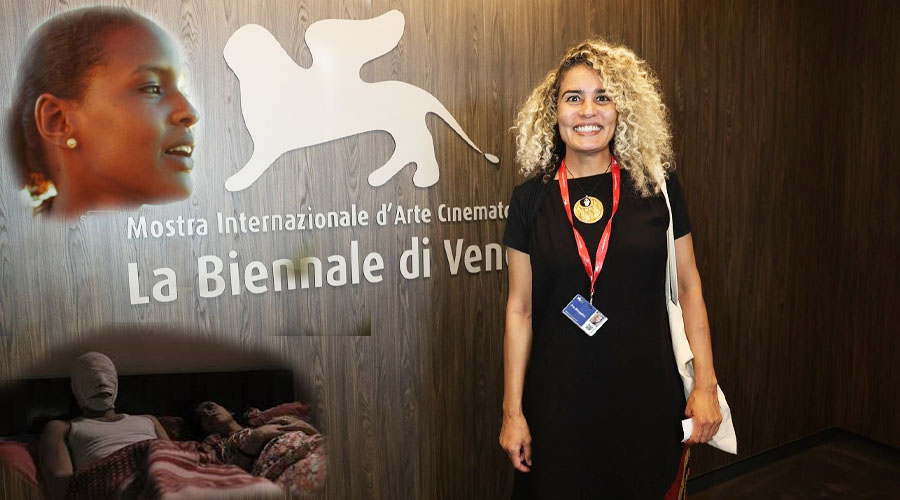
During the war, Sudanese cinema emerged as one of the most visible cultural fields globally. The film Goodbye Julia marked a turning point, not only through its screening at the Cannes Film Festival but also through its selection as Sudan’s official submission for the Academy Awards. This came at a time when cinemas inside Sudan were closed and most of the film’s creators were living in exile.
The film presented a profound Sudanese story about guilt, identity, and memory, far removed from propaganda or rapid news narratives. In doing so, it helped redefine Sudan in the global cinematic imagination—from a country of war to a country of complex human stories.
This presence was further reinforced when Cotton Queen, directed by Suzannah Mirghani, won the Golden Alexander Award for Best Feature Film at the Thessaloniki International Film Festival in 2025. This prestigious prize affirmed Sudanese cinema’s place within the global cinematic landscape, not as a fleeting exception but as a recognized contributor.
During the ongoing war, Sudanese filmmakers also produced Sudan, Remember Us, a documentary about the December Revolution, as well as Khartoum, which documents the lives of five Khartoum residents forced to flee following the outbreak of the civil war in April 2023.
Literature and the World’s Conscience
In literature, Sudanese–Scottish writer Leila Aboulela was awarded the 2025 PEN Pinter Prize, one of the most prestigious honors given to writers who combine literary excellence with humanitarian commitment.
The award carried particular significance in the context of the war, once again drawing attention to Sudanese literature written in English as a form of cross-border writing—capable of engaging a global readership from an ethical and human standpoint, not merely from the position of victimhood.
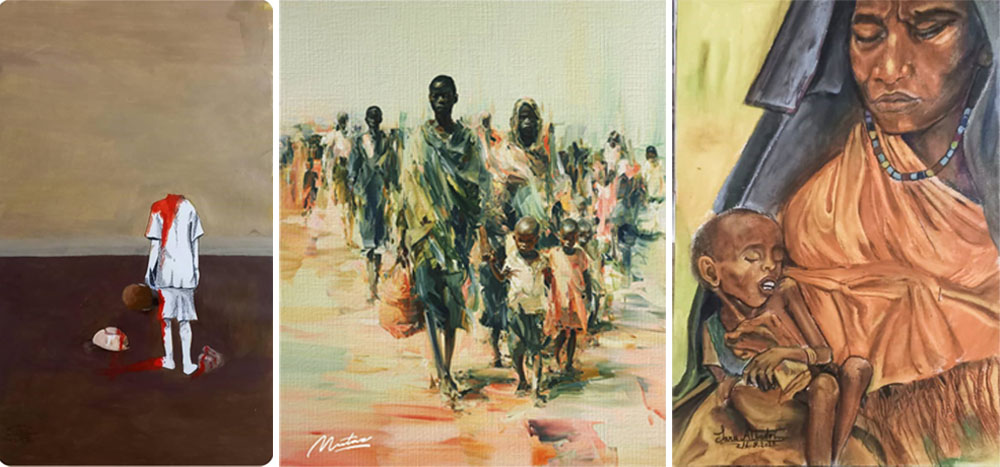
Visual Arts as an Archive of War
Visual arts have also remained present. Sudanese artists have participated in European and international exhibitions addressing war, memory, and displacement. Artist Moataz Mukhtar received recognition and nominations in global art competitions, including the Luxembourg Art Prize.
Although some of these participations did not culminate in major awards, their value lies in transforming Sudanese art into an unofficial visual archive of the war—recording what political reports and official statements often fail to capture.
Numerous exhibitions in Europe, the United States, and the United Kingdom have showcased Sudanese art. The Petrie Museum in London hosted Sudan Living Cultures from 26 October to 9 November 2024, a digital exhibition featuring works by Sudanese artists (Ahmed Akasha, Dina Nour Satti, and Yasmin Al-Nour) inspired by Sudanese heritage and the museum’s collections, reconnecting ancient artifacts with contemporary artistic memory.
Another exhibition, A Visual Art Narrative (6 June–13 July 2025), traced the history of Sudanese art through works by artists from two generations, surveying the evolution of the artistic movement from the early twentieth century to the present day.
Sudan was also prominently represented in the exhibition Africa & Byzantium at The Metropolitan Museum of Art in New York.
Sports in a Time of Collapse
In sports, despite the near-total collapse of Sudan’s domestic sports infrastructure, Sudanese athletes participated in the Paris 2024 Olympic Games, particularly in swimming and athletics. Although results were modest, the participation carried strong symbolic value, maintaining Sudan’s presence at one of the world’s largest sporting events.
In 2025, Sudanese swimmers achieved advanced results and won medals in regional and African championships—accomplishments largely driven by individual effort and external support rather than state institutions.
In football, although the Sudanese national team did not qualify for the finals, it nevertheless achieved a vibrant presence in which the voice of peace overshadowed the sound of war raging in the country.
Badran Al-Batal, advisor to the Sudanese Football Association, told OkayAfrica: “The recent success achieved by the Sudanese national team in the World Cup qualifiers was a great source of inspiration. At a time when our people are facing immense suffering and displacement, football managed to do what politics could not—silencing the sound of war, if only for ninety minutes.”
Emergency Rooms: A National Pride
Among the most significant achievements during the war was the Sudanese Emergency Rooms Network winning the 2025 Right Livelihood Award, a prestigious international prize honoring initiatives for change and humanitarian action. The award recognized the network’s role in saving lives and providing essential services amid bombardment and state collapse.
Previously, the network received the 2025 Chatham House Prize, the 2025 Rafto Prize, the 2025 Richard C. Holbrooke Award for International Advocacy, and the 2025 European Union Human Rights Award.
It was also nominated three times for the Nobel Peace Prize over two years (2024–2025) by the Peace Research Institute Oslo. In addition, the AidEx platform nominated Al-Sanousi Adam, External Communications Coordinator of Sudan’s Emergency Rooms, for the “Humanitarian Hero of the Year Award 2025.”
The Aurora Prize for Awakening Humanity was also awarded to Sudanese doctor Jamal Al-Tayeb, who continued working inside Khartoum under extremely dangerous conditions, in global recognition of individual civilian heroism in the face of war.
Beyond the Achievements
Despite their limited number, these successes reveal a profound shift in Sudan’s external image. Rather than being seen solely as a humanitarian case file or a battleground, Sudan is increasingly recognized as a country that produces art, meaning, and achievement—even in its darkest moments.
