
Updated: 30 October 2026 00:07:28
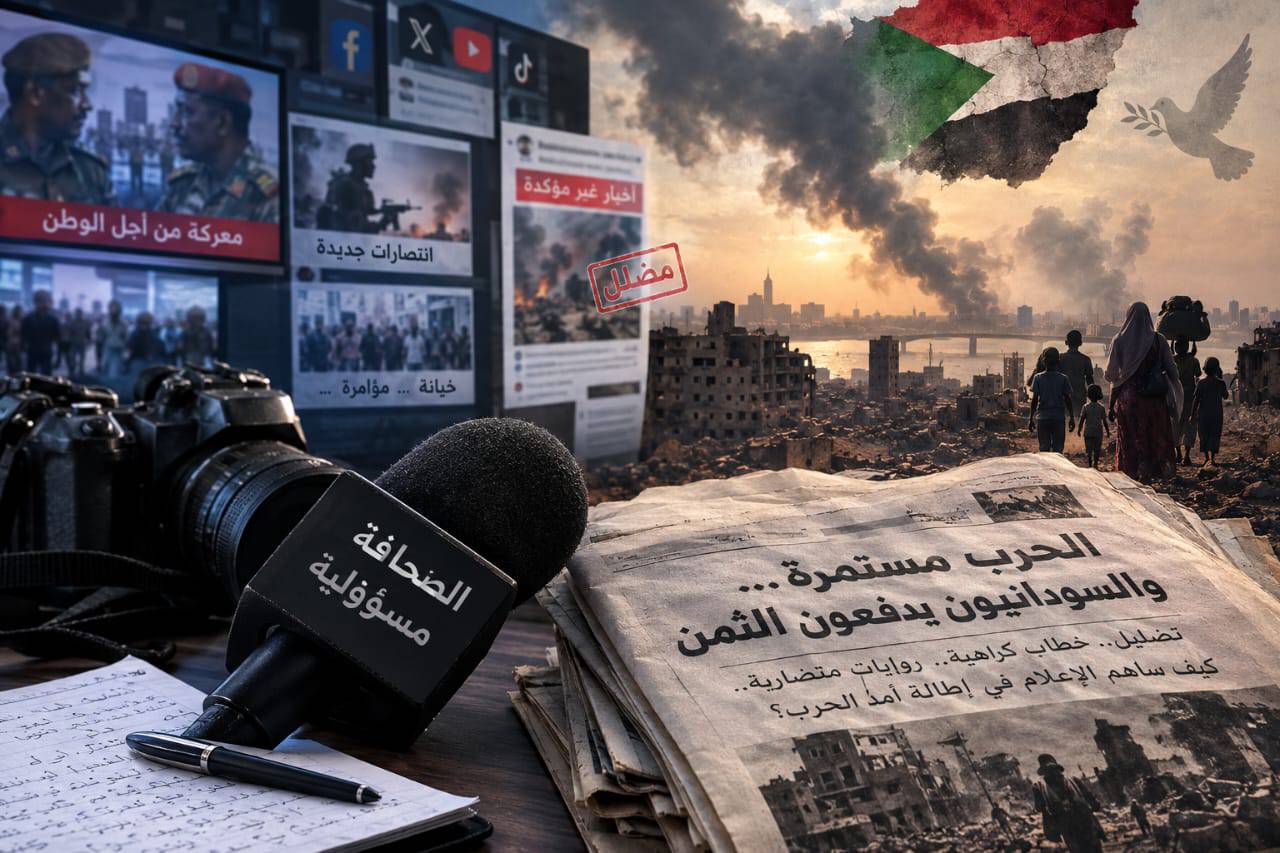
How Has Sudanese Journalism Contributed to Prolonging the War?
Sudanese journalism has not merely been a witness to the war that erupted on 15 April 2023. Some of its institutions and platforms have, to varying degrees, become part of the political and media environment that has contributed to prolonging the conflict, deepening polarisation and weakening prospects for peace.
Yet discussing the medias responsibility does not mean holding journalists alone accountable for the war or overlooking the conditions in which they work. Sudans war erupted from a complex political and military struggle, and media institutions themselves have suffered from the collapse of security, attacks, displacement, censorship and the loss of resources. These circumstances, however, do not remove the need to scrutinise the role of media discourse in perpetuating the war.
The war has exposed a profound crisis within Sudanese journalism, revealing the fragility of media institutions independence in the face of political and military centres of power, and their diminishing ability to perform their watchdog role at a time when Sudanese society needed independent information and objective analysis more than ever.
From Reporting the News to Military Mobilisation
From the earliest days of the war, Sudans media landscape became divided between platforms adopting the armys narrative and others leaning towards that of the Rapid Support Forces (RSF), while a limited number of institutions attempted to maintain professional distance from both sides.
This division extended beyond news reporting to the interpretation of the war itself. Some outlets portrayed the conflict as an existential battle between good and evil, a confrontation between patriotism and treason, or a war against a foreign conspiracy.
Such discourse narrowed the space for discussing the political causes of the war, the responsibility of the military parties and the interests of those who benefit from its continuation. When a media institution becomes an extension of a military narrative, it loses the ability to hold the side whose discourse it adopts to account, and news becomes part of a struggle to control public consciousness.
In this way, some media institutions helped turn military victories into a benchmark for assessing the countrys future, while political initiatives were treated as attempts to weaken one side or allow its opponent to regain strength.
This pattern of coverage goes beyond providing information. It has helped shape public sentiment and conferred social legitimacy on the war beyond its military dimensions. When military victory becomes the only acceptable path to ending the conflict, opportunities to consider a political settlement diminish, and calls for an end to the fighting become increasingly marginalised.
Hate Speech, Disinformation and the Marginalisation of Victims
Some media platforms have contributed to reproducing hate speech, particularly through the use of tribal, regional and ethnic affiliations to explain the conflict.
In some cases, such discourse went beyond describing individual or military violations to holding entire social groups responsible for the actions of armed factions. This is where the danger of the media lies: a crime committed by individuals or military formations becomes a collective accusation directed at an entire identity group.
Such discourse does not merely justify violence. It creates a social environment in which revenge becomes acceptable and the prospects for coexistence are reduced to a single political or military position.
Social media platforms, which have become an integral part of Sudans journalistic landscape, have accelerated the spread of such rhetoric, particularly amid the absence of independent verification of circulating images, videos and claims.
The war has also become fertile ground for disinformation through the publication of incomplete reports, the exaggeration of military victories, the circulation of old footage as new events and the use of images of victims to advance political accusations.
The problem is that some media institutions have republished such material without adequately verifying its sources or providing the context necessary to understand the circumstances in which events occurred.
As misleading information is repeatedly circulated, public confidence in journalism as an independent source of knowledge declines, and audiences become more inclined to believe narratives that align with their political or social positions.
At the same time, some journalistic coverage has focused on troop movements, control of cities, military operations and political statements, while paying less attention to the social and humanitarian consequences of the war.
In much of this coverage, the Sudanese citizen has become a figure in displacement statistics, a fleeting image in a report on shelling, or a witness to a military advance. But war is not merely a matter of territory changing hands. It is also the collapse of everyday life, the destruction of institutions, the loss of security and the breakdown of social relationships.
Neglecting these dimensions contributes to the normalisation of war, making its continuation appear routine while questions concerning the fate, rights and protection of civilians recede from public attention.
Undermining Independent Journalism and Closing the Door to Peace
The war has not merely tested the discourse of Sudanese journalism; it has also brought widespread destruction to the countrys media infrastructure. Journalists have been killed, arrested and threatened, media institutions have closed, newsrooms have lost the basic resources needed to operate, and many journalists have been forced to flee the country or relocate to safer areas.
Political polarisation has further restricted the space for independent journalism, exposing journalists to pressure from different sides.
Under these circumstances, access to information has become more difficult, while the capacity to conduct independent investigations, scrutinise military claims and document violations has diminished.
The weakening of independent journalism does not serve only one military party. Rather, it creates an environment in which all parties can evade accountability.
Within this context, hardline media rhetoric has helped portray the war as a battle that can end only through a complete military victory.
In some outlets, political initiatives, mediation efforts and calls for a ceasefire have been treated as concessions or conspiracies, without examining their merits or the conditions necessary for their success.
Such discourse undermines prospects for negotiation and reinforces the belief that peace can only be achieved after the defeat of the opposing side. The repeated use of language invoking vengeance and revenge, alongside accusations of treason against those calling for an end to the war, further closes public space to consideration of political solutions.
Responsibility, however, is not equal. There is a difference between a journalist working under the threat of armed violence, a media institution systematically adopting a military narrative, and a platform deliberately spreading misleading information to advance political objectives.
Journalists who have documented violations, exposed war crimes, presented victims testimonies and sought to protect civilians have been part of the resistance to war, not its continuation.
Professional accountability must therefore distinguish between independent journalism, politically directed journalism, military propaganda and digital content masquerading as news. Scrutiny of the media must not become another means of restricting freedom of expression or punishing journalists for their political views.
Restoring journalisms professional role begins with breaking media institutions ties to centres of military power, strengthening independent verification, holding hate speech to account and restoring victims to their rightful place as people with rights, rather than mere figures in news bulletins.
Journalism does not end a war simply by declaring opposition to it. It does so by resisting the media practices that allow war to continue: disinformation, incitement, accusations of treason, the normalisation of violence and the closing of space for peace.
In Sudan, the struggle to restore journalism goes beyond reopening institutions that have ceased operating. It also involves reclaiming their independence from the parties to the war and rebuilding trust between the media and society, so that the medias record of the war does not become an extension of the armed struggle.
