
Updated: 24 October 2026 14:59:42
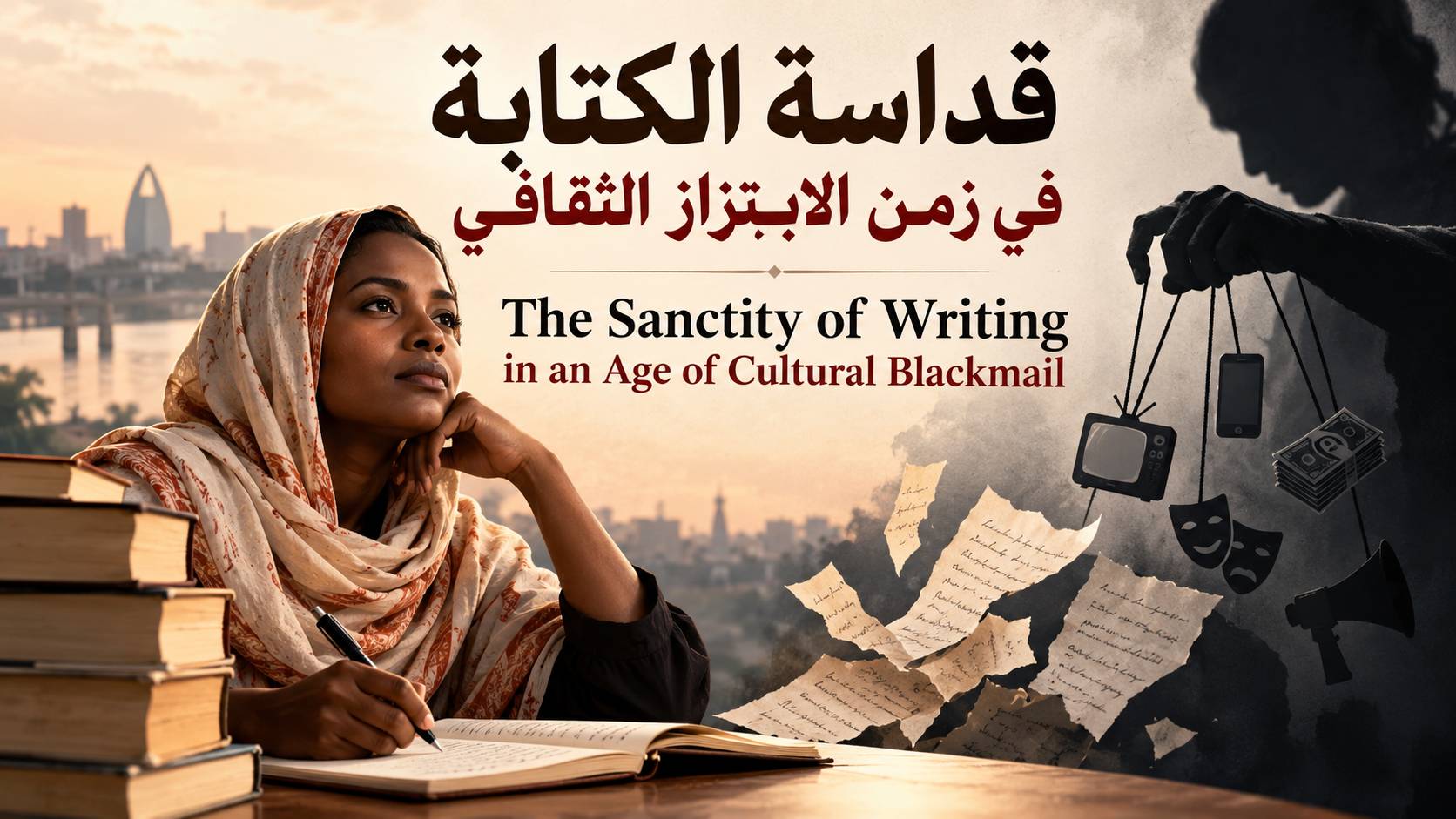
The Sanctity of Writing in an Age of Cultural Blackmail
War, in one of its most dangerous manifestations, is a test of meaning. When cities are thrown into turmoil, memory begins to fracture, and fear becomes part of the daily order of life, language itself turns into a battleground. Words that once seemed harmless in times of peace suddenly become laden with accusation. Bearing witness becomes an act of taking sides, silence is interpreted as complicity, and speaking out, in certain circumstances, becomes a risk whose limits the writer cannot foresee.
In such a climate, serious writing faces a test that goes beyond literary craftsmanship to the very essence of conscience. Writers do not write in a vacuum, nor do they exist outside their time. Yet their immersion in a troubled age gives no one the right to confiscate their freedom. Writing worthy of the name is writing that maintains a critical distance from all sides, resisting the temptation to become a political pamphlet, a mobilisation statement, or a testimony designed in advance to satisfy a particular audience.
War, by its very nature, has little tolerance for grey areas. It prefers a world divided into two camps, facts arranged in clearly defined ranks, and consciences ready to condemn or absolve.
Genuine literature, by contrast, often inhabits the territory that propaganda fears. It dwells in the realm of questions, reconstructs human experience from its fragments, leaves the reader free to doubt, gives victims a voice without turning them into symbols of propaganda, and regards the perpetrator as a human being responsible for his actions rather than a cartoonish figure that makes hatred easier.
This is where the ordeal of the independent writer begins. When independent institutions retreat and the language of polarisation advances, freedom itself becomes a burden for those who possess it. Pressure does not necessarily take the form of an explicit command. Sometimes it is enough for a writer to know that a particular text will close a door, that a single sentence may cost a publishing opportunity, or that a critical position could deprive them of an invitation, a translation, or a place in the cultural sphere. Thus emerges a more dangerous form of censorship: over time, writers learn to anticipate punishment and remove sentences before anyone asks them to do so.
This is one of the most subtle and dangerous mechanisms of cultural blackmail. No one tells the writer, "Change your position." Instead, they may be told, "Make the text more accessible." They may be asked to soften the tone, rearrange the facts, avoid a sensitive subject, modify a character, or remove a passage that "might be misunderstood." On the surface, this appears to be an exercise in literary editing. Yet the distinction between editing and domestication rests on a simple question: does the intervention help the text become more truthful and beautiful, or does it make it more accommodating to the network of interests surrounding it?
In the publishing industry, this dilemma takes on even more complex forms. A book no longer necessarily exists within a direct relationship between author and reader. There is the publisher, the editor, the agent, the platform, the promotional campaign, the media, literary festivals, funding institutions, and distribution networks. Each link in this chain may be necessary for a book to reach its readers, but together they can create an invisible authority over the text.
When writers begin their work with the expectations of the market, the requirements of platforms, the prospects of literary prizes, and the mood of the audience already in mind, they risk turning creativity into a prolonged negotiation with parties who have not yet read the first page.
The literary prize industry presents an even more ambiguous landscape. At its heart, a prize promises recognition of literary merit, an acknowledgement that a particular work has contributed something meaningful to human experience. Yet some contemporary prize systems have evolved into fully developed industries of reputation-making.
In this environment, the book itself is no longer the sole focus. It is surrounded by publicity campaigns, interviews, photographs, media platforms, public relations operations, and translation and distribution networks. In some cases, the prize itself becomes part of a broader marketing strategy, blurring the boundary between literary judgement and the careful engineering of visibility.
The danger does not lie in promoting books. Literature needs readers, and readers need channels through which they can discover books. The danger begins when publicity replaces literary value and celebration becomes a mechanism for manufacturing artificial consensus.
Under such circumstances, an average book may dominate the cultural landscape, while a profound work remains in the shadows because it lacks an institution capable of bringing it to public attention, has not entered the appropriate network, or because its author has not mastered the game of cultural connections.
More cruelly still, writers may find themselves compelled to participate in this game simply to survive. Hunger does not produce independence, and material need can drive people to accept conditions they would reject under different circumstances.
For this reason, discussions of writers freedom must not descend into abstract moral preaching. Creative independence requires a cultural environment in which writers can publish, work, and participate without having their livelihoods depend on their willingness to be moulded to fit others expectations.
In wartime, this question becomes particularly sensitive. Every cultural institution can, intentionally or otherwise, become part of a narrative machinery larger than itself. Every platform may select what suits its image. Every literary prize may help consolidate a particular narrative. Every media campaign may attach to a literary event a meaning that extends far beyond the text itself.
Against this backdrop, writers bear a delicate responsibility: to recognise that they are not raw material for someone elses propaganda project, and that their experiences do not belong to those who provide them with a platform.
Serious writing demands a dual resistance: resistance to political authority that seeks to subordinate it, and resistance to the market that seeks to domesticate it. In both cases, courage alone is insufficient.
Writers need a critical awareness that enables them to recognise traps before falling into them, an understanding of the rules governing the cultural sphere, and the ability to distinguish genuine support from transactions disguised as celebration.
This struggle may seem insignificant against the vast devastation of war. Yet culture begins with details that appear insignificant. When a word is distorted, a testimony is suppressed, a text is pushed into the spotlight because it serves a particular image, or another is excluded because it challenges that image, something happens that reaches far beyond the fate of a single book.
Gradually, a selective and biased collective memory takes shape, rearranging what deserves to be preserved and what should be forgotten.
The sanctity of writing, therefore, does not mean treating the text itself as something sacred and untouchable. Rather, it lies in the sanctity of the freedom from which writing derives its legitimacy.
Serious writing is open to criticism, revision, and rejection. What must never become negotiable is the writers right to express what they believe to be true, to take responsibility for what they have written, and to do so without allowing their need for publication or recognition to become a back door through which their voice can be confiscated.
In the end, what survives an age of war is not what propaganda says about itself, but what human memory can preserve of truthful testimony.
Literary prizes may fade from memory. The geography of publishing may change. The lights of platforms that manufactured so many reputations may eventually go dark.
But a text that resisted temptation, rejected blackmail, and preserved the independence of language may find its readers years later, when the noise has subsided and the question becomes more severe:
Who wrote about what happened because they sought the truth, and who wrote because someone was waiting for them to tell a particular story?
Only at that moment does writing reclaim its sanctity.
Not because it triumphed in the marketplace, won a prize, or became the subject of widespread attention, but because it managed to survive the war without carrying the war within itself.
