
Updated: 23 October 2026 17:56:03
“Ajar Memory”: One Year Since the Fall of El Fasher and the Scars of Genocide
Moatinoon
One year after El Fasher, the capital of North Darfur State, fell to the Rapid Support Forces (RSF), the city is returning to public attention through art and remembrance. The initiative seeks to revisit the final days of the siege, document the testimonies of survivors and victims, and keep alive the memory of one of the bloodiest chapters of Sudan’s war.
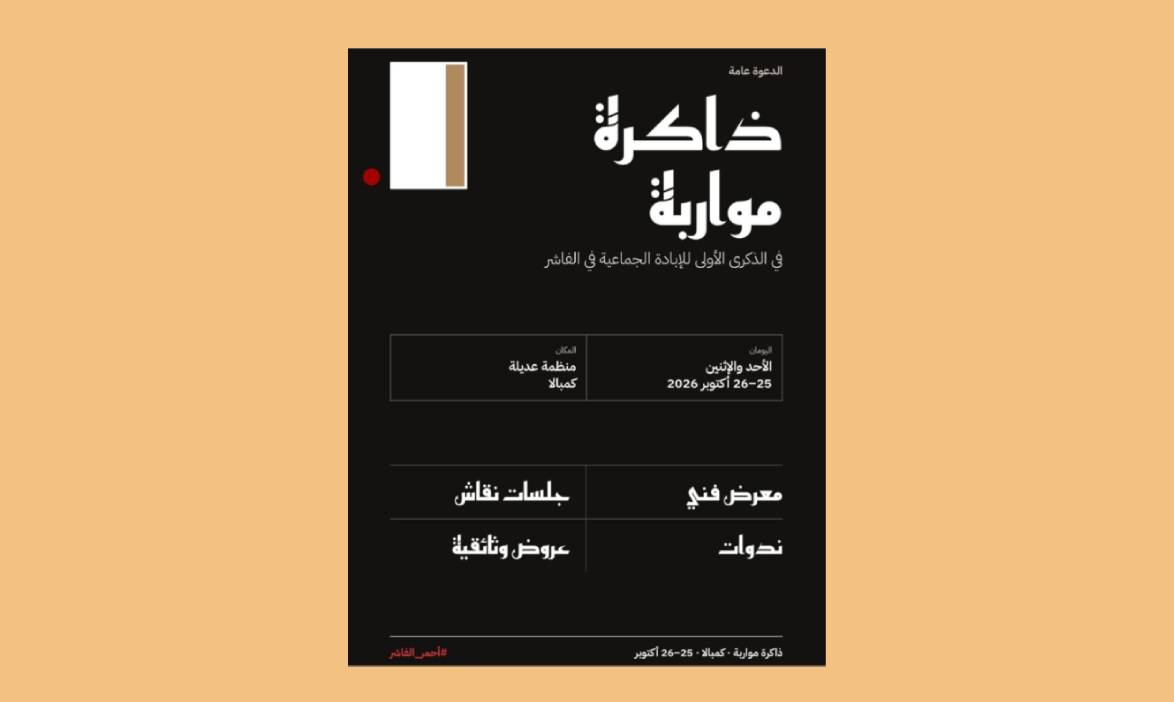
On Sunday and Monday, 25–26 October 2026, Adeela Organisation in Kampala, Uganda, will host an exhibition titled “Ajar Memory,” organised by the El Fasher Genocide Remembrance and Commemoration Initiative, a collective of Sudanese journalists, activists, and artists based in Uganda.
The programme combines an art exhibition, panel discussions, seminars, and documentary screenings. The event aims to commemorate the victims and create space for reflection on what happened in a city that became one of Sudan’s most significant centres of humanitarian suffering and military confrontation.
A City Under Siege
Before its fall, El Fasher endured more than 18 months of a devastating siege imposed by the RSF and its allies, while the Sudanese Armed Forces (SAF) and allied armed movements maintained control of the city.
United Nations documentation indicates that the siege effectively began in May 2024 and was accompanied by artillery bombardment, drone attacks, and repeated attempts to penetrate the city. These operations contributed to a severe deterioration in humanitarian conditions, restricted access to food, medicine, and relief supplies, and increased displacement.
Before the war, El Fasher had a population of more than one million and hosted hundreds of thousands of displaced people, particularly in the Abu Shouk, Al Salam, and Zamzam camps. As fighting spread across Darfur, the city became a refuge for thousands fleeing other areas, only to find themselves trapped by another siege.
In the months leading up to its fall, food shortages became increasingly severe. The blockade severely restricted civilian movement and the delivery of essential supplies, while markets, medical facilities, and residential neighbourhoods came under bombardment.
Humanitarian conditions reached catastrophic levels, with human rights organisations reporting that some residents were forced to eat animal feed because of the scarcity of food.
The Final Assault
On the night of 24 October 2025, the RSF launched its final assault on the besieged city, following months of fighting, bombardment, and attempts to encircle it.
By 26 October, RSF forces had seized key military positions, including the headquarters of the Sixth Infantry Division. Independent investigators documented footage showing the detention of civilians and people attempting to flee, as well as killings in different parts of the city and its surroundings.
The RSF announced that it had taken control of El Fasher. Subsequent reports described tens of thousands of residents fleeing towards safer areas, particularly Tawila and other parts of North Darfur.
But the fall of the city did not mark the end of the suffering. Instead, it ushered in a new phase of violations.
Days of Killing and Flight
In a report published in February 2026, the Office of the United Nations High Commissioner for Human Rights (OHCHR) stated that the final assault on El Fasher involved widespread violations amounting to war crimes, with some acts potentially constituting crimes against humanity.
According to the report, more than 6,000 people were killed during the first three days of the assault, including at least 4,400 inside El Fasher and more than 1,600 along escape routes from the city. The United Nations cautioned that the actual death toll during the week of the assault could have been considerably higher.
The report described mass killings, summary executions, sexual violence, abductions, torture, arbitrary detention, looting, enforced disappearances, and the use of children in hostilities.
The United Nations also documented attacks against civilians based on their ethnicity or suspected affiliation with, or sympathy for, the Sudanese Armed Forces and allied armed movements.
Among the incidents documented by the UN was the killing of approximately 500 people near Al Rashid student residence at the University of El Fasher on 26 October, after gunmen opened fire on civilians sheltering at the location.
Investigators also recorded testimony concerning the execution of men and boys, particularly members of non-Arab ethnic communities, as well as widespread sexual assaults.
In the days that followed, further reports emerged of civilians being killed inside the city and while attempting to escape. The United Nations said hundreds of people had been detained and thousands remained missing.
Warnings Before the Catastrophe
The fall of El Fasher and the atrocities that followed did not come as a surprise to international observers.
On 2 October 2025, just weeks before the final assault, the UN human rights office warned of the risk of large-scale ethnically motivated attacks. It noted that the city had already endured more than 500 days of siege and sustained fighting.
In November, the United Nations Human Rights Council called for an urgent investigation into violations committed in and around El Fasher, citing reports of ethnically motivated killings, summary executions, torture, and widespread sexual violence.
In February 2026, the United Nations concluded that the scale and nature of the violations committed during the final assault pointed to an organised and sustained pattern.
It linked the events in El Fasher to violations previously documented elsewhere in Darfur, including El Geneina, Ardamata, and Zamzam camp.
Memory Against Oblivion
One year later, the “Ajar Memory” exhibition is more than an artistic event. It is an attempt to reclaim the memory of a city that witnessed one of the most brutal episodes of Sudan’s war.
Through artworks, discussions, and documentary screenings, the organisers seek to create space for victims and survivors to recount what happened beyond the abstraction of statistics, connecting individual memories with the collective documentation of events.
As the exhibition’s title suggests, memory may remain only partially open, burdened by trauma, but it does not disappear.
Behind the figures of the dead, displaced, and missing lie the stories of families torn apart, homes emptied of their inhabitants, and survivors carrying testimonies of the days of siege, escape, and killing.
The event welcomes members of the Sudanese community in Uganda, including journalists, students, activists, and civil society organisations, alongside Ugandan and international guests, to participate in preserving and revisiting this memory.
For El Fasher, the fall was not merely the collapse of a military stronghold. It was a catastrophe for hundreds of thousands of civilians, marking one of the most tragic episodes of Sudan’s war.
A year later, questions remain unanswered about the fate of the missing, accountability for those responsible for the violations, and whether remembrance can become the beginning of a path towards justice rather than simply another record of the war’s victims.
The “Ajar Memory” exhibition will take place on Sunday and Monday, 25–26 October 2026, from 10:00 a.m. to 6:00 p.m., at Adeela Organisation in Kampala, Uganda.
