
Updated: 22 October 2026 16:37:35
Darfur: Hunger Has Shifted from a Seasonal Disaster to a War-Driven Crisis
Moatinoon
In Darfur, hunger is no longer a crisis associated with a passing drought season. It has become part of a long history of overlapping shocks in which climate, poverty, conflict, displacement and the destruction of livelihoods have reinforced one another. More than four decades after one of the region’s worst famines, the risk of famine has returned amid Sudan’s ongoing war, as millions of civilians face shrinking humanitarian assistance and a declining ability to secure food.
Historical studies indicate that Darfur experienced major food crises long before the current war began. Local communities endured famines in 1972 and 1973, followed by a more severe crisis between 1982 and 1984, associated with prolonged drought and declining agricultural and pastoral production. Field studies documenting residents’ experiences describe these periods as among the most deeply embedded disasters in the region’s collective memory.
Insufficient rainfall alone, however, cannot explain the scale of the catastrophe. During the 1980s, drought coincided with livestock diseases, the depletion of household assets and increased displacement, causing extensive losses among farming and pastoral communities. Historical famine databases indicate that the 1984–1985 famine in Darfur and Kordofan caused hundreds of thousands of deaths, although historical estimates vary.
The experience of those years offers an important lesson: drought can trigger a crisis, but it cannot by itself explain how food shortages turn into famine. When households lose their livestock, crops and savings, any disruption to markets, security or humanitarian assistance makes them more vulnerable to hunger.
In subsequent years, Darfur continued to experience cycles of drought, flooding, pest outbreaks and local conflicts. With the outbreak of armed rebellion in 2003, the nature of the food crisis changed significantly. Conflict triggered widespread displacement, disrupted farming, pastoral activities and markets, and deprived households of income and productive assets. Access to land, markets and humanitarian assistance became decisive factors in determining people’s ability to obtain food.
The war that erupted in Sudan in April 2023 has once again intensified these pressures on a much wider scale. In North Darfur, fighting, displacement and restrictions on humanitarian movements have rapidly worsened food insecurity, particularly in displacement camps.
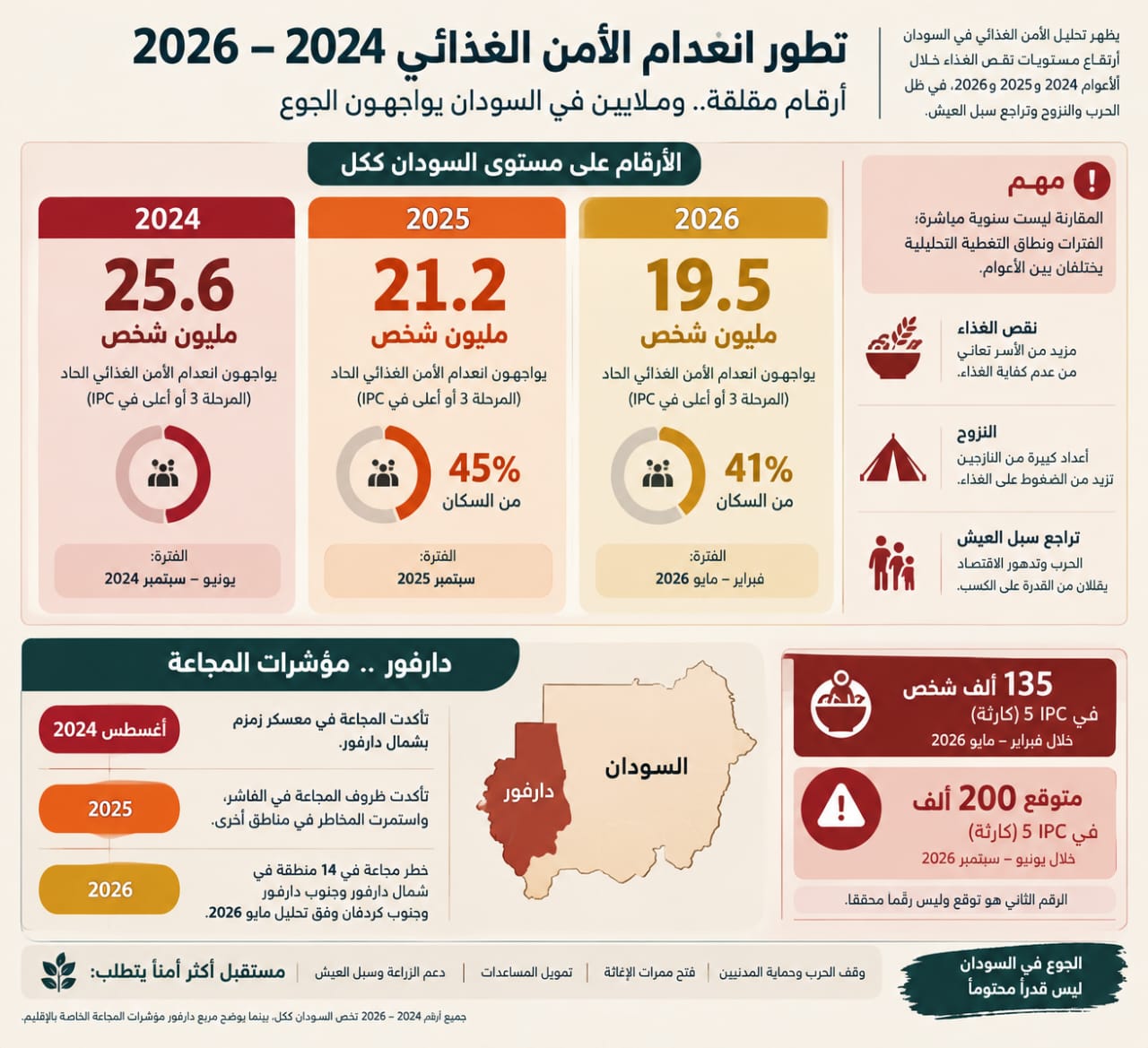
In August 2024, the Famine Review Committee of the Integrated Food Security Phase Classification (IPC) confirmed famine in Zamzam displacement camp in North Darfur, where more than 400,000 displaced people were estimated to be living, according to the World Food Programme. It was the first famine declaration in Sudan in years and one of the starkest indicators of the war’s humanitarian consequences.
By December 2024, the areas classified as experiencing famine had expanded to include Abu Shouk and Al Salam camps in North Darfur, alongside other areas of Sudan. United Nations agencies identified conflict, displacement and restricted humanitarian access as the main drivers of the crisis, while disrupted markets and soaring prices of essential goods left most households unable to afford adequate food.
In 2026, the risk of famine has not disappeared, despite changes in some classifications. The latest food security estimates indicate that around 19.5 million people in Sudan face high levels of acute food insecurity, while approximately 135,000 people are experiencing catastrophic conditions in several areas, including parts of Darfur. Fourteen areas in North and South Darfur and Kordofan also face a risk of famine if security conditions and access to food and essential services continue to deteriorate.
These developments come as the capacity to fund the humanitarian response is declining. For displaced people, reduced assistance can mean losing a crucial source of food, rather than simply receiving less support. In an environment where households have lost their land, livestock and income, cuts to food rations can force families to adopt desperate survival strategies, including reducing the number of meals they eat, selling their remaining possessions or withdrawing children from school.
Darfur’s history shows that famine becomes more deadly when shocks accumulate. Drought weakens production; war disrupts markets and agriculture; displacement depletes household assets; rising prices undermine people’s purchasing power; and funding shortages weaken the humanitarian safety net.
The risk of hunger in Darfur in 2026, therefore, cannot be understood solely as a climate crisis or attributed to a single cause. It is the culmination of decades of drought, poverty, displacement, conflict and the collapse of livelihoods, sharply exacerbated by the current war.
As fighting continues and humanitarian movements remain restricted in many areas, Darfur faces another test shaped by its history. Past famines demonstrated the cost of delayed action, while the current crisis underscores that famine prevention must begin before the formal threshold is reached. This requires ending the war, protecting civilians, opening humanitarian corridors, funding relief operations and rebuilding households’ ability to produce food and earn an income.
In a region that has experienced famine before, time may be the most decisive factor. The longer the response is delayed, the fewer options households have, and the wider the gap becomes between a food crisis that can still be contained and a humanitarian catastrophe that may be difficult to reverse.
