
Updated: 18 October 2026 11:54:03
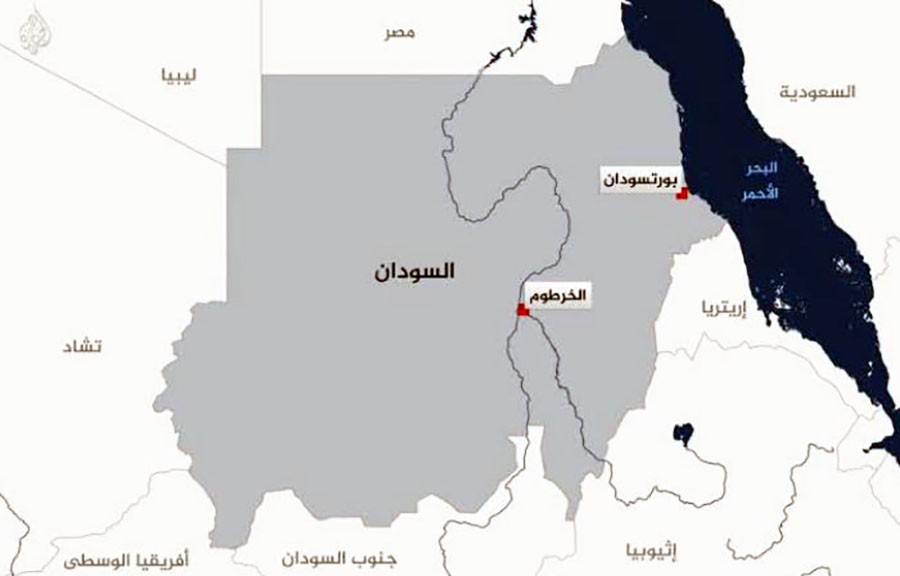
Sudan’s Borders and Its Neighbours, From Crisis to Integration
Ameer Babiker Abdallah
The catastrophe this month, in which Egyptian warplanes targeted Sudanese miners—claiming the lives of dozens of unarmed citizens—has brought the issue of Sudan’s borders with its neighbors to the fore. It has also ignited legitimate outrage among a broad segment of the Sudanese public, directed both at the Egyptian authorities—who did not deny the act—and at the Sudanese authorities, whose response to the incident lacked the urgency expected of a state that respects its own sovereignty.
Following the decision by the people of South Sudan to secede from the north in 2011, Sudan found itself bordered by seven neighboring countries. These political boundaries were drawn by colonial powers in accordance with their own geopolitical strategies and understandings for the post-colonial era. The peoples and tribes inhabiting these regions had no say in the matter, leaving Sudan as an open space for tribes that maintain deep-rooted connections across its borders with neighboring states.
This reality transcends the premise of the film *Al-Hudood* ("The Borders")—a brilliant work by Syrian artist Duraid Lahham, in which a man finds himself stranded in a "no-man’s-land" between "Westistan" and "Eastistan," lacking any identification papers. In the context of Sudan and its various borders, it is not uncommon to find one family member holding the nationality of one country, while a sibling holds the nationality of a neighboring state—or even for an individual to possess the citizenship of both. This reflects an attempt by borderland communities to circumvent the constraints imposed by colonial-era border demarcations—boundaries drawn without their input or consideration, effectively splitting these communities between two separate states. Since gaining independence and entering the era of national rule, Sudan and its neighbors have failed to develop a clear strategy for managing their shared borders. Consequently, these border regions—and the peoples inhabiting them—have been left vulnerable to the agendas, policies, and regional or international alignments of the ruling regimes. Borders have frequently served as conduits for the export of crises between Sudan and its neighbors. Over the past few decades, two primary approaches have emerged in dealing with these cross-border ethnic and tribal communities: one that exploits them to fuel conflict (by providing safe havens, recruitment, or arming opposition movements) and another that leverages them for constructive purposes (such as mediation, de-escalation, or economic exchange).
The Exploitative Use of Borders
The national regimes that have governed Sudan have often utilized their borders with neighboring states to incite instability—or even to attempt to topple the governments in those countries. The reverse has also been true, with many neighboring states employing their borders with Sudan toward similar ends.
When South Sudan gained independence in July 2011, the two sides did not abandon their "old tools of war." Instead, border-dwelling tribes—and the armed movements that emerged from them—became diplomatic and military bargaining chips between Khartoum and Juba.
Along the Sudanese-Chadian border, a series of events has transformed the frontier into a focal point of tension. Mutual interference and the support of armed opposition groups—aimed at overthrowing ruling regimes—have persisted since the 1960s; at various junctures, Sudan has effectively served as the "key" to regime change in Chad. The outbreak of conflict in the Darfur region in 2003 marked a historical peak in the use of "tribe" as a tool within the political and military struggle between the ruling regimes of Sudan and Chad. Chadian President Idriss Déby leveraged cross-border social and tribal ties, providing military, logistical, and training support to Sudanese armed movements in Darfur—most notably the Justice and Equality Movement (JEM), led by Dr. Khalil Ibrahim—capitalizing on their shared Zaghawa ethnic identity.
Along the border with the Central African Republic (CAR), which stretches for over 170 kilometers, the southwestern part of Darfur (specifically South Darfur State) connects to the northeastern regions of the CAR (the Vakaga Prefecture, with its capital, Birao).
Despite the absence of major ideological rifts between the two governments, rugged terrain, a lack of development, and the extreme weakness of the central state’s authority in Bangui over its northern territories have transformed this border into a quintessential "gray zone." This has resulted in a recurring pattern where both sides harbor each other’s rebel movements, leading to the entanglement of civil wars and the proliferation of international smuggling networks exploiting the region’s wealth.
In the far northwest, Libya and Sudan share a land border spanning approximately 380 kilometers across the rugged Sahara Desert, where northwestern Sudan (the Darfur region) meets southeastern Libya (the Kufra region). Despite the low population density directly along the border, the presence of cross-border tribal networks—such as the Zaghawa, the Toubou, and various Arab groups—has turned this region into a theater for some of the most intense political and military conflicts in North and East Africa. Relations between Tripoli and Khartoum have oscillated between "fierce ideological hostility" and "opportunistic alliances" aimed at toppling existing regimes.
To the north, the relationship between Sudan and Egypt stands as the deepest, most intricate, and most sensitive dynamic in the Nile Valley. Despite the official rhetoric—which frequently invokes notions of an "eternal" bond and a "shared destiny"—relations between the ruling regimes in Khartoum and Cairo (since Sudan’s independence in 1956) have been governed by a precise geopolitical and security paradigm. Issues concerning sovereignty, the management of Nile waters, and the ideological leanings of the respective regimes have often converged, at times escalating into a covert proxy war, with each side harboring the other’s political and armed opposition groups as a means to exert pressure or force a shift in the other’s strategic orientation.
Along the 600-kilometer border between Sudan and Eritrea, there is a profound tribal overlap, involving groups such as the Beja, Rashaida, and Beni Amer. Yet, despite these deep-rooted social ties, political relations between Khartoum and Asmara—both during the era of the Eritrean armed struggle and since Eritrea’s independence in 1993—have remained bound by that same paradigm: the use of armed opposition groups as a strategic bargaining chip, coupled with mutual accusations of destabilization. This has rendered the relationship highly volatile, oscillating between tactical alliances and overt hostility.
As for the Sudanese-Ethiopian border—perhaps the most contentious front—the relationship between the two nations represents one of the most complex instances of security and political rivalry in East Africa. Despite deep geographical ties and extensive shared borders—linking Sudan’s states of Al-Qadarif, Kassala, and Blue Nile with Ethiopia’s Amhara, Tigray, and Benishangul-Gumuz regions—both nations have, for decades, employed a strategy of "proxy warfare." They have utilized armed groups as regional leverage; whenever disputes over water, borders, or sovereignty escalated, the capitals of both countries became safe havens and military staging grounds for arming and sheltering each other’s respective opposition forces.
From Conflict to Sustainable Integration
A primary challenge facing Sudan and its neighbors lies in the very structure of the state and its capacity to formulate a strategic vision that prioritizes the interests of its citizens over those of the ruling elite—interests often entangled with broader international and regional agendas. Should Sudan overcome the state crisis that has stifled it since independence, it could play a pivotal role in establishing a "border confederation." In such a framework, all participating states would collaborate to redefine the concept of borders—shifting them from zones of security friction and "ticking time bombs" toward spaces of social and economic integration.
This would require the creation of a regional security architecture rooted in shared interests—moving away from the doctrine of "hosting opposition groups" and engaging in political brinkmanship. Instead, it would necessitate binding security and economic agreements that respect the national security of all neighboring states, while fostering a system of open borders managed through positive, collaborative governance rather than military conflict. There are existing foundations that can be built upon. Rather than exploiting cross-border tribes as a human reservoir for militias and insurgent movements, these extended social ties could be leveraged as mechanisms for grassroots diplomacy to resolve local conflicts, and as frameworks for the joint management of natural resources and grazing lands.
Sudan and its neighboring states possess resources that could serve as a basis for shared development—a prospect that necessitates rethinking how these resources are utilized for the benefit of these nations and their citizens, rather than viewing these areas merely as security peripheries. Establishing free economic and border zones would transform cross-border trade and the movement of goods and people into an additional economic asset, while simultaneously curbing smuggling networks and illicit activities.
