
Updated: 18 October 2026 10:13:01
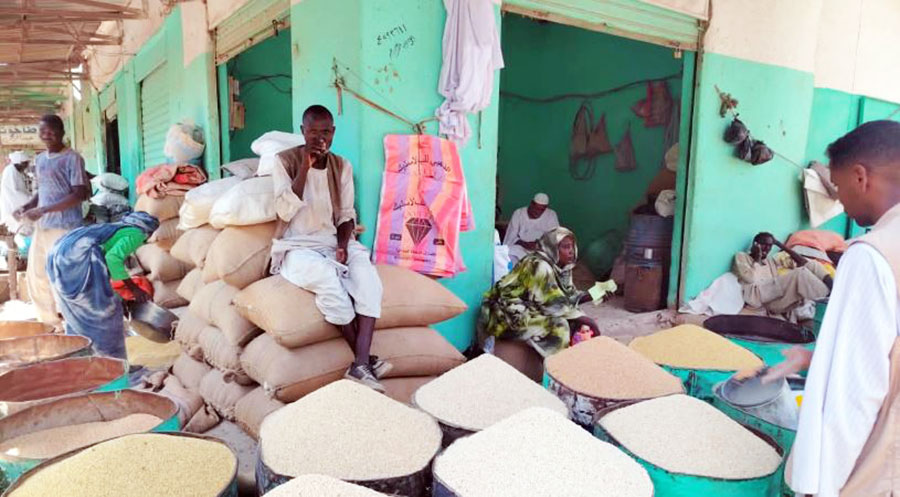
From “Keila” to “Malwa”: Al-Qadarif’s Autumn Reveals a Food Crisis
Moatinoon
In Al-Qadarif State, the autumn season this year does not carry its usual significance. A time once expected to bring bounty and abundance to grain markets has instead added a new burden to families. Amidst waves of soaring prices and the erosion of purchasing power, the question of survival is no longer about the *type* of food, but whether a family can secure any food at all. Quantities once purchased by the full sack are now split between two households, and the amount taken to the mill—formerly a full “keila”—has shrunk to a solitary “malwa”, barely enough to scrape through difficult days.
Shrinking Tables Under the Pressure of Prices
At a mill in the Al-Qadarif market, the words of Ruqayya Muhammad Ahmed reflect the immense strain her large family faces, given the number of children and the rising cost of food. She explains, with bitterness, that the amount of sorghum brought for milling has dropped significantly—from a “keila” to a “malwa”—a stark illustration of an accelerating inability to meet basic needs. This decline is not merely a statistic for the mill; it is a definitive indicator of the "forced austerity" imposed by current economic conditions.
Ruqayya notes that the price of wheat flour has jumped from 4,000 Sudanese pounds per kilogram to 6,500 pounds or more, compounding the hardship and closing off access to typical alternatives. In an autumn season that should ideally alleviate the burden of high prices, families find themselves compelled to reduce—rather than increase—the amount of grain they take to be milled. At the Millstone
Inside the mill, Al-Amin Adam Hussein experiences the daily pulse of the crisis firsthand. The volume of grain brought in by customers has shrunk remarkably; those who once brought a full *kila* (a traditional unit of measure) now bring only half, or sometimes just a single *malwa* (a smaller unit).
Al-Amin sums up this harsh human reality by saying, "We feel embarrassed to even accept payment for milling such a small amount"—reflecting the discomfort felt by service workers when dealing with customers who are struggling to scrape by. He attributes this decline to poor agricultural yields this season, noting that it poses a direct threat to the viability of the mills and the livelihoods of those who work in them—a situation further complicated by the challenges of the rainy season, which brings additional hurdles regarding transportation, storage, and production costs.
The Equation of Inadequacy
The experience of Abida Al-Nour, a resident of the Al-Manara neighborhood, illustrates how meager incomes fail to meet the demands of daily life. Supporting orphans on a monthly salary of 70,000 Sudanese pounds, she finds that this fixed income can no longer cover even the most basic necessities. As the pressures of the rainy season intensify, she is left with no choice but to seek more affordable alternatives.
To cope with the high costs, Abida has turned to wheat—a cheaper option compared to sorghum—noting that a sack of wheat currently costs around 140,000 Sudanese pounds.
Faced with these crushing burdens, some families have resorted to collective solutions, such as purchasing a single 25-kilogram sack of flour and splitting it between two households—a desperate attempt to keep hunger at bay. Thus, the details of daily life become a testing ground for families’ resilience in the face of a widening gap between their income and the market.
