
Updated: 15 October 2026 13:30:45
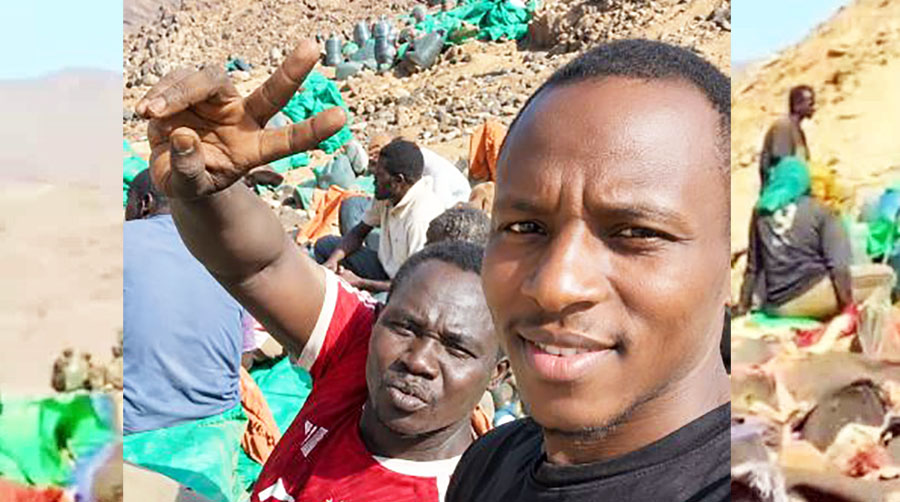
Shamal Al-Wadi: A Survivor Recounts the Massacre, While Families Search for Their Loved Ones
Moatinoon
Amidst the scattered remains of victims and the rubble of a mining site, Wael Issa Khater recounts the bloody hours experienced by Sudanese miners on October 10. Vehicles belonging to members of the Rashaida tribe rushed to transport the wounded, while questions remain regarding the circumstances of the attack and the fate of those still missing.
Wael Issa Khater, a resident of the Ruwaina neighborhood in the city of Gedaref, never imagined that a routine workday in the North Al-Wadi area would turn into a scene where the sounds of bombardment mingled with the screams of the wounded, and the remains of victims lay strewn about—all while survivors struggled to comprehend what had happened and searched for their companions.
Khater was carrying a sack of stones extracted from the mining site on his back, while others were busy preparing food or transporting stones, when the bombardment struck. In an instant, the workers found themselves facing what the survivor described as a "shocking" scene: some victims had been burned, while the bodies of others had been torn apart—an incident that left many dead, wounded, or missing, according to his account.
Khater told *Muwatinun* that determining the exact number of victims was difficult, not only due to the scale of the casualties but also because of the state of the bodies—some of which had been reduced to mere fragments—making identification and an accurate headcount extremely complex. He added that initial estimates suggested there were about 75 bodies outside the mining pits in the immediate aftermath, with more discovered subsequently, while the total number of wounded remains unknown. Testimonies from the Heart of the Mining Site
Khatir describes the North Wadi area as a mining site where young Sudanese men—who have arrived from various states in search of a livelihood—work. He explains that the workers are organized into groups, known locally as "al-kalla," operating in an environment that demands intense physical labor and entails numerous risks inherent to the nature of the work.
According to his account, the area contains sectors—referred to locally as "khatt al-jira" (lime line) and "al-sakhr" (rock)—which are distinguished by the varying composition of the soil. He also mentions the presence of missile fragments and debris at the site, suggesting that these should be examined to determine the type of weapon used, the trajectory of the attack, and the party responsible for it.
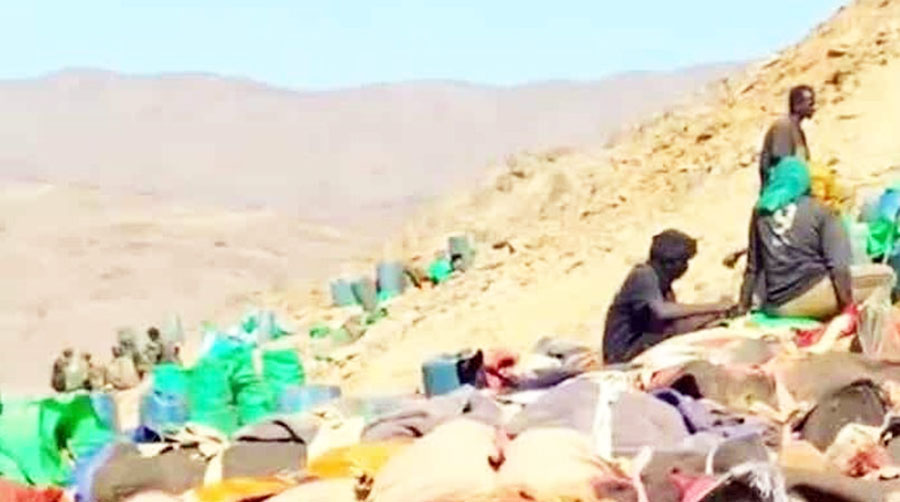
Who Is Responsible for Protecting the Lives of the Miners?
The questions raised by the bombardment go beyond the toll of the dead and wounded; they extend to the nature of the site itself, the entities overseeing the mining activity, and the extent to which the relevant institutions are responsible for protecting the workers and monitoring their well-being.
Khatir asserts that the mining area lies within Sudanese territory, noting that the workers paid fees—evidenced by receipts issued in the name of the Ministry of Minerals—as well as levies to the local Hadendowa tribal administrations. He further states that the gold extracted was transported to Sudan, and adds that an Egyptian company was operating in the same region, at some distance from their site.
Nevertheless, the questions prompted by this testimony remain fundamental: What were the circumstances leading up to the attack? Who carried it out? Has an official investigation been launched to establish responsibility? What measures have been taken to account for the victims and provide compensation to their families? And what is the outcome of the investigation conducted by the committee tasked by the authorities to look into this matter? Answering these questions does not merely serve the victims families; it is a necessary step toward preventing the recurrence of such a tragedy and ensuring that the lives of these workers do not remain just another set of statistics in the news.
The Rashaida: Vehicles to Save Lives
Amidst this tragedy, members of the Rashaida tribe stepped forward, rushing to the scene with their vehicles to help transport and provide aid to the injured. According to Khatir, three vehicles arrived at the site about an hour and a half after the bombardment, assisting in the evacuation of the wounded. Relief efforts continued throughout the day, with additional vehicles—belonging to the Joint Forces—arriving later on.
This humanitarian gesture deserves recognition; the members of the Rashaida tribe placed their own resources at the service of the wounded at a moment when there was an urgent need for transport and medical evacuation. In such circumstances, a single vehicle can make the difference between reaching life-saving treatment and remaining in the midst of danger.
Conversely, Khatir criticized the absence of government intervention, stating—according to his account—that no government authorities intervened until the end of the day. This testimony necessitates a thorough review of the response timeline: identifying which entities reached the site, how long the evacuation operations took, and what challenges were encountered in transporting the wounded.
Mubarak Ibrahim: A Survivor Who Has Gone Off the Grid
While survivors struggle to process what they have witnessed, other families endure heightened anxiety, having lost all contact with their loved ones.
From the Basanda region, the family of Mubarak Ibrahim reported that he survived the bombardment and managed to reach out to them, but has since gone silent. The family stated that he described the horrific scenes he had endured; they also expressed concern that he might be losing his memory. Currently, there is no confirmed information regarding his health status or his whereabouts.
This account reveals another dimension of the tragedy: the impact of the bombardment does not end when the shelling stops. It extends to families waiting for a reassuring phone call, others searching for missing relatives, and families in need of precise information—the identities of the victims, their burial sites, and the condition of the wounded. This underscores the urgent need to establish a reliable registry of the dead, the wounded, and the missing, and to provide clear information to families, while upholding the dignity of the victims and the privacy of their loved ones. The Truth Is a Right for Victims and Their Families
The account provided by survivor Wael Issa Khater, along with the testimony from the family of Mubarak Ibrahim, places a responsibility upon the relevant authorities to treat this incident as a matter that demands the full truth—not merely as a fleeting news report about casualties.
Behind every body lies a name, a family, and a life cut short. Behind every missing person is a family awaiting news, and behind every injured individual lies a potentially long road to recovery. All of them have a right to know what happened, who is responsible, and what the concerned authorities will do to ensure that such an event never happens again.

