
Updated: 6 October 2026 11:44:31

Deminers in Sudan clear a path to recovery
Moatinoon Follow Up
Source: unocha.org
Before Hiba Al-Emam became a deminer, she worked as an agriculture engineer in rural communities in Sudan’s Blue Nile region. What she saw there stayed with her.
“I grew up in an area that witnessed many armed conflicts which left frightening numbers of innocent victims due to remnants of war, especially landmines and unexploded ordnance,” she said.
Children had lost limbs and in some cases their lives to mines and unexploded ordnance. Families were afraid to carry out everyday activities such as farming, fetching water or herding livestock.
“The idea had been on my mind for some time, to work in humanitarian mine action,” Hiba shared.
In 2021, she joined a basic demining course after meeting mine action workers in Blue Nile. In September 2025, she joined a multi-task team with the National Units for Mine Action and Development (NUMAD) as a deminer.
Today, Hiba is part of a growing Sudanese mine action workforce responding to a threat that has changed dramatically since the war began in April 2023.
A new kind of danger
When fighting engulfed Sudan’s capital Khartoum, artillery shelling, aerial bombardment and intense urban combat left explosive ordnance scattered through streets, buildings, vehicles and rubble. Landmines, rockets, grenades and other unexploded ordnance now threaten people who seek to return and rebuild their lives.
“There have been many recent changes in the field of mine action in Sudan due to the current conflict. New types of explosive ordnance which were previously unfamiliar to us have appeared,” said Mohammed, a deminer with 17 years of experience in mine action.
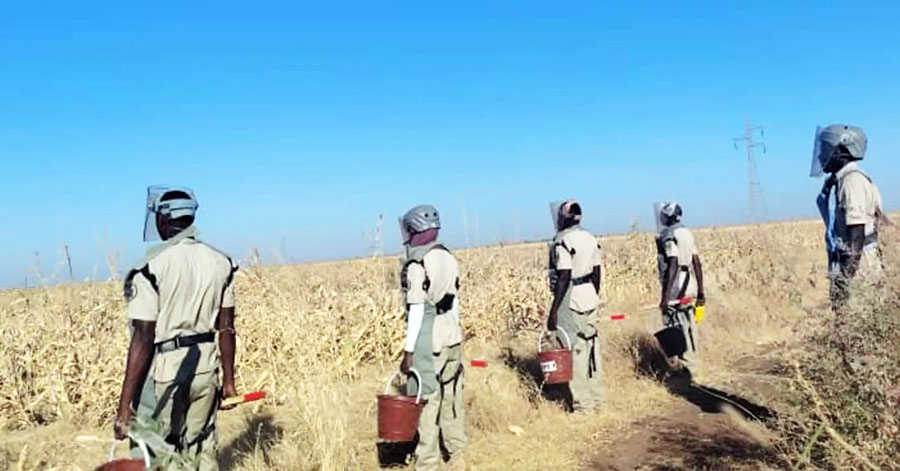
With support from the OCHA-managed Sudan Humanitarian Fund, the Danish Refugee Council and Sudanese mine action partners are helping clear contaminated areas and provide communities with information on how to recognize and report explosive hazards.
Building Sudans capacity to respond
The scale and changing nature of contamination means Sudan needs more trained specialists to deal with explosive ordnance.
In May 2026, with Sudan Humanitarian Fund support, the Danish Refugee Council delivered the first advanced training on ordnance disposal in Sudan since the conflict began. Fifteen personnel from Sudanese mine action organizations and the National Mine Action Center completed the intensive 25-day course.
The training included building searches and urban clearance techniques. The course increased the number of qualified personnel able to respond to growing needs in Sudan, helping expand the country’s ability to respond to explosive hazards and support safe humanitarian access and recovery efforts. Graduates can also take on team-leader roles, helping national organizations deploy additional clearance teams.
For Mohammed, the training also meant learning how to identify threats that were not commonly encountered before the current conflict.
“Through this course, we became familiar with many of these new threats and gained the knowledge to deal with them safely if encountered in the field,” Mohammed said.
For Hiba, training has been central to her own journey into a field where women remain underrepresented.
“Working in humanitarian mine action is neither easy nor difficult, but with training and patience you can do it even better than men,” she said, encouraging other women to join.
Making workplaces safer
The need for that expertise is already visible across Khartoum.
At the Arab Company for Livestock Development, explosive contamination threatened more than buildings and equipment. The company is a source of livelihoods for 450 workers and contributes employment and income to surrounding communities.
Teams from the National Units for Mine Action and Development and the Danish Refugee Council cleared and secured more than 457,000 square meters, covering facilities ranging from workers housing and administrative offices to hatcheries and production areas. During the operation, more than 370 items of unexploded ordnance were identified and neutralized, helping create safer conditions for the company to resume activities.
“We were not fully aware of the extent of the risks posed by war remnants within the companys premises,” said Dr. Saad El-Din Mohamed Ahmed, Director of the Arab Company. “The teams intervention revealed the extent of the threats surrounding the site, as well as the grave risks workers could have faced had they entered contaminated areas without knowledge of the nature of those hazards.
The intervention also extended beyond physical clearance. Community liaison activities reached more than 2,600 people with information about explosive hazards, while teams distributed brochures, posters and hotline cards encouraging people to report suspicious objects.
Clearing the way forward
For families returning home, workers restarting businesses and communities trying to recover, explosive remnants of war can turn ordinary activities into potentially life-threatening risks. Clearing those hazards is therefore about more than removing dangerous objects. It can help restore access to homes and workplaces, protect livelihoods and create safer conditions for humanitarian assistance and recovery.
Thanks to the generous support from its donors, the Sudan Humanitarian Fund provided US5 million to partners for mine action activities across the country in 2026, supporting clearance, training and efforts to reduce the risks faced by communities.

