
Updated: 3 August 2026 09:07:26
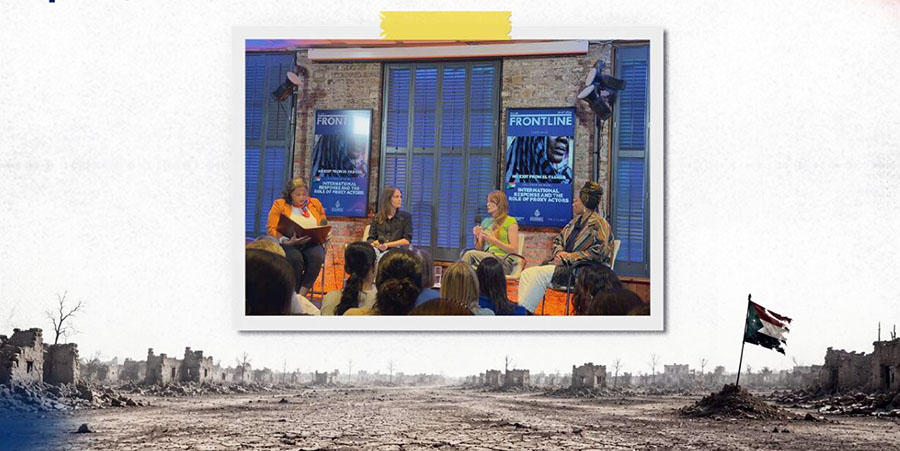
Why is Sudan absent from Arab and international screens?
Source: armediaobserver.com
At the prestigious Frontline Club in London, the screen of the film "No Way Out of El Fasher" went dark. The audience—journalists, producers, and human rights activists—had just witnessed scenes of horrific crimes committed against civilians in the besieged city.
The question didnt come from a single journalist searching for an angle; it rose from the entire hall in a single voice, almost an accusation: Where is the news about Sudan? How can a genocide the size of a region be swallowed up in near-total silence, while cameras flock to the Gaza war and the US-Iranian confrontation?
This question isnt a passing complaint; it has an answer, a structure, and beneficiaries. The common narrative is that Sudan is a "forgotten war" that the world has neglected by mistake. However, a careful reading reveals that this forgetting is deliberate, not accidental, and that the silence has its architects.
Numbers reveal the extent of what is being concealed in Sudan. Numbers alone are enough to measure what is being concealed. Since April 2023, some 12 million Sudanese have been forced from their homes—including 7.7 million internally displaced persons and 3.2 million refugees across borders—in what the UN Refugee Agency (UNHCR) and the International Organization for Migration (IOM) describe as the world’s largest displacement crisis.
In El Fasher alone, the UN Human Rights Commission documented the killing of some 6,000 people in the three days following the Rapid Support Forces’ (RSF) assault on the city in late October 2025. The actual toll is “much higher,” with researchers at Yale University’s National Laboratory even suggesting that the number of deaths in those ten days could exceed the total death toll of the entire Gaza war.
In February 2026, a UN fact-finding mission concluded that the events constituted “genocide” against the Fur and Zaghawa tribes.
Why is Sudan falling out of the spotlight?
Why, then, is this horrific situation disappearing from the headlines? To understand this, one test we call the “image test” suffices: an event only rises to the forefront of the news if two conditions are met: a broadcastable image and a vested interest that wants it seen.
Apply the test to three cases: Gaza passes both conditions, as does Ukraine; but Sudan fails both. And in this double failure lies the answer.
The first condition: what is not filmed does not exist. Television is a visual entity, and when the image is absent, the news disappears. Sudan was tightly closed to the camera: journalists visas were denied in Port Sudan, internet and phone service were cut off for weeks, and “compromise” with a military faction became the only way to gain access, at the cost of independence.
One Sudanese journalist estimates that “only 10% of this war has been covered.” Thus, the film footage of massacres that are actually taking place is absent, not because they are less horrific than others, but because newsrooms addicted to images have nothing to broadcast.
The second condition: who wants it seen?
Herein lies the crucial difference. In Gaza and Ukraine, a direct Western interest keeps the cameras rolling; but in Sudan, no weapons are being supplied by London or Washington to any particular faction, so it falls into what researchers call a "suspended space."
The events of October 7, 2023, redirected the compass of all newsrooms toward the Middle East, with Gaza, and then the escalating US-Iranian tensions, swallowing up what little space remained.
The numbers are glaring: The New York Times published nearly ten times more coverage on Gaza than on Sudan, and thirteen times more on Ukraine, according to a report by Byline Times. Added to this is a long-standing structural bias that renders the deaths of Africans "expected" news, not worthy of prominence.
When the funder wants it to remain unseen
The second condition reaches its peak when the influential interest not only remains silent but also creates a counter-narrative to capture attention.
Investigations by Human Rights Watch and Refugees International reveal that the UAE is a key partner in arming and funding the Rapid Support Forces—from paying officers salaries to training Colombian mercenaries at Emirati bases, according to the report "From Bogota to El Fasher," published in May 2026.
In the panel discussion following the film screening, Joy Shea, a researcher specializing in Saudi Arabia and the UAE at the organization, highlighted the same mechanism, arguing that "Manchester City Councils ties to Emirati officials have provided the UAE government with valuable moral cover while it supports forces committing atrocities in Sudan."
Manchester City Football Club, owned by Sheikh Mansour bin Zayed Al Nahyan since 2008, is not an exception, but rather a model: where the cameras follow the Etihad Stadium and not El Fasher, the sponsor of war becomes a respected patron, and the tools of media presence—broadcasting, imagery, and celebration—are employed to produce an absence.
In the Arab world: He who wields the gun owns the microphone. And in the Arab world, in particular: He who wields the gun owns the microphone. One of the parties to the war—the UAE—is a major owner and financier of media platforms and channels in the region. When the combatant is also the owner of the platform, silence becomes editorial policy, not a coincidence.
However, reducing the issue to a single conspiracy is a gross oversimplification. Sudanese journalists risk their lives to cover the war, human rights organizations and university laboratories have documented the massacres using satellite imagery, and some media outlets have published and investigated the findings.
The issue is not a lack of information, but rather the structure of attention that determines which information rises to the forefront and which is buried in the margins.
Who films the victim?
The question remains unanswered in the audience after the screen went dark: when the lens that was supposed to expose the massacre becomes a tool in the hands of its funders, who films the victim?
Attention, like a weapon, is not distributed fairly; it goes where interests dictate and disappears where it is intended to disappear.
