Updated: 6 April 2026 16:27:23
A Mother’s Long Walk from Sudan to South Sudan in Search of Care for Her Children
Moationoon Follow up
Source: storyteller.iom
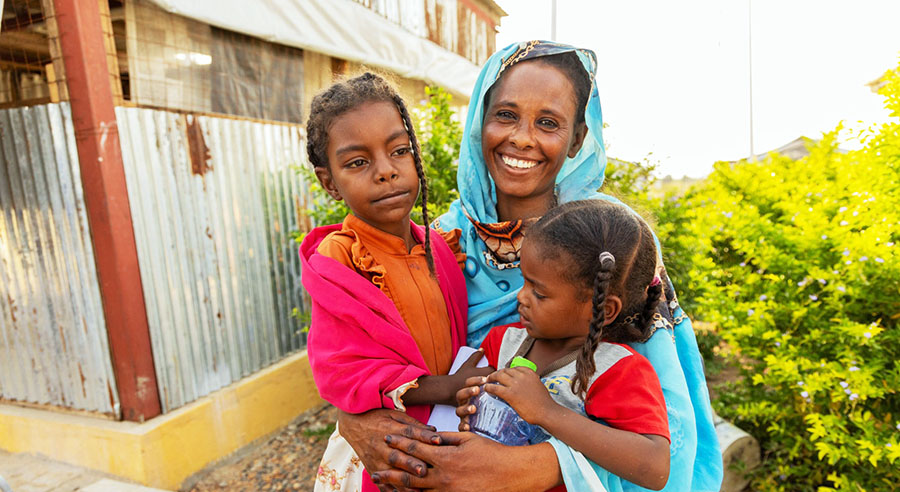
Under the relentless heat at the border between Sudan and South Sudan, 35-year-old Marida, a Sudanese mother of four, walks an hour to reach the only health clinic in the area, her small child in her arms.
Without a job and with almost no access to care where she lives, this walk has become her way of keeping her children safe and healthy. At the clinic, she sits in the shade with her child resting against her chest, gently braiding her daughter’s hair while they wait their turn. Every so often, she offers the little girl a sip of water from her own bottle, smiling softly as her daughter drinks.
In this remote, desert-like landscape, the clinic is a lifeline for families living near the border and one of the few places where people directly affected by the conflict in Sudan can receive care close to home. Despite the heat and exhaustion, Marida speaks openly about her journey without complaint.
Earlier that day, she had already been seen by a clinician, who performed an assessment and gave her a prescription for her medication. Marida comes to the clinic whenever she or her children require medical attention. She is raising four children, aged 13, 10, 8 and 4, after losing one of her sons when he was just four years old.
For Marida, access to care is not simple – it is something she must walk for, often in extreme conditions. After the treatment, she knows she will make the journey again for follow-up.
Marida recalls being attacked in her home area and fleeing to South Sudan, where she stayed for three months before returning. Just like many others in border communities, she moves back and forth in search of services.
On the side of the border where her family is staying, basic health care remains out of reach. “Where we are, there is no treatment and no vaccinations for children,” she says. “Only people with money can go to private clinics. For me, that’s very difficult.”
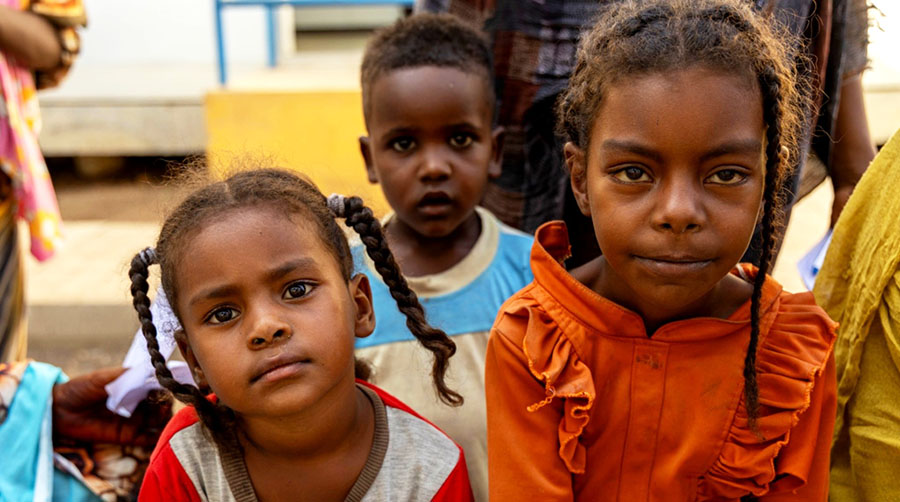
South Sudan continues to face a major humanitarian crisis, worsened by the ongoing conflict in Sudan. An estimated 10 million people across the country need assistance, including more than 1.9 million internally displaced. Since violence erupted in Sudan in April 2023, more than 1.3 million people have crossed into South Sudan seeking safety and services, most of them South Sudanese returning home.
They arrive through the border point in Renk, a town that once had a population of around 80,000 but has since seen a number of arrivals far exceeding its size in less than three years. Hundreds continue to arrive each day, often exhausted after long journeys and with little or nothing.
Teams working with the International Organization for Migration (IOM) in Renk support arrivals from the moment they cross the border, providing registration, medical screenings, protection, and mental health and psychosocial support.
Families are also assisted through onward transportation that helps them move safely to other parts of South Sudan, easing pressure on local communities. In the past two years alone, IOM has supported more than 610,000 people affected by the Sudan crisis, providing health care, clean water, protection, and transport assistance to help families begin again.
At the Joda/Wunthow border point between Sudan and South Sudan, the only functioning health clinic is run by IOM in partnership with the Ministry of Health. Each day, mothers arrive on foot or by donkey, carrying their children after long and exhausting journeys, seeking care they cannot find elsewhere. For many, it is the first time in months that they have been able to see a health worker.
Inside the clinic, children are examined, vaccinated, and treated for illness, while mothers receive essential care and medications. Relief is often immediate – a fever begins to ease, a child starts to recover, and a long-awaited vaccine is finally administered.
At the reception centre in Joda, where all new arrivals pass through, health teams provide screenings, immunizations, and referrals to identify urgent needs and prevent the spread of disease in often crowded conditions.
Since the conflict began in April 2023, IOM and its partners have provided medical care to more than 609,000 people at border areas and transit points, including roughly 279,000 consultations, over 221,000 child vaccinations, and about 3,000 women accessing reproductive health services.
Health support is also integrated into onward transportation assistance, which helps people move safely from border areas to other parts of South Sudan. More than 105,000 people have been screened before continuing their journeys, ensuring urgent health needs are identified early.
Along river routes, one of the main corridors for onward travel, emergency health teams provide care during the journey, and oral rehydration salts are distributed to boat operators to prevent dehydration among passengers travelling in difficult conditions.
Meanwhile, cholera prevention and surveillance efforts have reached over 163,000 people, helping to contain outbreaks in Renk and along the Nile corridor. Together, these services not only provide critical care but also reduce health risks at overcrowded entry points, supporting safer and more dignified onward movement for families fleeing the conflict.
For Marida, the clinic at Joda remains essential. It is where she brings her children when they are sick, where she receives treatment, and where, even in the midst of uncertainty, she finds a measure of reassurance.
“The conflict has made us lose a lot of hope,” she says. “We don’t know what will happen in the future, but we can only hope for the best.”
Her hope is simple: to see her children grow up healthy and safe. Until then, she continues to walk one hour each way under the scorching sun, carrying her toddler to the care her family depends on.

