
Updated: 21 March 2026 12:11:28
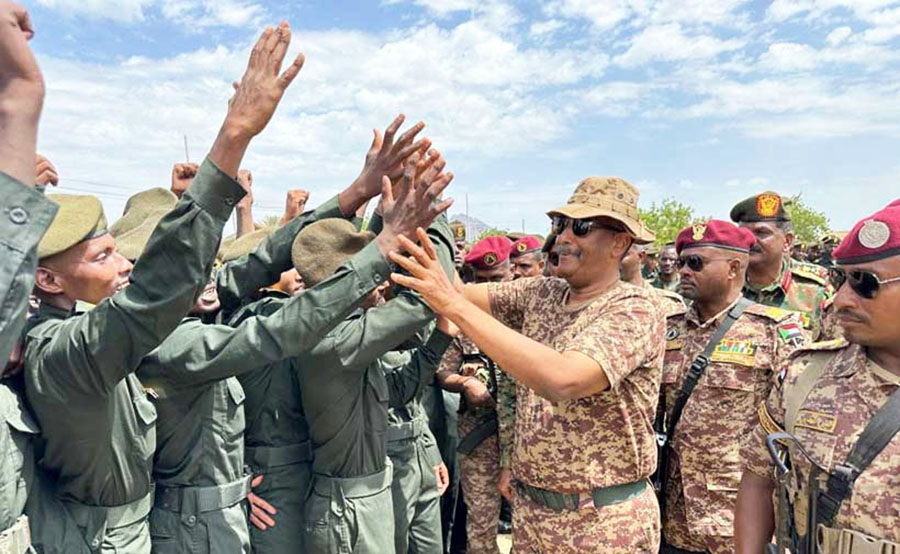
Integration of Islamist Forces into SAF Set to Deepen, Not Ease, International Alarm
By Willy Fautre*
Source: moderndiplomacy.eu
Lieutenant General Yasser al-Atta, member of the Sovereign Council and Assistant Commander-in-Chief of the Sudanese Armed Forces (SAF), stated on Saturday that arrangements are underway to revamp mechanisms for organizing and integrating support forces into the SAF, according to reporting in Sudan Horizon. It is likely Atta thought this news would reassure both the Sudanese people and the international community, perhaps indicating a more orderly setup. However, the idea that Islamist militias will become even more deeply entrenched within the SAF will more likely cause alarm inside Sudan and beyond. Adding to the intrigue is the fact that Atta’s announcement was immediately followed by the U.S. Department of State designating the Sudanese Muslim Brotherhood this week.
Ahead of us. Designation: Atta’s bringing ideologically committed Islamist militias formally into the SAF strengthened the hardline constituencies that favor prolonged military rule and may resist any power‑sharing or security‑sector reform. According to Reuters, the revival of Islamist factions began before the outbreak of the war in April 2023, during a period when a transition towards civilian rule was “veering off course.” The factions had established deep roots in Sudan’s ruling apparatus and in the army during Bashir’s three decades in power. When SAF commander General Abdel Fattah al-Burhan, who became head of Sudan’s ruling council shortly after Bashir’s overthrow in 2019, staged a coup two years later, he depended heavily on their support. Certainly Islamist militias are credited with helping Burhan and the SAF retake Khartoum.
Cameron Hudson, Senior Fellow, Africa Program, Center for Strategic and International Studies, commented, “Just integrating Islamist fighters into the military cannot be the complete answer. Yes, those militias need to be dismantled, but SAF is already accused of having a problem of Islamist penetration. If it wants to dispel that, adding more Islamists to the mix doesn’t do that. Now is the time to draw lessons and seek advice from other countries that have struggled with similar challenges if you are genuine about wanting to break ties with the past and forge a new path towards internal peace.”
Burhan’s tactical alliance with Islamist forces, including the Muslim Brotherhood, is undoubtedly a concern for international mediators, including the United States. Burhan depends on these militias and networks for fighters, training of volunteers, and access to economic assets, while Islamists see him and the war as their ticket back to power after Bashir’s fall.
However, there is mounting analysis that Burhan himself might have been engaged behind the scenes in the designation of the Muslim Brotherhood. He is in an increasingly tight spot, including being under international pressure over SAF atrocities, and it is believed by some commentators that he likely struck a deal behind the scenes over the designation, trading a “pass” to exit safely from Sudan if needed, or for him and his army to be spared in any further rounds of designation. The U.S. gets their designation at a time when they need to deal as firmly as possible with Iranian proxies, and Burhan gets the reassurances he craves when under such pressure. As one African affairs analyst put it, “The motivation and timing for such a deal were right for both sides.” Ultimately, the cracks are starting to show between Burhan and the Islamist militias he relies upon.
US officials and policy pieces explicitly frame Sudan’s Muslim Brotherhood–linked Islamist movement as a security and counterterrorism concern, citing its role in prolonging the war and incubating extremism. The US Treasury has sanctioned Sudanese Islamist actors and militias (for example, in 2025) for obstructing peace and collaborating with Iran’s Islamic Revolutionary Guard Corps. A US State Department representative stated that Washington is working to limit “negative Islamist influence in Sudan’s government,” linking it to attacks on Christians and broader backsliding on religious freedom since the war began in 2023.
US envoys have publicly described their “primary concern” with the Sudanese Armed Forces as its connections to radical Islamists and arms supplies from Iran, while also acknowledging some steps by the SAF to distance itself from the most hardline elements. In parallel, Congress advanced a “Muslim Brotherhood Terrorist Designation Act of 2025” that explicitly addresses Brotherhood structures, including those in Sudan, underscoring the political priority Washington attaches to this issue.
Given all of this international concern, it is unfathomable as to how the SAF’s Lieutenant General Yasser al-Atta could think that further integrating Islamist militias into the SAF could possibly reassure an international community that already fears the strong foothold of the Muslim Brotherhood in Sudan and sees the Islamist influence on General Burhan as a major stumbling block for international peace efforts.
Either that or Atta is merely reassuring Sudan’s ‘Islamist current’ (as their apologists refer to them) that their place in the SAF ‘vision’ for Sudan is secure and signalling to the world that the Burhan regime intends to go its own way, however that diminishes the prospects for peace.
*Willy Fautré is the founder of Human Rights Without Frontiers (Belgium). A former chargé de mission at the Belgian Ministry of National Education and the Belgian Parliament, he is the director of Human Rights Without Borders, a Brussels-based NGO he founded in 2001. He is a co-founder of the Raoul Wallenberg Committee (Belgium).
