
Updated: 2 March 2026 20:27:40
A Rare Royal Document Reveals Features of Governance in Old Dongola
Moatinoon
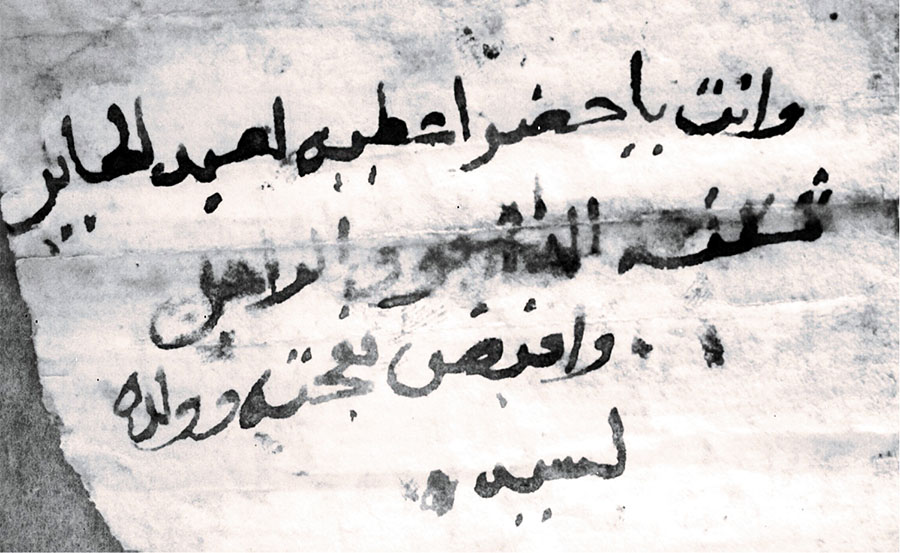
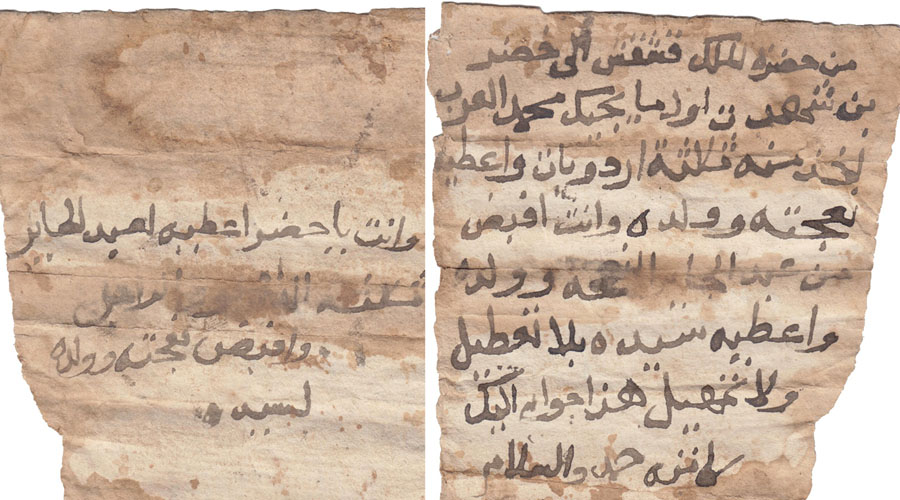
A recent study published in the journal Azania: Archaeological Research in Africa, which specializes in African archaeology, has revealed a document considered the first material proof of the existence of King Qashqash, a figure associated with the late medieval period in northern Sudan. The find sheds light on the nature of governance as well as the social and cultural transformations of that era.
The document, an order written on paper, records a transaction involving textiles and livestock. It shows that the ruler was not merely a war leader, as portrayed in some earlier accounts, but also carefully managed economic affairs and social relations.
The study explained that a team from the University of Warsaw, led by Tomasz Barański, conducted excavations in Old Dongola in 2018, where the decree was uncovered within a layer of debris alongside 22 Arabic texts indicating the use of Arabic in the royal court, even though it was not the native language of the population at the time.
The discoveries included a collection of luxury items, among them cotton and silk textiles, leather shoes, an ivory dagger, and a gold ring, as well as texts documenting exchanges of goods and gifts among members of the ruling elite, including head coverings reserved for nobles.
Preliminary analysis suggests the existence of an organized communication network between the royal court and leaders of surrounding nomadic groups, reflecting an advanced level of administrative organization and political relations in that period.
Researchers believe the document constitutes rare physical evidence of the nature of political authority in Nubia during a historically obscure transitional era between the end of the Christian kingdoms and the beginning of Turco-Egyptian rule in the nineteenth century.
A Period of Major Transformations
The document most likely dates to the late sixteenth or early seventeenth century, a time marked by rapid religious and cultural transformations as Islam and Arabic spread throughout the region.
During that period, Dongola was nominally under the influence of the Funj Sultanate, which ruled large parts of the Nile Valley for centuries but allowed local rulers to administer their territories in exchange for loyalty and tribute.
Historical sources indicate that the city remained a major commercial stop on the route linking Cairo, Sennar, and Darfur, explaining the economic importance of the local ruler’s role.
What Does the Document Say?
The document is an order from King Qashqash to a man named Khidr, instructing him to carry out an exchange with another individual called Muhammad al-Arab. The instructions include:
Delivering three units of textiles known as “ardawiyyāt.”
Receiving a ewe and her lamb from a third person named Abd al-Jabir.
Conducting an additional exchange that may have involved cotton cloth or a luxury head covering.
These small details reveal a complex network of economic relations personally overseen by the king and suggest that the exchange was not purely commercial but part of a system of political gift-giving and loyalty-building.
The document was found inside a large archaeological building locally known as the “House of the Mek,” the largest residence within the site’s citadel. Artifacts discovered there—such as imported silk, leather shoes, gold rings, and ivory dagger handles—indicate it was a residence of the ruling elite. Silver coins dating to the reign of the Ottoman Sultan Murad IV and his successor Ibrahim were also found, helping date the archaeological layer to the seventeenth century.
Correcting the Image of the “King of Nubia”
The traveler and historian Leo Africanus once described the “King of Nubia” as constantly at war. However, the new document presents a different image: a ruler managing commercial exchanges and maintaining social relations.
Accounts by the Ottoman traveler Evliya Çelebi support this view, noting the presence of networks of scholars and notables around Dongola, indicating an organized society rather than merely a battleground.
Language and Cultural Identity
The document is written in Arabic but contains grammatical irregularities and colloquial influences, suggesting that Arabic was an official written language but not the native tongue of all inhabitants. The terminology also reflects a mixture of Arabic, Nubian, and Ottoman elements, evidence of wide cultural interaction in the Nile Valley at the time.
Key Historical Implications
The document reveals three important facts:
The historicity of King Qashqash: he was not a mythical figure but a real ruler confirmed archaeologically.
The nature of local governance: authority relied on networks of exchange and mutual interests rather than military force alone.
The value of paper documents: despite their rarity in precolonial Africa, they can reconstruct social history with remarkable precision.
The discovery of this royal order in Old Dongola is a striking example of how a small, discarded document found in an archaeological refuse layer can transform our understanding of an entire historical period.
Instead of the familiar image of warrior kings alone, this paper reveals a ruler deeply engaged in managing the economy and relationships—opening a new window onto political and social life in precolonial Sudan.

