
Updated: 12 February 2026 20:31:41
Sudan: The Story of a Hijacked Revolution
Source: ici.radio-canada.ca
The latest Sudanese revolution has been “hijacked.”
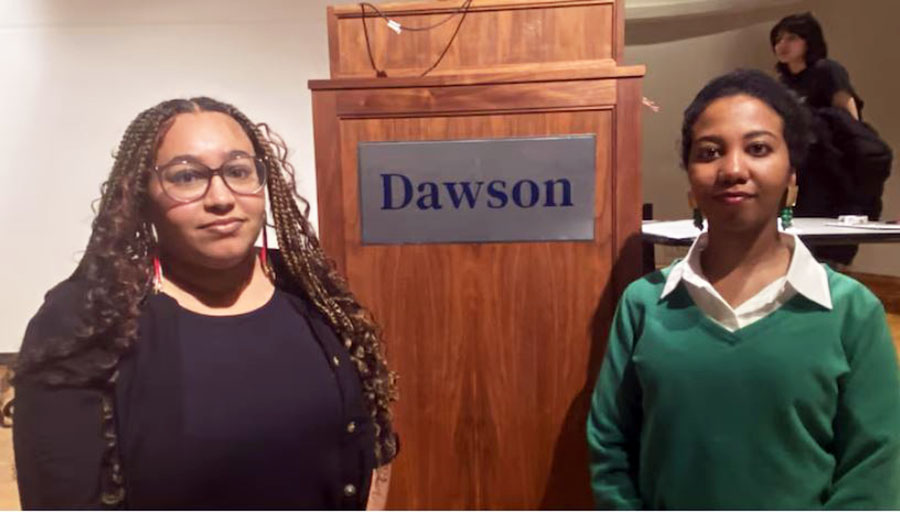
This is how community activist Duha Al-Maradi described it after a screening last Tuesday of the film Sudan, Remember Us by French-Tunisian director Hind Meddeb at Dawson College, a post-secondary institute in Montreal, as part of Social Sciences Week.
Duha was answering questions from students who attended the screening. She shared the microphone with filmmaker Razan Al-Khatib; both women are Sudanese.
The film Sudan, Remember Us portrays a generation that “chose poetry over silence and imagination over fear.”
It features a group of young people in their twenties who stood on the front lines of the revolution, facing the army and paramilitary militias.
Blending storytelling with political events, the film depicts the “unequal struggle between the gunfire of militias and the voices of the people.”
For both women, watching the film is a painful yet necessary experience.
In an interview with Radio Canada International, Duha Al-Maradi said she has watched the film about ten times and cried each time, because it captures the euphoria of the revolution (the sit-in), which sharply contrasts with the reality of the recent war that erupted in April 2023 between the Sudanese Armed Forces and the Rapid Support Forces.
Al-Maradi rejects the term “civil war” in her analysis of the situation, preferring instead “counter-revolutionary war.”
She condemned foreign intervention, pointing specifically to what she described as the role of the United Arab Emirates, “which funds the Rapid Support Forces to seize Sudan’s gold resources,” she said.
She also accused Canada of complicity, saying it “continues to export weapons used in this conflict.”
She does not believe either side in the conflict is better than the other.
Al-Maradi also criticizes border restrictions, noting the extreme difficulty Sudanese people face in fleeing to Egypt or benefiting from Canadian family reunification programs, which she considers humiliating and ineffective.
For her part, filmmaker Razan Al-Khatib stressed the central role of art and women in resistance.
She explained that the revolution was led by youth, and that women—nicknamed “Kandaka,” after the warrior queens of ancient Nubia—defied patriarchal norms to organize protests.
In her view, art (poetry, songs, murals) is not only used to mobilize people but also serves as an essential form of archive “to preserve historical truth in the face of propaganda that seeks to distort the narrative of the revolution.”
For both women, Meddeb’s film and others complement an authentic and necessary Sudanese perspective that conveys the “scale of pain and violence people experienced during the dispersal of the sit-ins.”
Razan Al-Khatib also emphasized the importance of Sudanese filmmakers who produced works such as Khartoum and Al-Madaniya (“Civilian”), which “carry the revolution’s central slogan: for a civilian government.”
She added: “Remembering the revolution, which is an inspiring moment in our history, helps us psychologically overcome this phase.”
