
Updated: 11 February 2026 16:44:54
Sudan: The War as Told by Neighborhood Women

Hawa Rahma – Khartoum, 11 February 2026 (Al-Alag Center for Press Services) – In Sudan, civilians trapped in areas of active fighting have not only been besieged by the direct violence of war, but also by mounting social and economic complications, along with harmful practices that civil society organizations and community initiatives had worked for years to combat—particularly those related to gender-based violence.
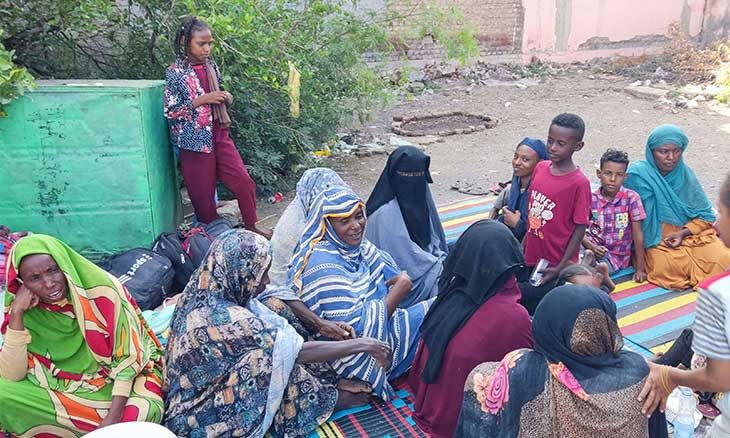
In a series of community dialogue sessions organized in Khartoum by the Al-Alag Center, powerful human stories emerged, reflecting the suffering of women who had long struggled to fight harmful practices such as child marriage and female genital mutilation (FGM).
For these women, the situation was far from easy amid the absence of legal oversight and community awareness. Below, women recount what they experienced and witnessed during two years in which Khartoum became an active military operations zone between the Sudanese army and the Rapid Support Forces (RSF), the latter of which controlled large parts of the capital for much of that period.
Beatings, Threats and Intimidation
The sessions confirmed that some women were subjected to beatings and threats by RSF members. Others lost their husbands due to the war and endured severe psychological trauma, living through harrowing moments without receiving assistance from any party. Many spoke through tears, expressing feelings of oppression and profound loneliness.
Women in the Karkoj neighborhood of East Nile said they felt psychological relief after the lifting of a two-year siege during which they had been trapped in direct conflict. They emphasized their need for psychological support sessions to process what they had endured. One mother (who preferred to withhold her name) recounted that an RSF member climbed over the wall of her home and demanded that she hand over her 14-year-old daughter. “I stood in his way and pleaded with him to leave her,” she said. “When we reached the point of collapse, he finally left. I breathed a sigh of relief, but we have remained in a state of fear and terror to this day.”
Another woman spoke of families forcing girls of marriageable age to undergo FGM. She said that during the RSF siege of Khartoum, some families reverted to the practice in the absence of law enforcement.
Lack of Community Awareness
In the same session, a staff member who had worked for over 30 years at a girls’ school in Karkoj spoke about the absence of social guidance for adolescent girls, leaving them vulnerable to harassment, rape, or exploitation. She added that some mothers feel embarrassed to guide their children—especially teenage girls—and called for the introduction of educational approaches aimed at protecting girls from abuse and violence.
In the same context, Asia Adam, a social welfare activist, revealed that kindergarten children had been exposed to harassment and domestic violence. She called for increased psychological support for children, particularly those suffering from trauma and those trapped in conflict zones. She also stressed the importance of raising awareness among mothers and combating harmful practices such as child marriage and FGM. She pointed to a rise in reports of rape and harassment involving children under five in the Haj Yousif area.
A licensed midwife in Haj Yousif stressed the need to strictly enforce legal provisions criminalizing FGM. She revealed that some mothers and midwives had been prosecuted for performing circumcisions, adding, “There is social cover-up of these practices.”
Widows and Orphans Without Support
Community sessions organized by the Al-Alag Center revealed the presence of numerous widows as a result of the war. Most of the deceased husbands were killed inside their homes by RSF members, while others died due to shelling of houses and markets. Several women spoke about the severe psychological damage caused by the loss of the family breadwinner and the absence of institutions providing care or economic support. More than one woman who had been beaten or injured stressed the urgent need for psychological support, saying they were unable to overcome their trauma. The effects of fear continue to shape their daily lives, and some said they struggle to care for their children due to the severity of their psychological distress.
Child Harassment and Mothers Silenced by Stigma
Shireen Rahmatallah, an employee in East Nile locality, revealed that FGM continues to be practiced secretly, particularly in areas such as Mayo Goma and Wad Babiker. She noted that families often conceal the practice, raising fears that mutilations are increasing without accountability for perpetrators—especially midwives. Areas such as Um Dom and Abu Dulaig, along with other parts of East Nile, continue to practice FGM under social protection and require organized awareness campaigns.
Regarding violence in schools, she pointed to serious incidents requiring attention from school administrations and parents. “We caught students carrying narcotic pills in their school bags,” she said. “We conducted investigations to determine the source and referred the students for treatment until recovery from addiction.”
Afaf, an employee, attributed the persistence of FGM to communities’ attachment to longstanding traditions and resistance to abandoning inherited customs, despite efforts to combat them. She stressed that community awareness plays a crucial role in fighting harmful practices and violence against women.
Intisar Abdel Salam spoke about the impact of war on families, especially after displacement and mixing with other families in new areas, making child protection from violence an ongoing concern.
One mother who participated in the session said that social pressure and fear drove her to accept the marriage of her 16-year-old daughter, who was in her second year of secondary school. The daughter has since given birth to a child.
Another mother recounted her 16-year-old daughter’s experience of requesting divorce on the first night of marriage after realizing she knew nothing about married life. The girl threatened suicide. Her husband was 20 years older. “I thought she would live happily with a man working in a Gulf country,” the mother said, “but I regretted the decision.” Her daughter has since returned to school as a divorcee.
Durriya Noreen, a member of an association combating harmful practices, called for awareness sessions in schools about sexual violence. She revealed cases of harassment and noted that such phenomena are spreading amid a lack of school oversight. She stressed the need for families to receive awareness support to help children develop healthy behavior and avoid abuse.
Hanaa Mustafa believes that schools alone cannot fulfill the educational role, emphasizing that upbringing begins at home. She stressed the importance of coordination between schools and families. “Monitoring children is essential,” she said. “Awareness must include warnings about sources of danger. Mothers should not leave children alone for long periods, as they can easily be exploited.”
Another participant said that customs and traditions remain a major obstacle to eliminating FGM. “We must abandon harmful practices without compromise to protect girls’ safety,” she said. She added that some families, after being displaced to other states, secretly circumcised girls as young as 13—one of the war’s consequences that has intensified violence against women.
- The Sudan Media Forum publishes this report, prepared by the Al-Alag Center for Press Services, as it reflects women’s perspectives on the war they have endured and how it has pushed communities backward, reviving harmful practices such as FGM and child marriage, in addition to the war’s consequences, including rape, harassment, and the spread of drugs.
The report also highlights women’s responses to these regressive practices—some resisted, while others yielded under pressure and are now calling for urgent support wherever possible.
