
Updated: 5 January 2026 09:40:09
The UAE and the Sudan War: Strategy and Regional Consequences
By William Keenan
Source: Times of Israel
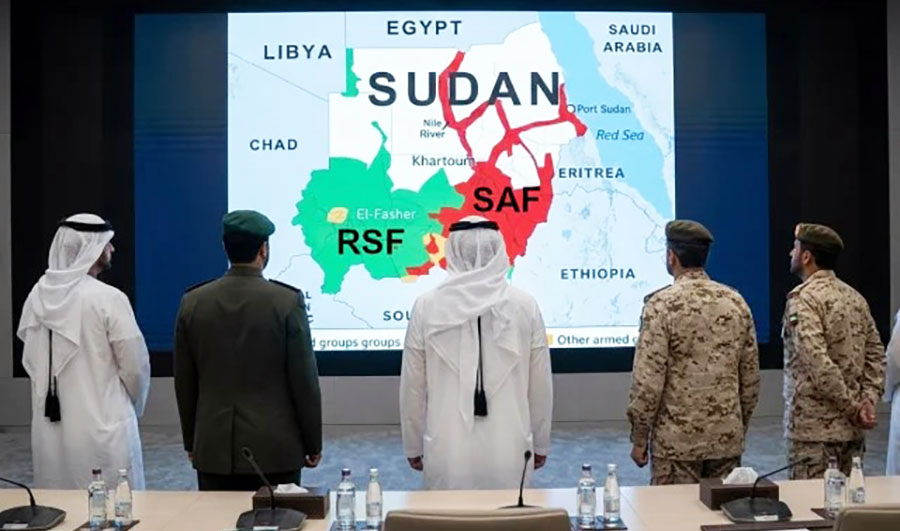
The United Arab Emirates (UAE) has become one of the most consequential external actors shaping the trajectory of Sudan’s civil war. While Abu Dhabi publicly denies taking sides and emphasizes humanitarian assistance and diplomatic engagement, a growing body of open-source reporting, intelligence assessments cited by U.S. officials, and observable battlefield dynamics indicate that the UAE has functionally aligned with the Rapid Support Forces (RSF) and, in parallel, coordinated with Khalifa Haftar’s Libyan National Army (LNA). This involvement is not ideological but transactional and strategic. It combines military enablement, logistical facilitation, financial integration, and diplomatic insulation to secure economic access, expand regional influence, and shape post-conflict outcomes in a state whose geography and resources confer disproportionate strategic value.
The UAE’s primary alignment in Sudan is with the RSF. This relationship is operational rather than declaratory: the RSF controls territory, population centers, and critical resource nodes, while the UAE enables the RSF’s ability to fight, sustain itself, and monetize those assets. The persistence, scale, and sophistication of RSF operations—particularly their endurance under international pressure—suggest access to external support that exceeds what indigenous capabilities and captured stocks alone would plausibly provide. The UAE’s secondary alignment with Haftar’s LNA in eastern Libya reinforces this assessment. LNA-controlled airfields, depots, and overland routes provide strategic depth and redundancy for RSF supply chains, creating a trilateral configuration—UAE, LNA, RSF—that reduces interdiction risk and bypasses many international monitoring mechanisms. This architecture allows materiel, fuel, and personnel to flow into western Sudan with relative resilience.
Abu Dhabi’s objectives in Sudan are best understood across three dimensions. Economically, the UAE seeks secure access to Sudanese gold and extractive revenues and to preserve leverage over transit corridors linking the Sahel, the Horn of Africa, and the Red Sea. Strategically, Sudan’s Red Sea coastline and proximity to key maritime chokepoints make it an attractive arena for influence, particularly as regional competition intensifies. Politically and from a security perspective, the UAE has consistently opposed Islamist political movements and favors strong, pliant security actors capable of coercive control. The RSF, a paramilitary force unencumbered by institutional constraints and reliant on external support, fits this preference, even if it lacks the attributes required for legitimate national governance.
The means through which UAE support alters the conflict are visible in RSF operational behavior. RSF forces exhibit access to aerial intelligence, surveillance, and reconnaissance, along with strike or loitering-munition capabilities, armored vehicles, fuel, and steady ammunition resupply. These enablers have shifted RSF activity from opportunistic raids to sustained, multi-axis campaigns. The RSF has demonstrated an ability to isolate urban centers, interdict supply routes, and maintain pressure over extended periods—capabilities that materially change the character of the war.
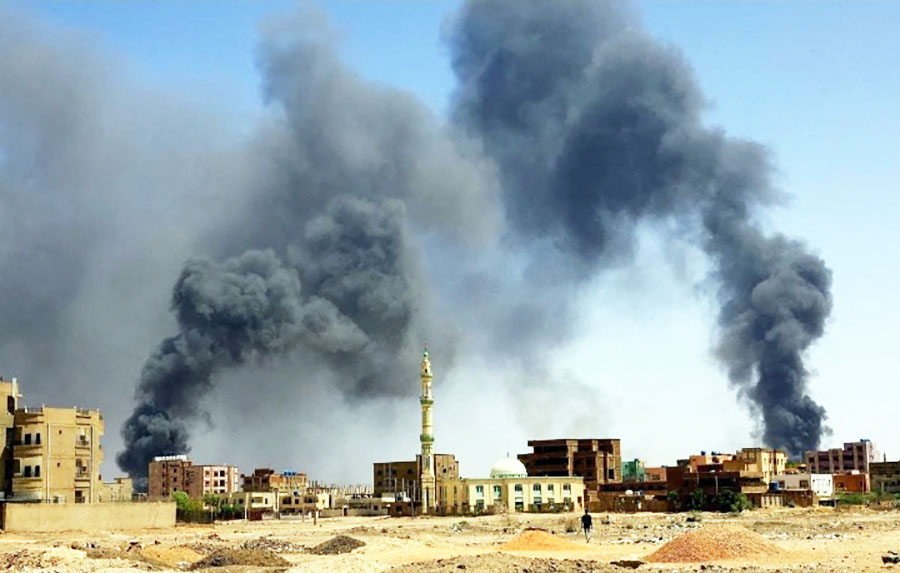
Equally important is the logistics architecture sustaining these operations. RSF supply lines rely on multiple, overlapping corridors, including air and ground routes through Chad, transshipment via eastern Libya using LNA-controlled infrastructure, and landings into RSF-held or permissive airstrips inside Sudan. The redundancy of these routes is analytically significant. It explains why RSF operations persist despite international scrutiny and episodic interdiction efforts and why external pressure has thus far failed to alter battlefield incentives.
Financial autonomy further distinguishes the RSF from many non-state armed groups. Control of gold mines, combined with access to UAE-linked trading, refining, and financial ecosystems, has created a gold-to-procurement pipeline that underwrites prolonged warfare. This revenue stream reduces RSF reliance on civilian taxation or formal state institutions and enables continued operations even in contested environments. Reporting on foreign advisors and mercenary involvement suggests increased tactical sophistication and a lower political threshold for violence, particularly in urban and ethnically mixed areas.
The humanitarian consequences of this dynamic are severe and measurable. Best current estimates place conflict-related deaths in the range of 150,000 to 200,000, including large numbers of indirect deaths from starvation, disease, and health system collapse. Approximately 12.5 million people are internally displaced, with an additional 3.5 to 4 million refugees in neighboring states. Over 25 million people face acute food insecurity, and IPC Phase 5 (Famine) conditions have been declared in multiple locations across Darfur and Kordofan. An estimated 70 to 75 percent of hospitals in conflict-affected areas are non-functional.
These outcomes are not incidental. The mechanisms linking externally enabled RSF capacity to civilian harm are well established. ISR and strike capabilities enable targeted attacks on markets, transport nodes, and civilian infrastructure, increasing lethality and enabling siege tactics. Reliable fuel and ammunition flows allow RSF forces to sustain offensives and blockades long enough to collapse food systems and prevent humanitarian stabilization. Systematic degradation of agriculture, storage, irrigation, and transport destroys livelihoods and accelerates famine. Attacks on hospitals, displacement of medical staff, and disrupted supply chains magnify mortality from otherwise treatable conditions. Credibly documented RSF abuses—including mass executions, ethnic cleansing in parts of Darfur, sexual violence, and forced displacement—have produced acute protection crises.
Direct responsibility for these crimes rests with RSF commanders and units. External support that materially enables the capabilities used constitutes a causal contribution to the resulting harm. This causal responsibility is analytically distinct from legal complicity, which requires proof of intent or knowledge that assistance would facilitate specific crimes. Nonetheless, the foreseeability of civilian harm arising from sustained military enablement creates substantial political and moral responsibility for external sponsors.
The strategic effect of UAE involvement is paradoxical. On one hand, it increases the likelihood that the RSF can seize and hold resource-rich regions, transit corridors, and revenue nodes, strengthening its bargaining position and prospects for localized dominance. On the other hand, nationwide consolidation requires administrative capacity, legitimacy, and institutional depth that the RSF does not possess. External backing therefore tends to produce partial territorial control rather than coherent state authority. The net effect is to increase the probability of both localized RSF success and a prolonged national stalemate in which neither side can achieve decisive victory, but both can continue destructive operations.
The regional implications of this outcome are significant. Sudan’s fragmentation degrades governance along the Red Sea coast, complicates maritime security, and increases risks to shipping and port infrastructure. Armed groups operating in ungoverned spaces heighten instability along a corridor already strained by conflict elsewhere. Beyond the Red Sea, the UAE’s Sudan policy interacts with its broader regional ambitions. Abu Dhabi’s aspiration to play a leading role in Gaza reconstruction, for example, depends on diplomatic credibility and regional trust. Visible association with a conflict marked by mass atrocities in Sudan complicates donor coordination, host-nation consent, and the security guarantees required for reconstruction.
Bilateral relationships are also affected. UAE support for the RSF strains ties with Egypt, which prioritizes Nile security and has leaned toward the Sudanese Armed Forces. It complicates coordination with Saudi Arabia, particularly as competition over Red Sea influence intensifies. It creates friction with Turkey, which pursues its own influence in Sudan and the Horn. It raises concerns in Washington regarding human rights, sanctions exposure, and reputational risk. Even where relationships remain formally intact, diplomatic flexibility is reduced and policy costs increase.
The economic benefits of the UAE’s approach—access to gold revenues and corridor leverage—are tangible and immediate. The strategic and diplomatic costs, however, are broad, cumulative, and potentially long-lasting. Sanctions exposure, reputational damage, regional instability, and association with actors implicated in mass atrocities represent liabilities that extend well beyond Sudan. On balance, current evidence suggests that while the economic upside is real, the tradeoff is unfavorable if long-term regional stability and durable international partnerships are core UAE priorities.
The UAE’s role in Sudan is therefore not peripheral but structurally significant. Alignment with the RSF and coordination with Haftar’s LNA have reshaped the conflict’s military balance and political economy. That involvement increases RSF capacity to dominate resource hubs while entrenching a protracted, high-intensity stalemate. The humanitarian catastrophe—explicit in scale, mechanism, and geography—is not accidental; it flows directly from the operational endurance, financial autonomy, and coercive reach that external sponsorship has enabled.

